Planners
ADHD-friendly planning: systems that work
By Jobi · Creator & Maintainer, PrintablesWorld · Updated 2026-07-28 · 6 min read
Most planning advice assumes two things: that you will remember to check the plan, and that you can estimate how long things take. Both are exactly what many people with ADHD find hardest, which is why the advice can feel like being told the solution to forgetfulness is to remember better. A free printable ADHD daily planner helps, but only inside a system designed around those difficulties rather than despite them.
This is general information, not clinical advice. What follows are commonly recommended strategies, and which of them work varies a great deal from person to person.
Why standard planners fail
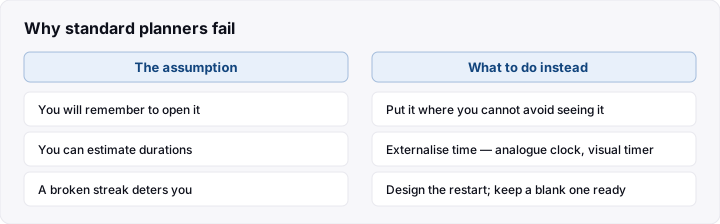
Three assumptions built into most planners cause the trouble.
That you will open it. A closed planner in a bag is invisible, and out of sight is genuinely out of mind. The planner has to be seen without any deliberate act of remembering.
That you can estimate durations. Time blindness, difficulty judging how long has passed or will pass, makes hour-by-hour scheduling collapse quickly, then feel like failure.
That a broken streak should be a deterrent. Systems built on unbroken chains punish the missed day, and one missed day frequently ends the system entirely.
A planner that fails is not neutral. It leaves behind evidence that planning does not work for you, which makes the next attempt harder. That is the real cost, and it is why the design matters.
Make it visible, not organised
The most useful change is usually physical rather than methodological: put the plan where you cannot avoid seeing it. On the fridge, taped beside the desk, on the back of the front door.
A beautifully organised planner in a drawer does nothing. A scruffy sheet stuck at eye level works, because the seeing is the mechanism.
This is also the strongest argument for paper over an app here. A phone reminder arrives in the same stream as everything else and is dismissed with the same reflex; a sheet on the wall does not compete for attention with notifications, and cannot offer you something more interesting when you look at it.
Externalise time
If time is hard to feel, it has to be made visible.
- Analogue clocks in the rooms where time matters. A dial shows time passing; a digital display shows only a number.
- Visual timers that show a shrinking coloured wedge. Widely recommended precisely because elapsed time becomes something you can see.
- Write estimates down, then the actual. Not to feel bad about the gap, but to build real data. After a fortnight you have your own multiplier, many people find it is roughly double, and can plan with it rather than against it.
- Alarms for transitions, not just for events. The hard part is usually stopping, not starting. An alarm ten minutes before a change works better than one at the change.
The three-task rule
Long to-do lists are actively counterproductive when prioritising is hard: everything looks equally urgent, so choosing becomes exhausting and nothing is chosen.
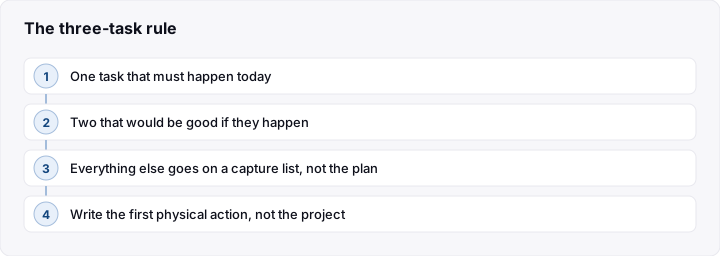
Write three tasks for the day. One that must happen, and two that would be good. Everything else goes on a separate capture list that is not today's plan.
Three is small enough to be achievable on a difficult day and small enough that finishing is possible. Which matters, because a plan that is never completed stops being believed. The capture list still exists; it is just not pretending to be a schedule.
Making starting easier
The gap between intending and starting is often the whole problem, and it responds better to structural tricks than to resolve.
Write the first physical action, not the task. "Do taxes" is a project and produces nothing. "Open the folder" is a movement, and movement tends to continue.
Shrink the unit. Ten minutes with permission to stop afterwards. Starting is the expensive part; continuing is usually cheap once underway.
Body doubling. Working alongside someone else, in person or on a call, helps a lot of people and costs nothing to try.
Pair the dull with the tolerable. Music, a walk while phoning, standing rather than sitting. Whatever makes the task less aversive to begin.
Build for restarting, not for streaks
Every system gets abandoned. After an illness, a busy fortnight, a holiday. With ADHD this may happen more often, and a system that cannot be restarted easily is a system that gets abandoned permanently.
So design the restart in advance. Keep a blank week printed and ready so beginning again is picking up a sheet rather than rebuilding a method. Keep the system simple enough to explain in one sentence; complex systems cannot be restarted from memory. And treat a gap as a gap, not as evidence. The sheets are a tool, not a report card.
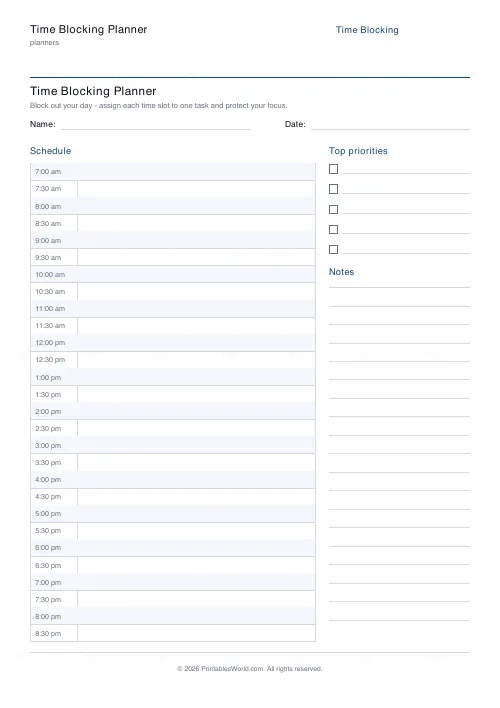
If time blocking appeals but full days feel impossible, the time blocking planner works in partial form: block only the two or three hours you most need to protect, and leave the rest unassigned.
Frequently asked questions
Is paper better than an app for ADHD?
Often, for one specific reason: paper is visible without being unlocked and cannot offer you a distraction when you look at it. Apps win on reminders and on capture-anywhere. Many people end up with paper for the day's three tasks and a phone for alarms.
How detailed should the plan be?
Less than feels responsible. Three tasks and a couple of fixed appointments is usually the right level. Detailed plans take energy to make and are abandoned faster.
What if I keep forgetting to look at it?
Move it rather than trying harder. Attach checking to something that already happens every day. The kettle, the front door, brushing teeth. If it is still not being seen, the location is wrong, not you.
Does this work for children with ADHD?
The same principles generally apply, visible, short, few items, with the addition that an adult usually needs to own the reminding at first. Speak to the child's school or clinician about approaches suited to them specifically.
Before you print
Put the sheet where you will see it without looking for it, write three tasks rather than ten, make time visible with a clock or timer, and keep a blank one ready for the restart. Print a week of the ADHD daily planner at a time rather than a month.
Related tools
ADHD Daily Planner
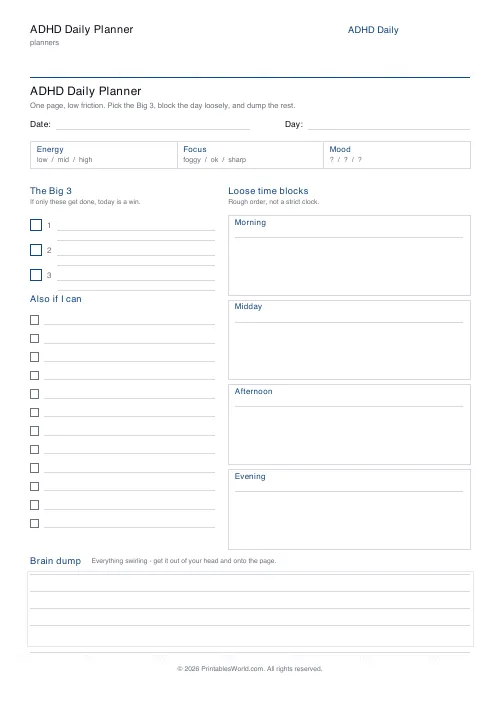
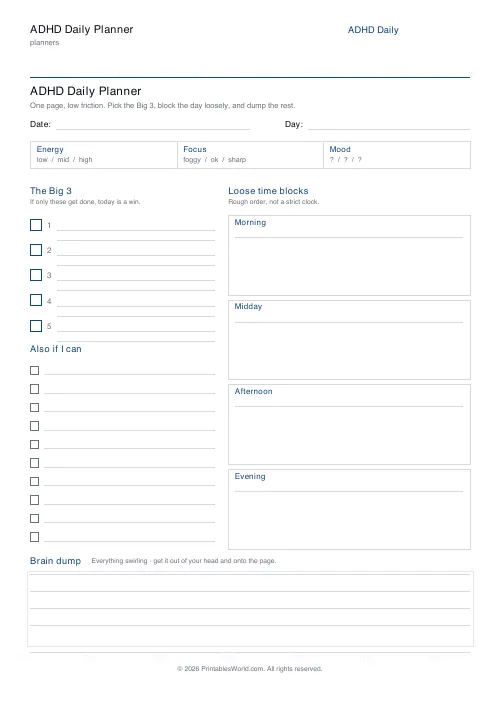
A low-friction one-page daily planner built for ADHD brains: the Big 3, loose time blocks, an energy check-in, and a brain dump.
Time Blocking Planner
Printable time blocking planner: hourly or half-hourly day blocks, priorities box, notes box.
30-Day Habit Tracker
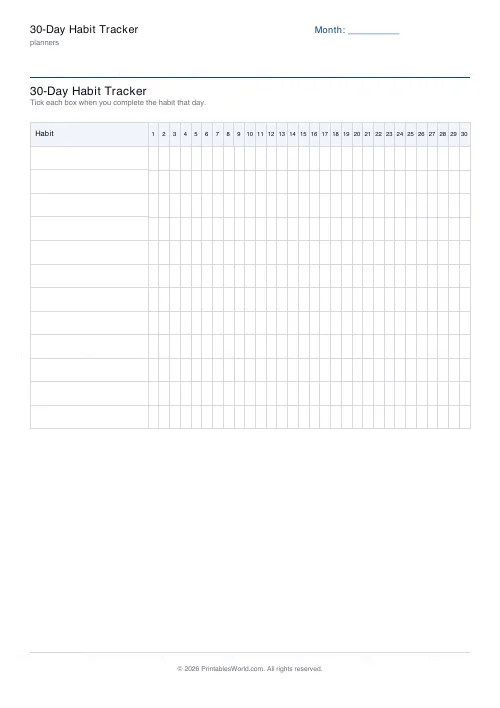
A printable 30-day habit grid to tick off every morning. One row per habit.
Continue reading
Planners
Time blocking for beginners: a complete guide
Time blocking is deciding when each task happens, not just what. Here is how to size blocks realistically, what to do when the day breaks, and why most beginners over-schedule.
5 min read
Planners
How to build a daily routine that actually sticks
Most routines fail in week two, when motivation runs out and nothing has replaced it. The fix is structural: fewer items, fixed anchors, and a plan for the day you miss.
6 min read