Planners
How to build a daily routine that actually sticks
By Jobi · Creator & Maintainer, PrintablesWorld · Updated 2026-06-17 · 6 min read
Almost everyone can keep a new routine for four days. The interesting question is what happens in week two, when the novelty has gone and motivation is back to its usual level. Routines that survive that point are built differently from the start. And a free printable daily planner helps mostly because it removes the daily decision, not because it is motivating.
Why most routines fail in week two
Three failure modes account for nearly all of it.
The routine was designed on a good day. People plan routines while feeling motivated and organised, and unconsciously design for that version of themselves. The routine then has to be executed by the tired, busy, ordinary version. If it only works on a good day, it works about twice a week.
It has too many items. A morning routine with nine steps has nine chances to break, and breaking one usually ends the whole sequence. Three items that happen every day beat nine that happen sometimes.
There is no recovery plan. Missing a day is inevitable. What matters is whether missing one day means missing three, and that is decided in advance or not at all.
Start with two anchors, not a schedule
An anchor is something that already happens at roughly the same time every day without any effort from you: waking, the first coffee, the school run, sitting down at your desk, dinner, getting into bed.
Pick two. Build around those rather than around clock times. "After I pour my coffee" is far more robust than "at 7:15", because the coffee happens whether or not the morning went to plan, and 7:15 does not survive a bad night's sleep.
This is also why copying someone else's routine rarely works. Their 5am start is built on their anchors. Yours are different.
Attach new habits to existing ones
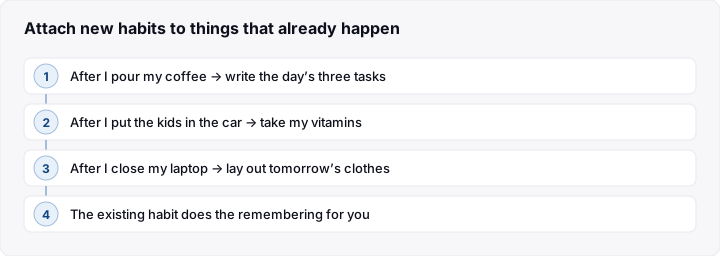
Once you have anchors, new habits attach to them rather than floating free in the day. The pattern is: after [existing thing], I will [new thing].
- After I pour my coffee, I will write the day's three tasks.
- After I put the kids in the car, I will take my vitamins.
- After I close my laptop, I will lay out tomorrow's clothes.
The existing habit does the remembering. This is the single highest-yield change most people can make to a routine, because forgetting, not unwillingness, is what kills most new habits in the first fortnight.
Make the first version embarrassingly small
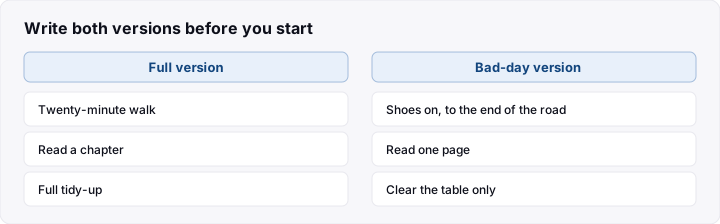
The version of a routine you can do on your worst day is the version that becomes permanent. If your planned twenty-minute morning walk becomes "put on shoes and go to the end of the road" on a bad day, the routine survives. If the only option is twenty minutes or nothing, you get nothing.
Write both versions down: the full routine, and the two-minute version for bad days. Having the small version pre-decided means you are choosing between two forms of success rather than between success and failure.
Scale up only after the small version has run for two full weeks without effort. Most people scale up in three days and are surprised when it collapses.
Plan for the day you miss
You will miss days. Illness, travel, a bad night, an emergency. The rule that protects a routine is simple and worth writing on the sheet itself: never miss twice.
One missed day is an interruption. Two in a row is the new pattern, and the third is barely a decision. Most abandoned routines can be traced back to a specific second consecutive miss.
Note that the rule is not "never miss". A routine that demands perfection breaks permanently the first time life interferes, and then carries a sense of failure that makes restarting harder.
Why a printed routine beats an app for this
Apps are better at reminding and worse at everything else that matters here.
A sheet on the fridge or the desk is visible without being opened. Phone reminders arrive in the same stream as messages, work notifications and everything else, and get dismissed with the same reflex. A paper checklist also cannot suggest you check something else while you are looking at it, which is not a small advantage first thing in the morning.
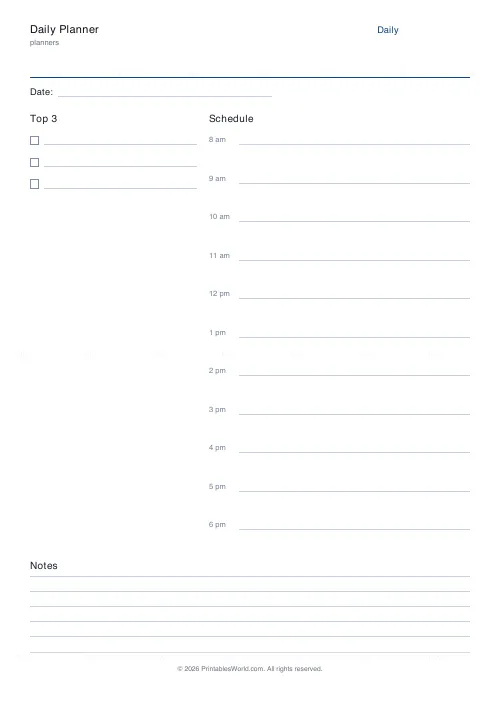
The daily routine checklist prints morning and evening sections, which suits the two-anchor approach directly. For a fuller day, the daily planner gives hour slots alongside a task list. Useful once the routine is established and you are scheduling around it rather than trying to build it.
Print a week at a time. A month of blank sheets is a commitment; seven is an experiment.
Frequently asked questions
How long does it take for a routine to become automatic?
Longer than the popular "21 days" figure suggests, and it varies a great deal between people and habits. Research on habit formation has found averages of a couple of months with a very wide range, and simpler habits attached to a clear cue tend to settle faster. The practical implication is to expect weeks rather than days, and not to treat week three as failure.
Should I plan my whole day or just part of it?
Start with the edges. The first hour and the last hour. Those two shape the rest of the day and are the parts most under your control. Scheduling every hour usually collapses on contact with a normal day's interruptions.
What if my days are all different?
Then anchor to events rather than times, and keep the routine to things that travel: the three tasks, the vitamins, the ten minutes of reading. Shift work and caring responsibilities make clock-based routines impossible, but anchor-based ones still work.
Is a morning routine better than an evening one?
Neither is inherently better. Evening routines are often easier to keep because the day's demands are behind you, and preparing the night before removes decisions from a rushed morning. If mornings are chaotic, build the evening first.
Before you print
Pick two anchors that already happen, attach one small habit to each, write down the bad-day version, and adopt the never-miss-twice rule. Then print a week. The daily routine checklist for the routine itself, and the daily planner once you are scheduling around it.
Related tools
Daily Planner
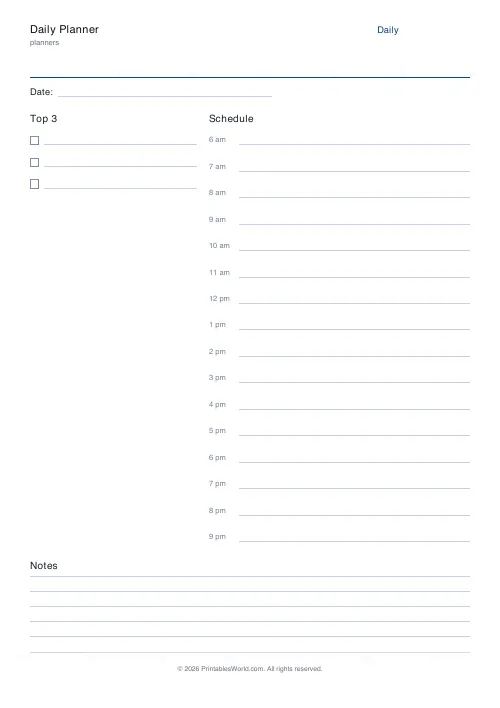
One-page daily planner with priorities, hourly schedule, and a notes strip.
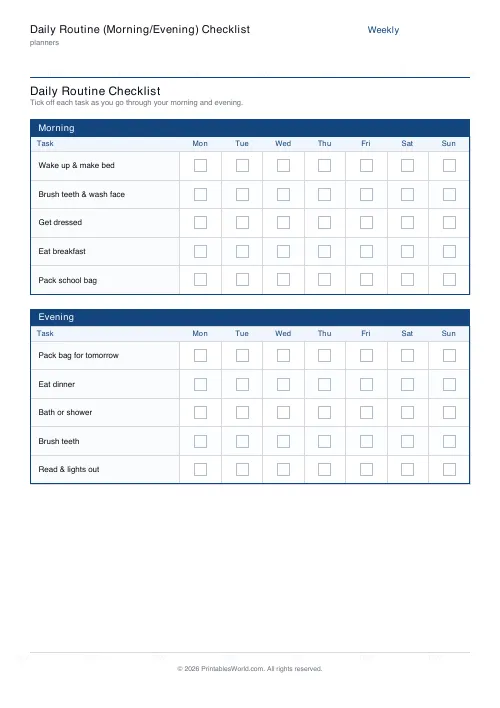
Daily Routine (Morning/Evening) Checklist
Printable morning and evening routine checklist with a tick box for every task, every day of the week.
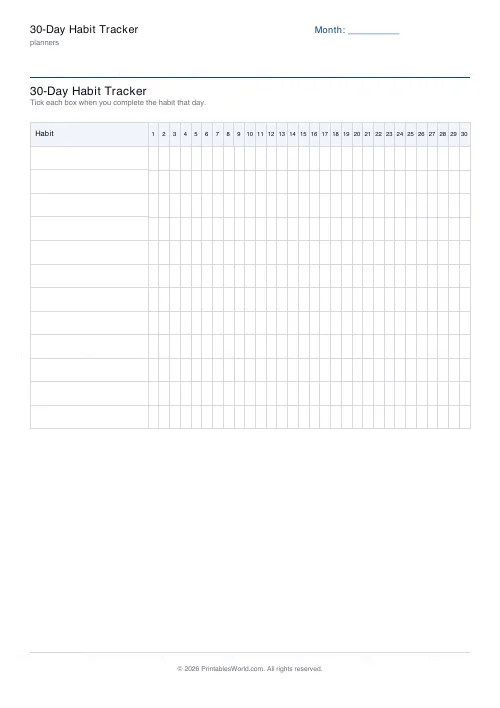
30-Day Habit Tracker
A printable 30-day habit grid to tick off every morning. One row per habit.
Continue reading
Planners
How to track habits that actually change your life
Habit tracking works because it makes an invisible process visible. It fails when you track too many things, or when protecting the streak becomes more important than the habit.
5 min read
Planners
Time blocking for beginners: a complete guide
Time blocking is deciding when each task happens, not just what. Here is how to size blocks realistically, what to do when the day breaks, and why most beginners over-schedule.
5 min read