Planners
Budgeting for beginners: the 50/30/20 rule explained
By Jobi · Creator & Maintainer, PrintablesWorld · Updated 2026-07-19 · 5 min read
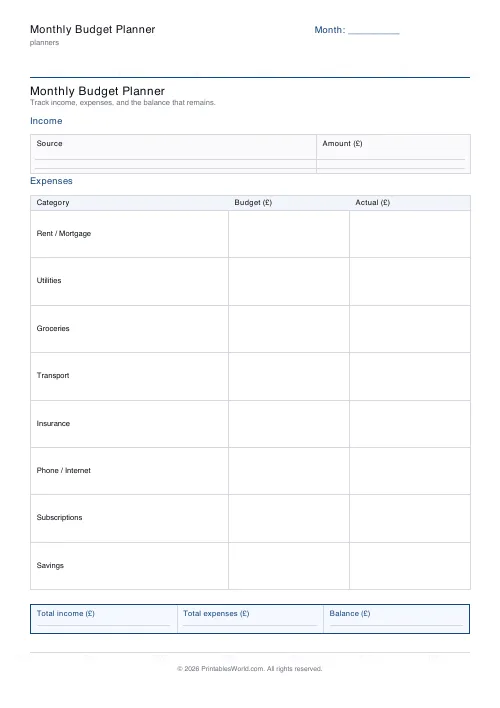
The 50/30/20 rule is the most-recommended starting budget for a reason: it has three categories instead of thirty, so you can actually finish setting it up. Half your take-home pay goes to needs, 30% to wants, 20% to savings and debt repayment. A free printable monthly budget planner is enough to run it.
The difficulty is never the arithmetic. It is deciding which category a thing belongs in, and what to do when the percentages do not fit your life.
The rule in one paragraph
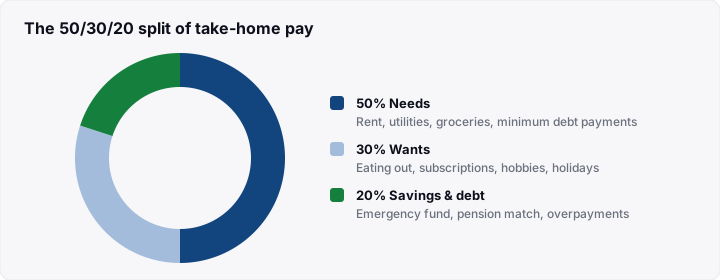
Take your monthly income after tax. Allocate 50% to needs, 30% to wants and 20% to savings and debt repayment beyond minimum payments. Popularised by US senator Elizabeth Warren and Amelia Warren Tyagi, it is a rough allocation frame rather than a law, and its value is that it is simple enough to keep using.
What counts as a need
A need is something with real consequences if unpaid: housing, utilities, groceries, transport to work, insurance, minimum debt payments, childcare that lets you work.
Two boundaries people get wrong.
Groceries are a need; restaurants are a want. The supermarket shop keeps you fed. Eating out is something else, however routine it has become.
Minimum debt payments are a need; overpayments are in the 20%. The minimum is a contractual obligation. Anything above it is a choice to get out of debt faster, which is what the third bucket is for.
Phone and internet are usually needs in practice. A £70 contract when a £15 one would do is a need with a want attached, which is exactly the kind of line worth noticing.
What counts as a want
Everything that makes life better but has no serious consequence if it stops: eating out, subscriptions, holidays, hobbies, clothes beyond what you need, the upgraded version of anything.
Wants are not the enemy. A budget with no wants is a diet with no food. It works for three weeks. The 30% exists so you can spend it without guilt, which is what makes the other two categories survivable.
If you are over on wants, subscriptions are the usual reason. They are individually small, invisible after setup, and easy to forget. Listing them on the planner is often the single most productive twenty minutes of the whole exercise.
The 20%, in priority order
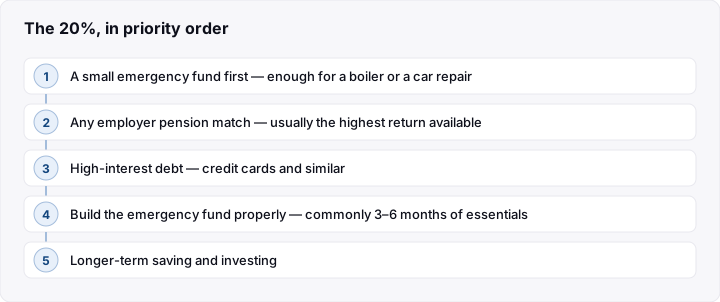
The 20% covers savings, investments and debt repayment above the minimum. Order matters more than the total when you are starting.
- A small emergency fund first. Enough to cover an unexpected bill. A boiler, a car repair. Without it, the first emergency goes on a credit card and undoes months of progress.
- Any employer pension match. Where an employer matches contributions, this is usually the highest-return use of the money available to you.
- High-interest debt. Credit cards and similar. Paying down debt at 25% is a guaranteed return that almost no investment matches.
- Build the emergency fund properly: commonly suggested at three to six months of essential spending, depending on how secure your income is.
- Longer-term saving and investing.
Setting it up in one sitting
Take three months of bank statements. One month is too easily unrepresentative.
- Write down your monthly take-home pay.
- Calculate your three targets: half, 30%, 20%.
- Go through the statements and put every transaction in one of the three buckets. Do not optimise yet; you are measuring.
- Total each bucket and compare with the targets.
- Pick the single biggest gap and change one thing.
Most people find needs are higher than 50% and savings lower than 20%. That is the normal starting position, not a failure. Pair the planner with a monthly bill tracker so fixed costs are listed in one place. They are the hardest category to recall from memory and the easiest to underestimate.
When the numbers do not fit
For a great many households, particularly in expensive housing markets, needs simply exceed 50% and no amount of discipline changes that in the short term. The rule is still useful, in two ways.
First, as a diagnostic. If needs are 70% of income, that tells you the problem is structural, housing, transport or childcare, rather than a matter of coffee and subscriptions. It directs attention at the big lever instead of the small ones.
Second, as a direction of travel. Try 70/20/10 and aim to shift a percentage point at a time. A budget you can actually follow beats an aspirational one you abandon.
Irregular income needs one adjustment: budget on your lowest recent month rather than an average, and treat anything above that as a windfall to be allocated deliberately.
Frequently asked questions
Is it based on gross or take-home pay?
Take-home. After tax and after any deductions made at source. If your pension contribution comes out before you see the money, you can reasonably count it towards the 20%.
What if I have no savings at all?
Start with a small emergency fund before anything else, even while carrying debt. Without a buffer, the next unexpected expense becomes new debt and the cycle continues.
How is this different from zero-based budgeting?
Zero-based budgeting assigns every pound to a specific category until nothing is left. More precise, more work. 50/30/20 uses three broad buckets. Many people start here and move to something more detailed later, if at all.
Do I need an app?
No. Apps categorise automatically, which is convenient and also means you engage with the numbers less. Doing it on paper for the first few months is slower and teaches you considerably more about where the money goes.
Before you print
Use three months of statements, sort every transaction into three buckets before changing anything, and fix the largest gap first. If needs exceed half your income, treat the rule as a direction rather than a target. Print the monthly budget planner and the bill tracker together.
Related tools
Monthly Budget Planner
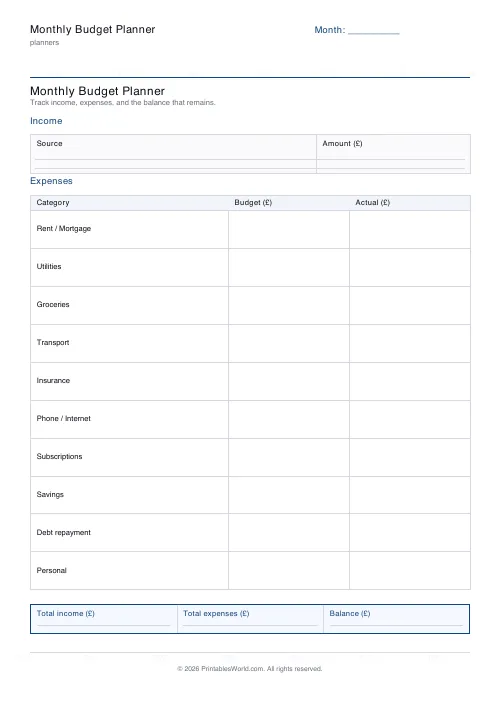
One-page printable budget: income, categorised expenses, balance summary.
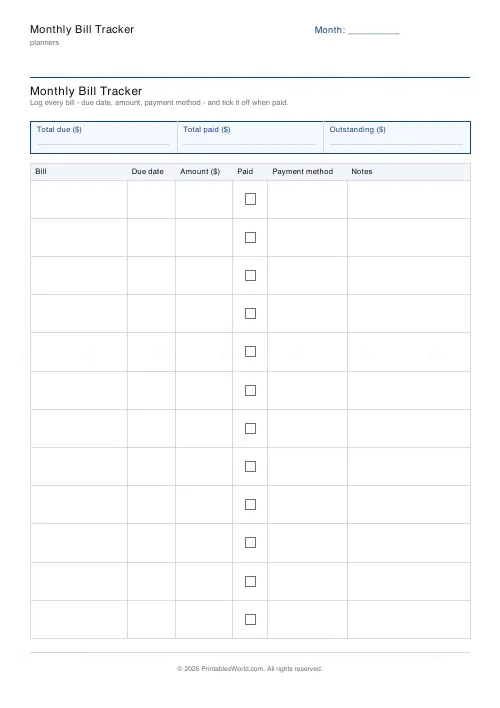
Monthly Bill Tracker
Printable bill tracker: due date, amount, paid check, payment method, notes.
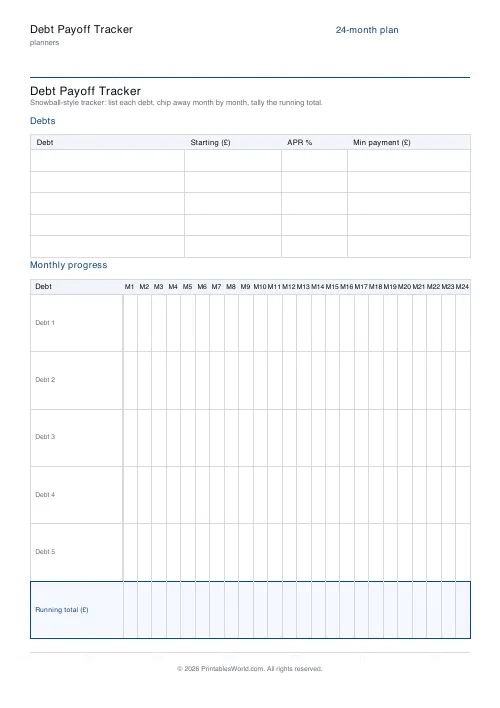
Debt Payoff Tracker
Debt snowball chart: starting balances, minimum payments, monthly progress, running total.
Continue reading
Planners
Meal planning 101: save time and money every week
A weekly meal plan saves money mainly by changing how you shop. Here is a thirty-minute method, the shortcuts that keep it going, and the mistake that ends most plans in week three.
5 min read
Planners
How to track habits that actually change your life
Habit tracking works because it makes an invisible process visible. It fails when you track too many things, or when protecting the streak becomes more important than the habit.
5 min read