Printable Paper
Bullet journalling with dot grid paper: a starter guide
By Jobi · Creator & Maintainer, PrintablesWorld · Updated 2026-07-11 · 5 min read
Search for bullet journals and you will find elaborate spreads with hand-lettered headers and watercolour borders. That is a craft hobby that grew up around the system; it is not the system. The original method, devised by Ryder Carroll, was designed to be fast: a way of capturing things in seconds. A free printable dot grid paper sheet is enough to start today.
What a bullet journal actually is
An analogue system for capturing tasks, events and notes in one notebook, using short bulleted lines rather than sentences. Its defining feature is that it is rapid, a task takes a couple of seconds to record, and that it uses an index rather than fixed sections, so the notebook does not need planning in advance.
That last point is what makes it different from a pre-printed diary. Pages are used in the order they come and found again via the index, so you never run out of space in the "notes" section while the "January" section sits empty.
Why dot grid rather than lines or blank
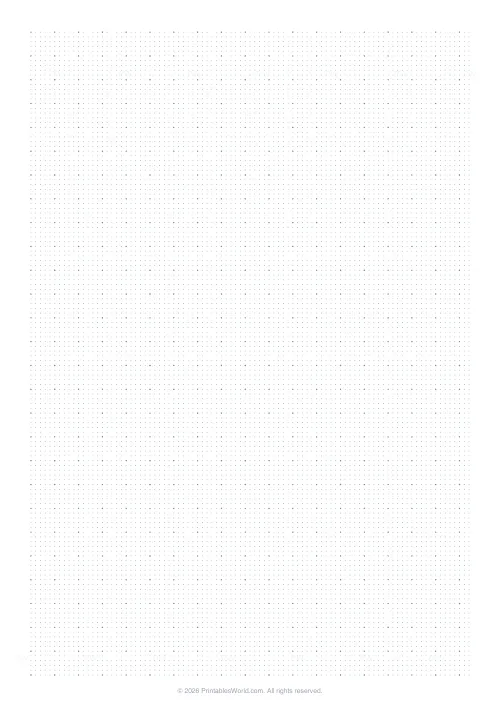
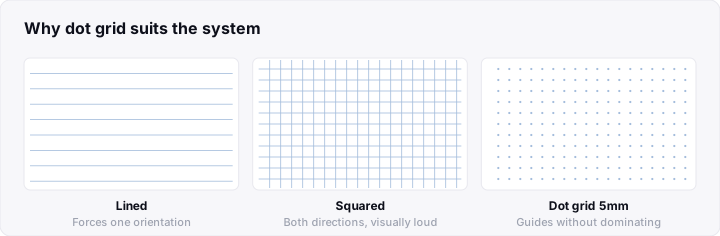
Dot grid is the standard choice for a practical reason rather than an aesthetic one: it guides without dominating.
- Lined paper forces one orientation. Drawing a two-column layout or a small table means fighting the lines.
- Blank paper gives total freedom and no support. Most people's writing drifts and their boxes come out crooked.
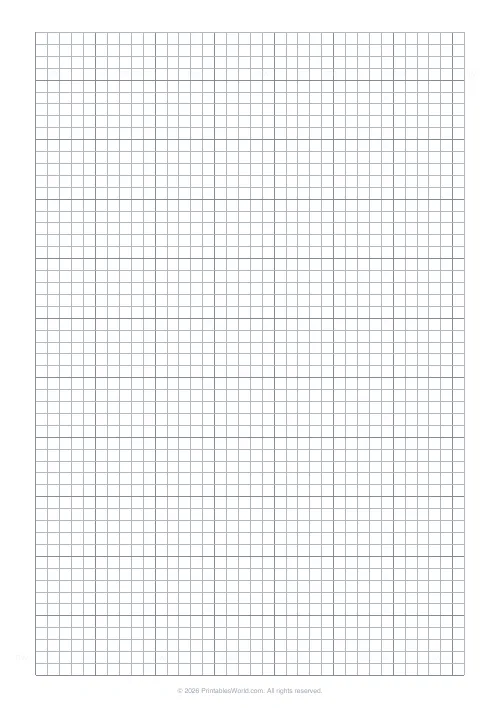
- Squared paper supports both directions but the full grid is visually loud and shows through the writing.
- Dot grid marks the intersections only. You get alignment in both directions, and the dots recede once there is writing on the page.
5mm spacing is the usual default and suits most handwriting. If your writing is large, print at a wider spacing; the point of generating your own is that you are not stuck with a notebook manufacturer's choice.
Rapid logging: the whole notation
The notation is deliberately tiny. Three symbols and two modifiers, all drawn in one stroke:
- • a task
- ○ an event
- – a note
- × over a task dot, completed
- >, migrated (moved to another day or collection)
Some people add a * for priority. Resist adding more than that. Every extra symbol is one more decision at the moment of writing, and the speed is the point. A system that takes ten seconds per entry stops being used within a fortnight.
The four collections you need
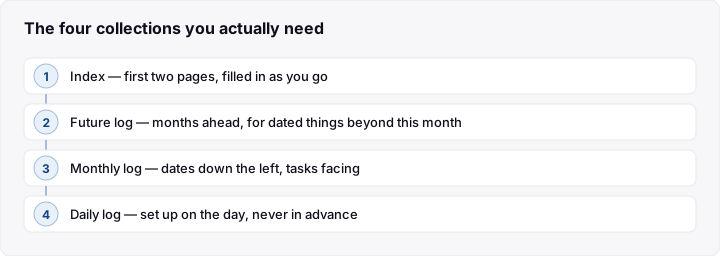
Index: the first two pages, left blank at the start. As you use pages, write what is on them and their number. This is what makes the whole thing work; without it you have a notebook.
Future log: a few pages divided into months for things dated beyond this month. Dentist in October, someone's birthday in March.
Monthly log: one page listing the dates down the left for appointments, and a facing page for the month's tasks.
Daily log: the working page. Date at the top, rapid-log through the day. Do not set these up in advance: writing "Tuesday" on an empty page before Tuesday happens is how a system acquires guilt.
That is the complete system. Habit trackers, mood logs and reading lists are optional additions, not requirements. If you are printing loose sheets rather than using a bound notebook, the blank notebook page works well for collections that want a header and a margin.
Migration, the part people skip
At the end of each month you look at the unfinished tasks and decide, one at a time: does this still matter?
If yes, copy it into the new month. Copy it by hand. If no, cross it out.
Hand-copying is not inefficiency; it is the filter. A task you cannot be bothered to rewrite for the third month running is a task you were never going to do, and the system surfaces that instead of letting it sit on a list for a year. This is the single biggest advantage the analogue method has over an app, where an undone task costs nothing to keep forever.
Beginner mistakes
Starting with the artwork. The elaborate spreads online took people years and are a hobby in themselves. Beginning there means spending an hour on a header and abandoning the system in three weeks.
Setting up months in advance. Pre-drawn empty pages become an obligation. Set up the day you need it.
Too many trackers. Fifteen habits, mood, water, steps, sleep. Pick two.
Restarting over a mistake. Cross it out and carry on. A notebook with crossings-out is a notebook in use.
Buying an expensive notebook first. Print a few dot grid sheets and run the system for a month before committing. Loose sheets also let you try 5mm against a wider spacing to see which suits your handwriting.
Frequently asked questions
Do I need a special notebook?
No. Any notebook works, and printed dot grid sheets in a folder work for trying the system out. Bound notebooks are better long-term mainly because pages cannot fall out and the index stays reliable.
What dot spacing should I use?
5mm is the common default and suits most handwriting. Larger writing benefits from wider spacing; printing your own means you can test a couple of options rather than guessing.
Is it better than a digital to-do app?
Different. Apps are better at reminders, search and syncing. Paper is better at thinking, at not showing you anything else while you use it, and at the monthly migration that quietly deletes tasks you never intended to do.
How long does the daily setup take?
Under a minute if you are rapid logging as intended. Write the date and start. If it is taking ten minutes, you have drifted into the decorative version, which is fine as a hobby but is not what makes the system work.
Before you print
Start with the index and a daily log, use the five symbols and no more, set up pages on the day you need them, and do the monthly migration by hand. Print a few sheets of dot grid paper at 5mm and run it for a month before buying anything.
Related tools
Continue reading
Planners
How to track habits that actually change your life
Habit tracking works because it makes an invisible process visible. It fails when you track too many things, or when protecting the streak becomes more important than the habit.
5 min read
Printable Paper
Graph paper sizes: which grid for which task
What graph paper sizes and grid spacings mean, how to match a grid to maths, art or design, and how to set it all in the free graph paper generator.
7 min read