Planners
How to pay off debt faster with a payoff tracker
By Jobi · Creator & Maintainer, PrintablesWorld · Updated 2026-07-14 · 5 min read
Two things decide how quickly debt clears: how much you can put towards it, and whether you keep going. The first is arithmetic and the second is psychology, and most people underweight the second. A free printable debt payoff tracker exists entirely to serve the second.
This is general information rather than financial advice. For your own circumstances, particularly if you are struggling to meet minimum payments, speak to a qualified adviser or a free debt charity.
What has to happen first
Two things come before any payoff method.
List every debt in one place: balance, interest rate, minimum payment, due date. Most people are surprised by the total, and the surprise is useful. Vague debt is easy to avoid thinking about; a written list is not.
Build a small emergency fund first, even while carrying debt. It seems backwards, because savings earn less than the debt costs. But without a buffer, the next unexpected expense goes on a credit card, and the balance you just reduced comes straight back. Enough for a car repair or a boiler is generally sufficient at this stage.
Then pay every minimum, always. Missing minimums adds fees and damages credit, which makes everything harder. The payoff method only governs where any extra money goes.
Avalanche or snowball?
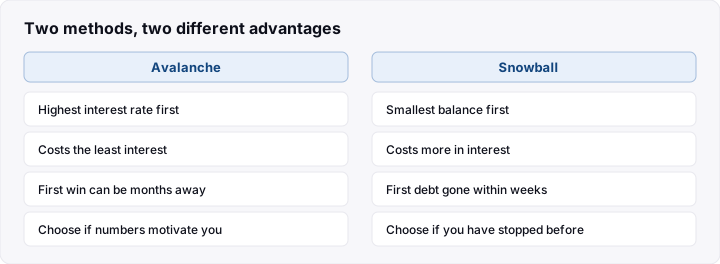
Avalanche: pay minimums on everything, and put all spare money at the debt with the highest interest rate. When it clears, roll that payment into the next-highest.
Mathematically optimal. Costs the least interest and clears the debt soonest, sometimes by a meaningful margin.
Snowball: pay minimums on everything, and put all spare money at the smallest balance. When it clears, roll that payment into the next-smallest.
Costs more in interest. Its advantage is that debts disappear sooner, often within weeks rather than months, and each one that vanishes is a visible win.
Both work by the same underlying mechanism: as each debt clears, its payment is added to the next, so the amount attacking the remaining balance grows. That is the "snowball" in both cases.
Which to choose, honestly
The right answer depends on which failure mode you are more likely to hit.
If your largest debt is also the highest-interest one, the two methods agree and there is nothing to decide.
If they disagree, ask yourself honestly: have you tried to clear this debt before and stopped? If yes, the snowball's early wins are worth the extra interest, because a plan you continue beats a cheaper plan you abandon. If you have never abandoned a financial plan and the numbers motivate you, take the avalanche and the saving.
A hybrid is legitimate: clear one small irritating debt first for the win, then switch to avalanche for everything else. Nobody is marking this.
One genuine exception. If a debt has a punitive rate, some short-term credit does, clear that first regardless of method, because the interest can outrun your payments.
Why a visual tracker changes the odds
Debt repayment is long, and for most of it nothing observable changes. The balance drops slowly, there is no event to mark, and the temptation to stop is strongest in the featureless middle.
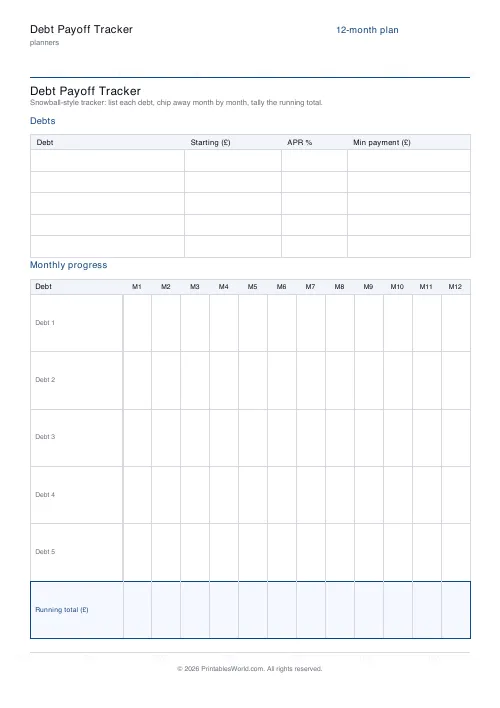
A tracker turns an abstract balance into something visible. A bar you colour in, a grid of squares each worth £50, a thermometer that fills. The specific format matters far less than that progress becomes something you can see without doing arithmetic.
Two things make it work. Put it somewhere you pass daily, not in a folder. And colour it in the moment you make the payment, so the act of paying and the sense of progress are attached to each other.
Pair it with a monthly budget planner, because the tracker records progress while the budget is what creates it.
Finding more to pay with
Every extra pound goes straight at the principal, so this is where the real speed comes from.
- The subscription audit. Small, invisible, and frequently the single biggest quick win.
- Windfalls in full: tax refunds, bonuses, gifts. Assign them before they arrive, or they are absorbed.
- Balance transfers, carefully. A 0% period can help substantially, but check the fee, note the end date, and be honest about whether a freed-up credit card will stay unused.
- Ask for a lower rate. Unglamorous and occasionally works, particularly with long-standing accounts.
- Keep the payment level after a debt clears. This is the whole engine. If a cleared £80 payment quietly becomes £80 of spending, the snowball stops.
Frequently asked questions
Should I save or pay off debt first?
Generally a small emergency fund first, then debt, then build the fund properly. Without a buffer, an unexpected expense recreates the debt you just cleared.
Does paying off debt improve a credit score?
Usually over time, though the mechanics vary by country and agency and the effect is not always immediate. Consistently making payments on time is typically the larger factor.
Is the snowball method worse because it costs more?
It costs more in interest, which is a real disadvantage. Whether it is worse depends on whether the early wins are what keep you going. A completed snowball beats an abandoned avalanche.
Should I close a card once it is paid off?
Not automatically. Closing can affect your available credit and account history in ways that vary by country. Many people cut the card up and keep the account open. But check what applies where you are.
Before you print
List every debt with its rate, build a small buffer, keep paying every minimum, and pick the method matching your actual failure mode rather than the one that sounds more disciplined. Print the debt payoff tracker for the visible progress and a budget planner to create the money that fills it.
Related tools
Debt Payoff Tracker
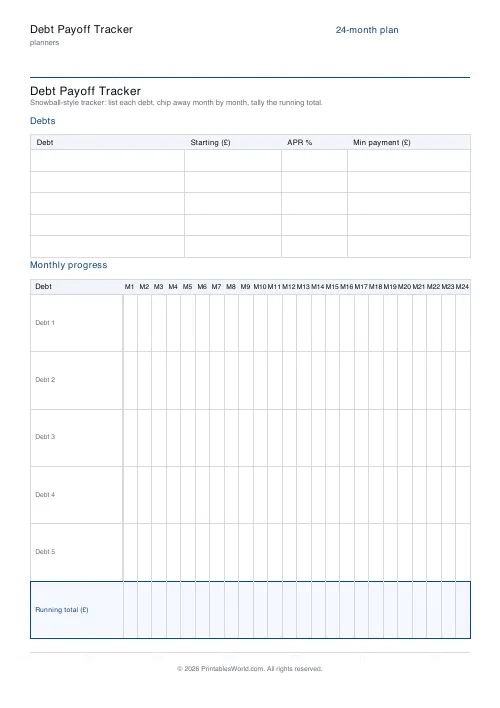
Debt snowball chart: starting balances, minimum payments, monthly progress, running total.
Monthly Budget Planner
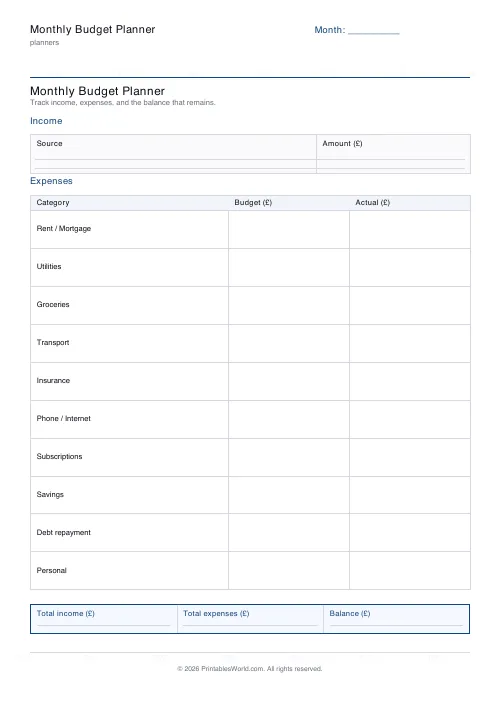
One-page printable budget: income, categorised expenses, balance summary.
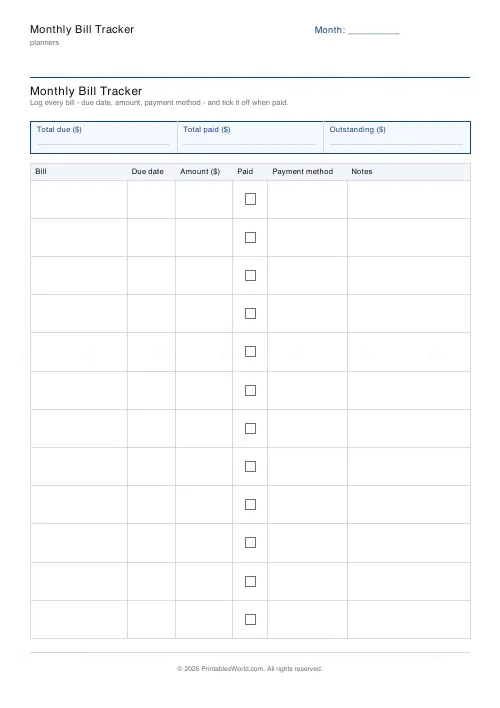
Monthly Bill Tracker
Printable bill tracker: due date, amount, paid check, payment method, notes.
Continue reading
Planners
Budgeting for beginners: the 50/30/20 rule explained
Half to needs, 30% to wants, 20% to savings and debt. A useful starting frame. And this covers what actually counts as which, plus what to do when the numbers do not fit.
5 min read
Planners
Meal planning 101: save time and money every week
A weekly meal plan saves money mainly by changing how you shop. Here is a thirty-minute method, the shortcuts that keep it going, and the mistake that ends most plans in week three.
5 min read