Math Worksheets
How many maths worksheets per day? A parent's guide
By Jobi · Creator & Maintainer, PrintablesWorld · Updated 2026-07-04 · 5 min read
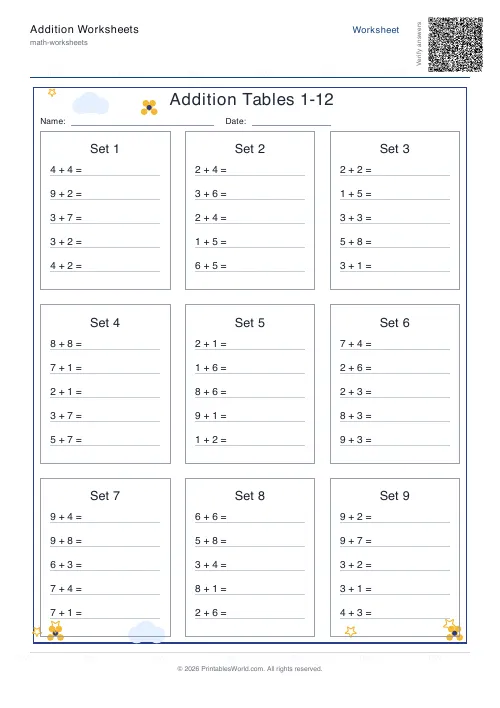
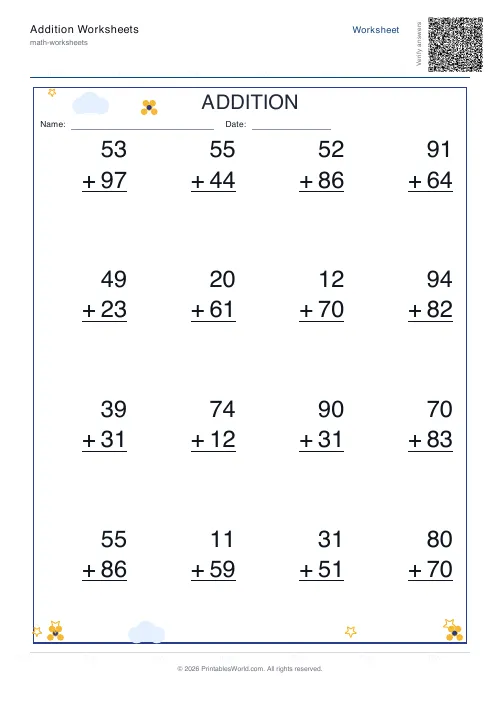
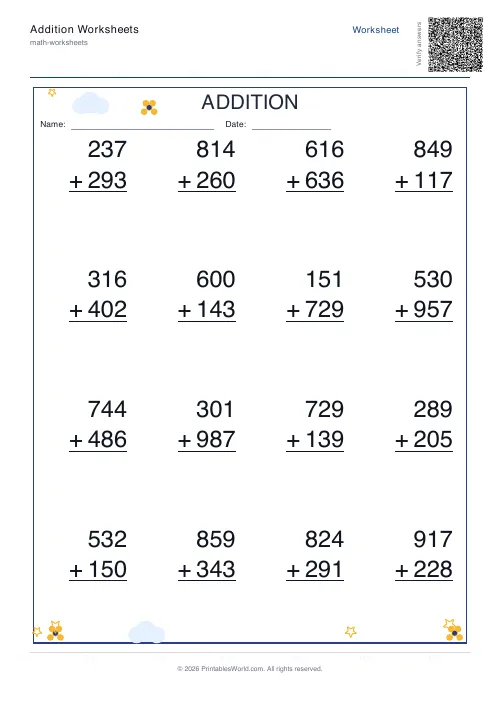
Parents ask this expecting a number, and the number is smaller than most people want to hear. Ten to fifteen minutes on most days does more for a primary-age child than an hour at the weekend. And the length of the session matters considerably more than how many questions fit on the page. Free printable addition worksheets let you set the question count, which is the setting most worth using deliberately.
Think in minutes, not sheets
A "worksheet" is not a unit of anything. One sheet might hold ten questions or sixty, and a sheet of long division is not comparable to a sheet of number bonds.
Time is the better measure, and attention is the real constraint. When a child stops concentrating, further questions rehearse inattentive work. Which is worse than stopping, because errors made while drifting can become habits.
So set a timer rather than a page count, and let the sheet be as long or short as it needs to be. A child who finishes early has learned they can finish; a child who never reaches the end learns the opposite.
Rough amounts by age
Alongside school, not instead of it, and assuming the child is broadly on track:
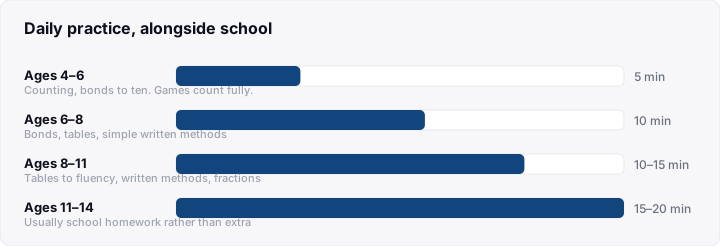
- Ages 4–6: 5 minutes, most days. Number recognition, counting, bonds to ten. Games count fully.
- Ages 6–8: 10 minutes. Bonds, times tables, simple written methods.
- Ages 8–11: 10–15 minutes. Tables to fluency, written methods, fractions.
- Ages 11–14: 15–20 minutes, usually driven by school homework rather than extra practice.
These are ranges for ordinary maintenance and fluency. A child preparing for a specific exam, or catching up on a specific gap, may need more for a defined period. But "more, indefinitely, because maths is important" is how children come to dislike it.
Why fewer questions works better
Twenty questions on one idea beat sixty mixed. A long mixed sheet tells you a child got fourteen wrong without telling you which idea failed. A short focused sheet is diagnostic.
Finishing matters. Completing a short sheet builds the sense that maths is doable. Abandoning a long one halfway does the opposite, every time it happens.
Marking together is only realistic when it is short. Immediate feedback is one of the more useful things a parent can offer, and it is only possible on ten questions, not sixty.
Errors compound quietly on long sheets. A child misunderstanding the method does forty wrong before anyone notices. Forty repetitions of the wrong thing.
A practical shape: ten questions, marked together, and a second short sheet tomorrow if the first went badly.
Signs you are doing too much
- Tears, or dread when it is mentioned. The clearest signal, and the one most often pushed through.
- Accuracy falling through the sheet: the first ten right, the last ten wrong. That is fatigue, not misunderstanding, and the last ten taught nothing.
- Speed without thought: answers written fast and carelessly to reach the end.
- "I'm rubbish at maths." Attitude is the thing hardest to repair; treat it as a stop signal.
- It has become a battle. The relationship costs more than the practice gains.
If any of these appear, cut the amount by half and drop the difficulty for a fortnight. Rebuilding willingness is worth more than the fortnight of content.
Holidays and catching up
Some maintenance over a long break is worthwhile. Skills fade with disuse, particularly fluency-based ones like tables. But a holiday of daily worksheets buys resentment that outlasts the holiday.
A reasonable pattern is ten minutes, a few days a week, mixed with games and everyday maths, cooking, shopping, journeys. The aim is keeping the machinery warm, not covering the next term.
For genuine catching up, be specific. Identify the actual gap, usually one thing, such as bonds or a particular table, and work on that alone for two or three weeks. General extra maths rarely fixes a specific gap, and it takes far longer.
Frequently asked questions
Is a worksheet a day too much?
Not if the sheet is short and the child is willing. Ten questions a day is sustainable; a full page of forty every day for most primary children is not.
Should I do maths at the weekend?
One short session is fine if it fits your family. A day off is also fine. Consistency across the week matters more than never missing.
My child finishes in two minutes and wants more. Should I let them?
Yes, while the enthusiasm lasts, and consider whether the work is pitched too easy. Willingness is worth more than any schedule.
How do I know if the level is right?
Roughly eighty to ninety per cent correct is a good target. Everything right means it is too easy to be teaching; half wrong means it is too hard to be practising.
Before you print
Set a timer rather than a page count, keep each sheet to one idea and about ten questions, mark it together, and stop while it is going well. The addition and subtraction generators both let you set the question count, so print the short version deliberately.
Related tools
Addition Worksheets Generator
Free printable addition worksheets in tables or line-by-line layouts.
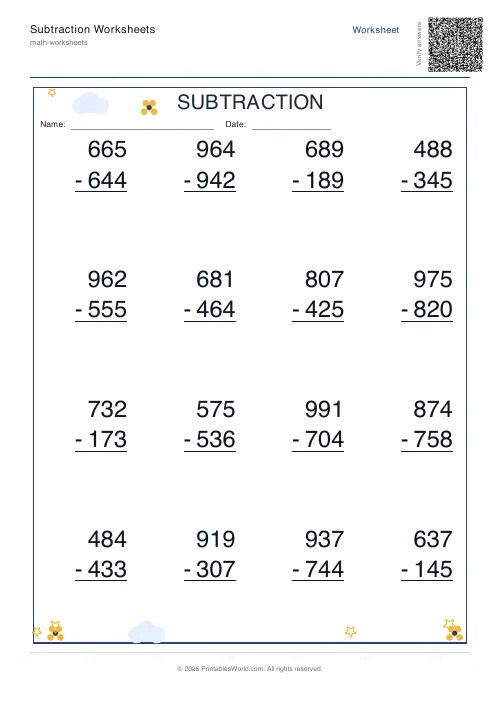
Subtraction Worksheets Generator
Free printable subtraction worksheets in tables or line-by-line layouts.
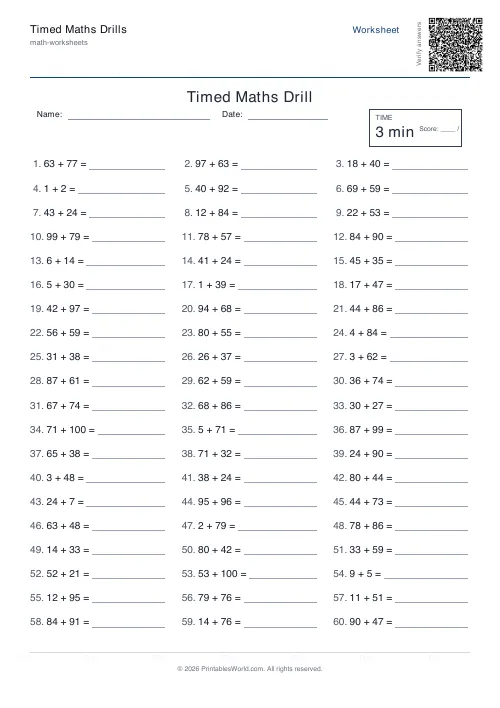
Timed Maths Drills Generator
Dense 50–100 question timed drills with a printed timer box and score line.
Continue reading
Math Worksheets
Making maths fun: 15 ways to practise without tears
Maths tears are usually about difficulty, length or fear of being wrong, not about maths. Fifteen practical changes, grouped by which of those three problems they actually solve.
6 min read
Math Worksheets
Addition strategies: number lines, regrouping and more
Column addition is the destination, not the route. Here are the strategies that come before it, why each matters, and how to tell which one a child is actually using.
5 min read