Math Worksheets
Addition strategies: number lines, regrouping and more
By Jobi · Creator & Maintainer, PrintablesWorld · Updated 2026-07-30 · 5 min read
Adults tend to think of addition as one method. Write the numbers in columns, carry when needed. Children are taught several strategies before that, and each exists because it builds something the next one needs. Free printable addition worksheets can practise any of them; the useful part is knowing which one a child is on.
Counting on
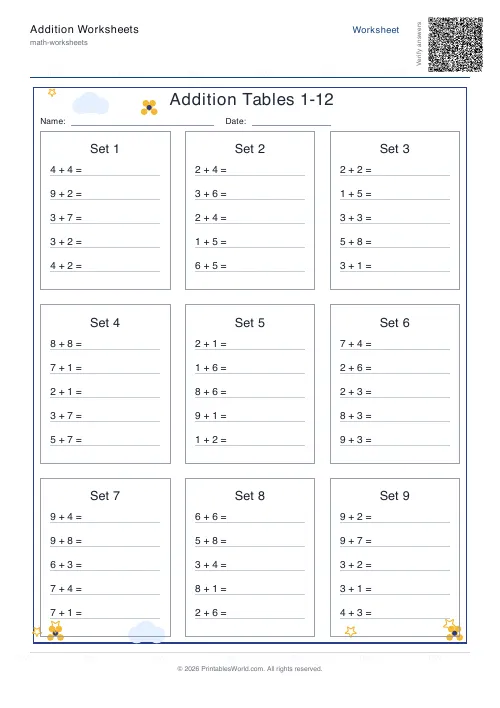
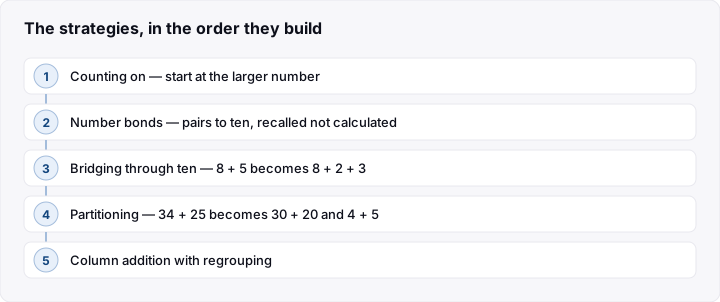
The first real strategy: start at the larger number and count forward. For 3 + 8, start at 8 and count on three.
Two things to watch. Children often start at the first number rather than the larger one, which is slower. "start with the bigger one" is a genuine strategy worth teaching explicitly. And counting on from the number itself (8, then 9, 10, 11) rather than counting the start number as one is a common source of answers exactly one too big.
Counting on is a stage, not a destination. A child still counting on for 6 + 7 at eight or nine needs number bonds, not more counting practice.
Number bonds. The foundation
Pairs that make ten (6 + 4, 7 + 3) and later twenty, known instantly without calculation.
This is the single most important thing in early addition. Almost every later strategy assumes it: bridging through ten needs bonds to ten, column addition needs to know when a column exceeds ten, and mental arithmetic of any speed rests on them.
Bonds should be recalled, not worked out. A child who computes 6 + 4 each time has not got the bond yet, however reliably they arrive at ten. Short daily practice, five minutes, is what converts calculation into recall.
Bridging through ten
Using the bond to ten as a stepping stone. For 8 + 5: 8 needs 2 to reach 10, and 5 is 2 + 3, so 8 + 2 = 10, then 10 + 3 = 13.
This is where number bonds pay off, and it is the first strategy that is genuinely faster than counting. It also builds the idea that numbers can be split and recombined, which is what partitioning and later algebra depend on.
A number line makes it visible. The jump to ten, then the jump on. Many children need to see it drawn several times before it becomes mental.
Partitioning
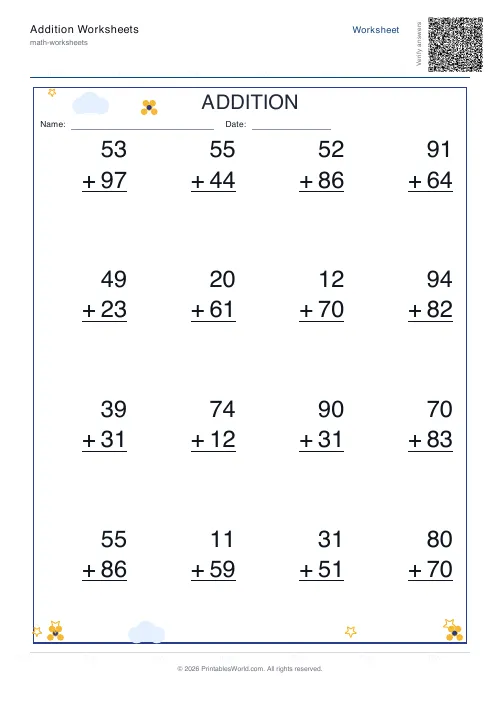
Splitting numbers into tens and ones and adding each part. For 34 + 25: 30 + 20 = 50, 4 + 5 = 9, so 59.
Partitioning works left to right, which is how most people add mentally. Ask an adult to add 34 and 25 in their head and they will almost certainly do the tens first. This is worth pointing out to children, because column addition works the other way and can feel unnatural after this.
It also keeps the place value visible: the child is adding 30 and 20, not 3 and 2. That understanding is exactly what goes missing when column addition is taught too early as a procedure.
Column addition and regrouping
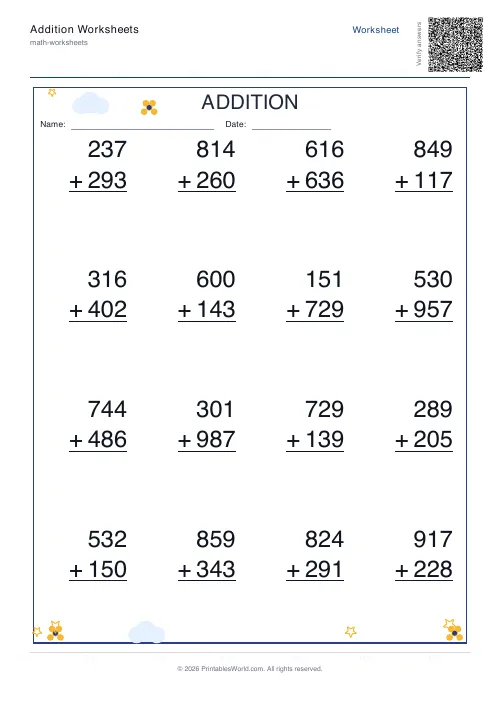
The formal written method: digits aligned by place value, working right to left, carrying when a column exceeds nine.
Regrouping, also called carrying, is where most difficulty appears, and nearly always for one of three reasons:
- Number bonds are not secure, so the child cannot see that a column has passed ten.
- Place value is not secure, so the carried 1 is just a mark rather than a ten being moved.
- It was introduced too early, before partitioning made place value concrete.
If a child is stuck on regrouping, the fix is usually upstream rather than more column practice. Go back to partitioning with two-digit numbers and check the bonds.
Keep the layout tidy. Misaligned columns cause as many errors as misunderstanding. Squared paper helps considerably here, one digit per square.
Working out which strategy they are using
Ask. "How did you work that out?" applied to correct answers as well as wrong ones tells you more than a page of ticks.
Listen for the tell-tales. Whispering or nodding means counting. An instant answer to 7 + 3 but a pause on 7 + 5 means bonds to ten are secure and bridging is not. Getting the right answer to 34 + 25 but writing the digits in the wrong columns means the method is memorised and the place value is not.
This matters because two children with identical marks can be at completely different stages, and giving both the same next worksheet helps only one of them. Keeping each sheet to a single strategy, rather than mixing four, is what makes the diagnosis possible.
Frequently asked questions
Why not just teach column addition from the start?
Because it is a procedure that works without understanding, which is precisely the problem. A child who reaches it via bonds and partitioning knows what the carried digit means; a child taught it cold often does not, and that shows up later in subtraction, decimals and algebra.
My child counts on their fingers. Should I stop them?
Not by force. Fingers are a legitimate support and a visible sign of where they are. What helps is building the bonds that make fingers unnecessary. The habit fades on its own once recall is faster than counting.
What is the difference between carrying and regrouping?
They describe the same thing. "Regrouping" is the more modern term and is more accurate, because a ten is being regrouped into the next column rather than mysteriously carried.
How much daily practice?
Ten minutes on most days, on one strategy at a time. Number bonds especially reward short daily repetition over long occasional sessions.
Before you print
Find out which strategy the child is actually using before choosing a sheet, and keep each sheet to one strategy so the answer tells you something. If regrouping is the sticking point, go back to partitioning rather than doing more columns. The addition worksheet generator lets you set the digit count and range to match the stage exactly.
Related tools
Continue reading
Math Worksheets
How many maths worksheets per day? A parent's guide
The honest answer is less than most parents assume. And the number of questions matters less than whether the session ends well.
5 min read
Math Worksheets
Ten frames and number bonds: early maths foundations
A ten frame is two rows of five. That arrangement does something a row of counters cannot. It makes quantities visible without counting, which is where number sense starts.
5 min read