Math Worksheets
Ten frames and number bonds: early maths foundations
By Jobi · Creator & Maintainer, PrintablesWorld · Updated 2026-07-30 · 5 min read
A ten frame is a rectangle of ten boxes, two rows of five. It looks almost too simple to matter, and it is one of the most effective tools in early maths. Because that particular arrangement lets a child see a quantity rather than count it. Free printable ten frame and hundred chart sheets cover the whole progression below.
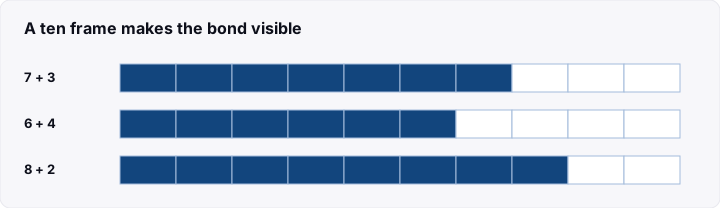
What a ten frame is
Ten boxes in two rows of five, filled left to right, top row first. Counters, dots or stickers go in the boxes.
Two design choices do all the work. Ten, because our number system is built on it. Two rows of five, because five is a quantity most people can recognise at a glance, so any number can be read as "a full row and some more".
Consistent filling matters. Always left to right, top row first. A randomly filled frame is just scattered counters and loses the whole benefit.
Subitising: seeing without counting
Subitising is recognising how many without counting. Most people can do this up to about four or five instantly. You do not count the pips on a die.
A ten frame extends this. Seven in a frame is a full top row and two in the second, and after a little practice a child sees "seven" rather than counting to it. That is a genuine shift: counting is a procedure, recognising is knowledge.
It also makes several facts visible at once. A frame showing seven simultaneously shows that seven is five and two, that it is three short of ten, and that it is one more than six. A child who has internalised the frame carries all of that.
Why number bonds matter so much
Number bonds are pairs that make a total. Most importantly, the pairs making ten: 1+9, 2+8, 3+7, 4+6, 5+5.
They are the foundation almost everything later rests on. Bridging through ten needs them. Column addition needs to recognise when a column passes ten. Mental arithmetic at any speed needs them. Subtraction facts fall out of them directly.
The key point is that bonds must be recalled, not calculated. A child who works out 6 + 4 every time has not got the bond, however reliable the answer. The ten frame is what turns the calculation into a picture, and the picture into recall.
The progression, in order
- Counting into the frame. Place counters one at a time, saying the numbers. Establishes the filling order.
- Recognising small amounts. Flash a frame briefly and ask how many. Start with 1–5.
- Reading through five. "Six is five and one." The top row becomes a unit.
- How many more to ten? The empty boxes are the answer, visible without any calculation. This is the bond, seen.
- Bonds without the frame. Ask the same questions with no frame present, and check against one afterwards.
- Two frames, teen numbers. Thirteen is a full frame and three, which makes place value concrete early.
- Addition across the frame. 8 + 5: fill to ten, then continue. Bridging, made physical.
Do not rush step 4 to step 5. That is the step where a picture becomes a fact, and it needs repetition rather than explanation.
Activities that work
Flash and tell. Show a filled frame for two seconds, hide it, ask how many. The brevity forces recognition rather than counting.
Make ten. Show a partly filled frame; the child says how many more are needed. The single most valuable ten-frame activity there is.
Frame snap. Cards showing frames and cards showing numerals; match them.
Build the number. Say a number, child fills the frame. Reverses the direction.
Two-frame teens. Show 10 + something and ask for the total. Builds the "ten and a bit" understanding of teen numbers, which is where many children first stumble.
Keep sessions to five minutes. This is knowledge that builds through frequent short exposure, not through long sittings.
Beyond ten: the hundred chart
A hundred chart, ten rows of ten, is the natural next tool, and it works for the same reason: the arrangement makes structure visible.
Moving one square right adds one; moving one square down adds ten. That single observation does a great deal of work, and it is why children who use hundred charts often find two-digit addition easier. They have seen that adding ten changes only the tens digit.
Useful activities include counting in steps and colouring the pattern (twos, fives, tens. The patterns are unmistakable), covering a number and working out what it must be from its neighbours, and finding the number ten more or ten less than a given one.
Frequently asked questions
What age are ten frames for?
Typically ages four to seven, though they remain useful for older children who are shaky on bonds or place value. There is no reason to retire a tool that is still working.
Ten frames or fingers?
Both, and they complement each other. Fingers are always available and naturally grouped in fives; frames are visual, sit still, and show the empty spaces. Which is exactly what makes bonds to ten obvious.
How long before bonds are automatic?
It varies widely. Weeks of short daily practice for many children, longer for some. The test is not accuracy but speed: an instant answer means the bond is known; a pause means it is still being worked out.
Do I need counters?
Anything works. Buttons, pasta, coins, cereal. Printed sheets where children draw or colour the dots work perfectly well and need nothing else.
Before you print
Fill the frame the same way every time, spend real time on "how many more to ten?", and move to bonds without the frame only when the picture is secure. Print ten frame and hundred chart sheets together. The chart is the natural next step once ten is understood.
Related tools
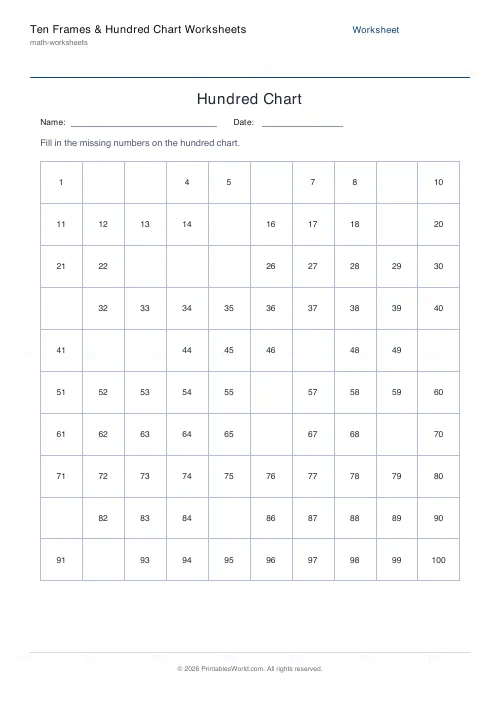
Ten Frames & Hundred Chart Worksheets
Build number sense with ten frames and hundred squares.
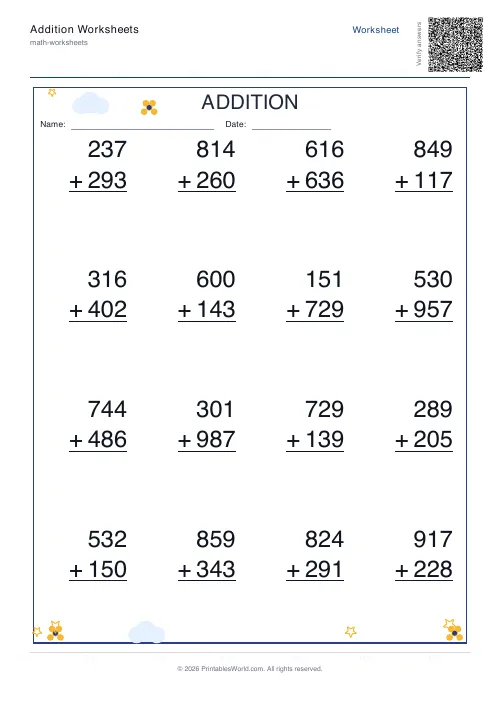
Addition Worksheets Generator
Free printable addition worksheets in tables or line-by-line layouts.
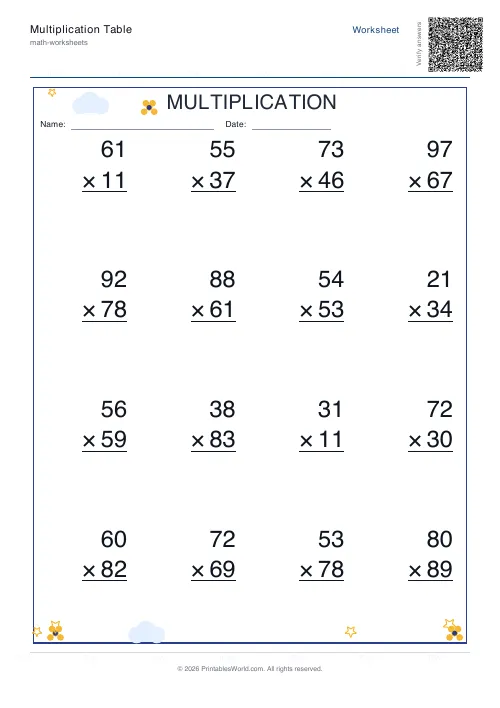
Multiplication Table Generator
Create free printable multiplication tables in table or line-by-line format with custom ranges and themes.
Continue reading
Math Worksheets
Addition strategies: number lines, regrouping and more
Column addition is the destination, not the route. Here are the strategies that come before it, why each matters, and how to tell which one a child is actually using.
5 min read
Math Worksheets
How many maths worksheets per day? A parent's guide
The honest answer is less than most parents assume. And the number of questions matters less than whether the session ends well.
5 min read