Printable Paper
Music manuscript paper: a guide for musicians
By Jobi · Creator & Maintainer, PrintablesWorld · Updated 2026-06-08 · 4 min read
Manuscript paper looks like a single product and is not. The number of staves on the page, and therefore their height, changes what the paper is good for. And getting it wrong means either cramped notation or wasted space. Free printable music staff paper lets you set it rather than accept whatever the shop had.
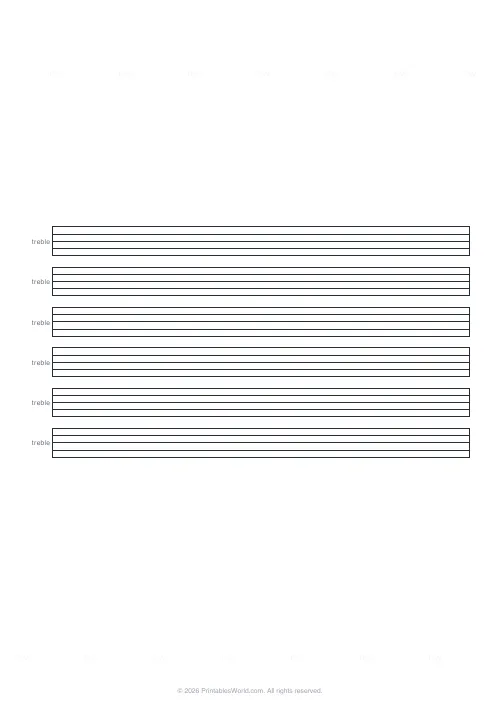
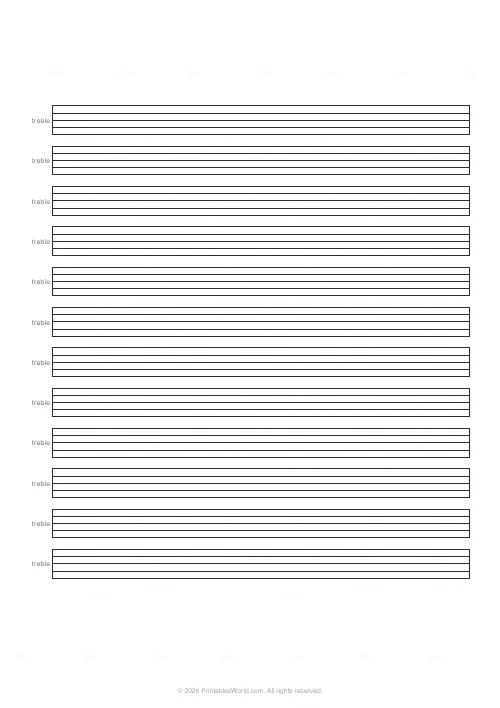
How many staves per page
The decision that governs everything else.
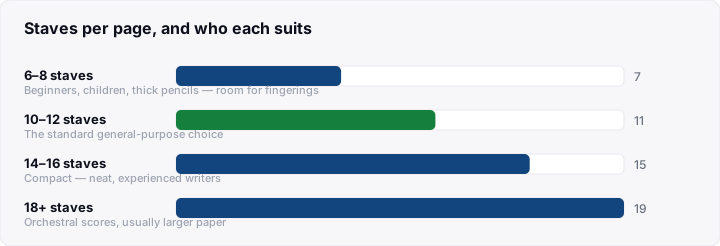
- 6–8 staves: large and widely spaced. Right for beginners, for young children, and for anyone writing with a thick pencil. Room above and below for fingerings, lyrics and corrections.
- 10–12 staves: the standard general-purpose choice. Enough space to write comfortably, enough music per page to be practical.
- 14–16 staves: compact. Suits neat, experienced writers and situations where fitting a piece on one page matters more than comfort.
- 18+: orchestral or full-score work, generally on larger paper.
If in doubt, take fewer staves than you think. Cramped notation is far harder to read at a stand than a piece that runs to a second page, and page turns are a smaller problem than illegibility.
Stave height and why it matters
Stave height, the distance from the bottom line to the top line, determines how large the noteheads must be, and therefore how much detail fits.
Published sheet music commonly uses a stave height somewhere around 7mm for standard instrumental parts, with larger sizes for beginner material and smaller for dense scores. Handwritten manuscript benefits from more height than printed music, because handwriting is less precise than engraving.
Two practical consequences. Ledger lines need space above and below, so a part with a lot of high or low writing wants generous spacing between staves rather than more staves. And anything with lyrics, chord symbols or fingerings needs room between staves for the text, which is a separate consideration from the stave height itself.
Single staves, grand staves and systems
Single staves suit monophonic instruments. Voice, flute, trumpet, a melody line.
Grand staves, treble and bass braced together, are what piano and harp need. A page of unbraced single staves is genuinely awkward for keyboard writing, because you have to draw the braces yourself and keep the pairs aligned.
Systems of three or more staves are for ensembles, where each line is an instrument and all must align vertically so the music reads across.
Check which you need before printing a stack. Manuscript paper for a pianist and manuscript paper for a singer are not the same paper, and this is the most common mismatch.
When to use tab instead
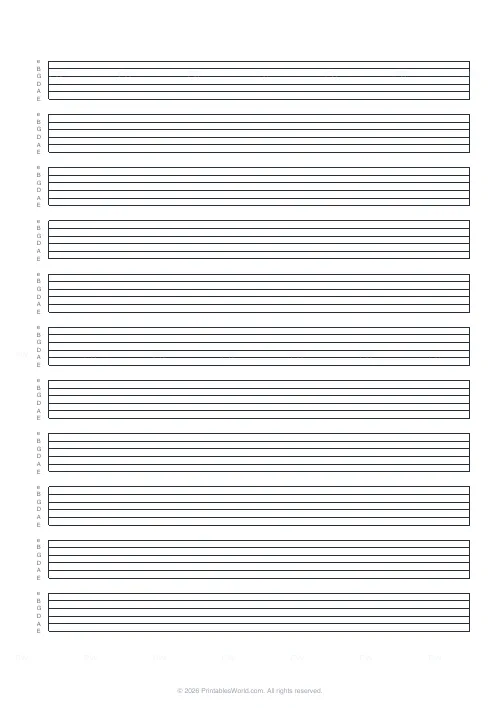
Tablature shows string and fret rather than pitch and rhythm, and for fretted instruments it answers a different question: standard notation says what note, tab says where to put your finger.
Tab is the practical choice for working out a guitar or bass part, for recording a riff you have just found, and for players who do not read standard notation. Its weakness is rhythm. Plain tab does not indicate note lengths reliably, so a part you do not already know how to play can be ambiguous.
Many guitarists use both: standard notation above, tab below, so rhythm comes from one and fingering from the other. Guitar tab paper covers the six-line version; bass players want four lines, and ukulele four.
Practical notes
- Pencil, not pen. Music gets revised. A propelling pencil with a soft lead and a good eraser is the standard kit.
- Leave the first system room for the title, tempo marking and key signature.
- Print single-sided if the music will go on a stand. You cannot turn a double-sided page mid-piece without losing the previous one.
- Number the pages and bars before rehearsal, not during it. "From bar 47" is the only efficient way to rehearse.
- Heavier paper for anything performed. 100gsm survives a stand, a folder and a draught; 80gsm curls.
Frequently asked questions
How many staves should manuscript paper have?
Ten to twelve for general use. Six to eight for beginners and children; fourteen or more only if you write small and neatly.
What is the difference between manuscript paper and staff paper?
Nothing. The terms are regional. "Manuscript paper" is more common in the UK, "staff paper" in the US.
Should beginners learn tab or standard notation?
Tab is faster to start with on guitar and gets a player playing sooner. Standard notation transfers to every instrument and carries rhythm properly. Many teachers introduce tab early and add notation alongside rather than choosing.
Can I print manuscript paper on A4?
Yes, and most people do. A3 is used for full scores where many instruments must align on one system, but it is unnecessary for single parts or piano writing.
Before you print
Decide the staves-per-page from who is writing, not from what looks efficient, and check whether you need single staves or braced grand staves before printing a stack. Print staff paper for notation and tab paper for fretted instruments. And single-sided for anything going on a stand.
Related tools
Continue reading
Printable Paper
The best note-taking paper for students (Cornell, grid, lined)
The paper you take notes on quietly decides how you review them. Here is what each format is actually for, and which subjects each suits.
4 min read
Printable Paper
Graph paper sizes: which grid for which task
What graph paper sizes and grid spacings mean, how to match a grid to maths, art or design, and how to set it all in the free graph paper generator.
7 min read