Logic Puzzles
Kakuro, killer sudoku and other number puzzles explained
By Jobi · Creator & Maintainer, PrintablesWorld · Updated 2026-07-13 · 5 min read
Sudoku is not really a number puzzle. The digits are just nine distinct symbols, and no arithmetic is involved. The puzzles below are the ones where the numbers actually matter, and they are the natural next step once sudoku has stopped being difficult. Free printable killer sudoku and kakuro are both a click away.
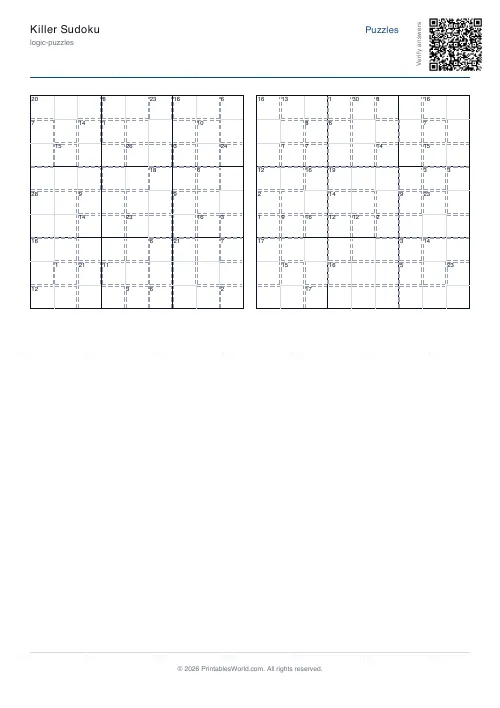
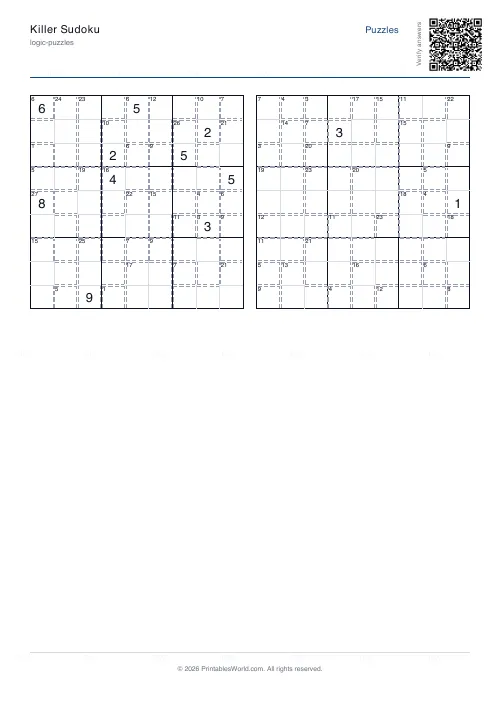
Killer sudoku
A standard 9×9 sudoku grid with the usual rules, plus dotted "cages" covering groups of cells. Each cage shows a total, and the digits inside it must add to that total. And must not repeat within the cage.
Crucially, a killer sudoku typically starts with no given digits at all. Everything comes from the cage totals.
The way in is the cages with few cells and extreme totals, because those have only one possible combination. A two-cell cage totalling 3 must be 1 and 2. A three-cell cage totalling 6 must be 1, 2 and 3. A two-cell cage totalling 17 must be 8 and 9. Those forced cages give you the footholds, and normal sudoku logic does the rest.
The other standard technique is the rule of 45: each row, column and box contains 1–9, so it sums to 45. If cages cover most of a box, the missing cell can be found by subtraction.
Kakuro
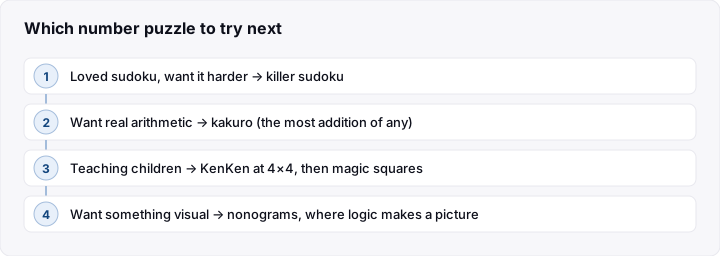
Often described as a numerical crossword, and the description is accurate. A grid of white and black cells; the black cells carry clue numbers for the runs of white cells to their right and below.
Each run must sum to its clue, using digits 1–9, with no digit repeated within a run. That last rule is what makes it solvable.
The technique is the same as killer sudoku's opening move: find runs whose length and total admit only one combination. A two-cell run totalling 3 is {1,2}. A three-cell run totalling 24 is {7,8,9}. A four-cell run totalling 10 is {1,2,3,4}. Where a horizontal and a vertical run cross, the intersecting cell must appear in both combinations, which usually pins it down.
Kakuro involves more addition than any other puzzle here, and experienced solvers work largely from memorised combinations rather than by adding each time.
Calcudoku
A grid, commonly 4×4 or 6×6, where each row and column contains each number once, as in sudoku. The grid is divided into cages, and each cage shows a target and an operation: 12×, 3−, 2÷, 7+.
The digits in the cage must produce the target using that operation, in any order. For subtraction and division the order is whichever way gives a positive or whole result, which is what makes those cages ambiguous and interesting.
Calcudoku is the most accessible of these for children, because a 4×4 grid uses only 1–4 and the arithmetic is small. It practises multiplication and division facts inside a genuine logic puzzle, which is why it appears in classrooms more than the others.
Magic squares
The oldest of the group by a wide margin. A square grid where every row, column and both diagonals sum to the same number.
A 3×3 magic square using 1–9 has a magic constant of 15, and 5 must be in the centre. A small, satisfying proof that children can follow. A 4×4 using 1–16 has a constant of 34.
Magic squares are less a puzzle type than a structure to explore, which makes them good for a classroom: children can be asked to complete partial squares, or to find why the centre must be 5, rather than simply solving.
Which to try next
Depends on what you want more of.
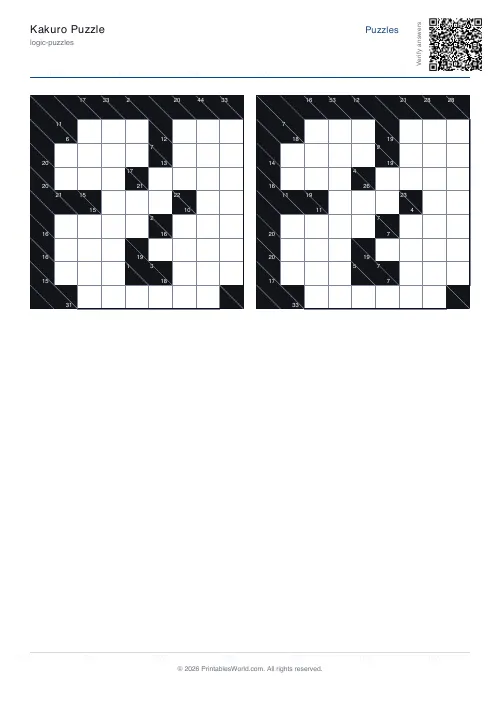
- Loved sudoku, want it harder → killer sudoku. Same core logic, extra layer.
- Want real arithmetic → kakuro. The most addition of any of them.
- Teaching children → Calcudoku at 4×4, then magic squares. Small numbers, real reasoning.
- Want something visual instead → nonograms, where the logic produces a picture.
One caution: all of these are a genuine step up from sudoku. Expect the first one to take considerably longer than you think, and start at the smallest available size rather than the standard one.
Frequently asked questions
Do you need to be good at maths for these?
Only arithmetic, and not much of it. Addition to 45 and simple multiplication. The difficulty is logical rather than mathematical, which is why people who dislike maths often enjoy them anyway.
Which is hardest?
Broadly, kakuro and killer sudoku are the most demanding at full size, Calcudoku is the most approachable, and magic squares are the most structured. But difficulty within each type varies enormously with the size and the puzzle.
What age can children start?
Calcudoku at 4×4 works from around eight, once multiplication facts are becoming reliable. Killer sudoku and kakuro generally suit older children and adults.
Is guessing ever needed?
Not in a well-constructed puzzle. Each has a single solution reachable by logic. If you are guessing, there is usually a forced combination you have not spotted.
Before you print
Start with the smallest size available, and learn the forced-combination openings. The short cages and runs with extreme totals are where every one of these puzzles is cracked. Try killer sudoku if you already solve sudoku comfortably, or kakuro if you want the arithmetic to matter.
Related tools
Continue reading
Logic Puzzles
How to solve Sudoku: a beginner's step-by-step guide
Four techniques, learned in order, solve almost every easy and medium Sudoku: scanning, the last free cell, pencil marks and naked pairs. Here is each one with a worked example.
6 min read
Logic Puzzles
The benefits of logic puzzles for developing brains
Logic puzzles teach deduction and persistence, which are worth having. The claim that they make children generally smarter is weaker than the marketing suggests.
5 min read