Logic Puzzles
How to solve Sudoku: a beginner's step-by-step guide
By Jobi · Creator & Maintainer, PrintablesWorld · Updated 2026-07-30 · 6 min read
Sudoku has exactly one rule: every row, every column and every 3×3 box must contain the digits 1 to 9 once each. Everything else is a technique for working out where a digit has to go. Four of them solve almost every easy and medium puzzle, and you can practise each on a fresh grid from the free printable Sudoku generator.
Learn them in the order below. Each one only makes sense once the one before it is comfortable.

The one rule, and what follows from it
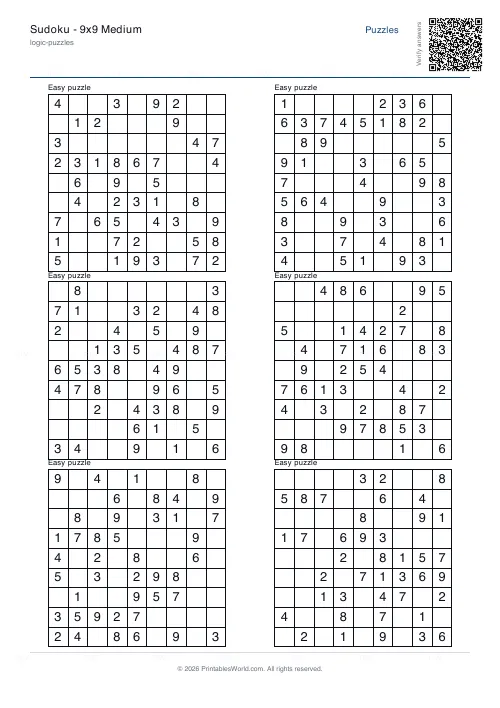
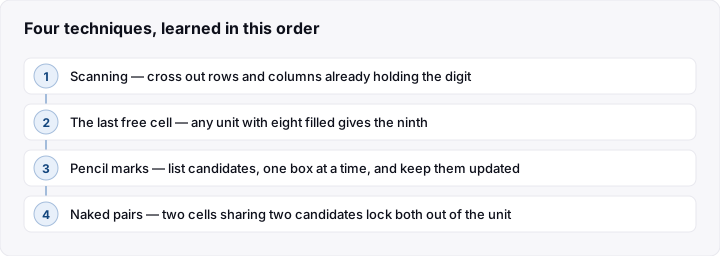
A standard Sudoku is a 9×9 grid divided into nine 3×3 boxes. Each row, column and box holds 1–9 exactly once.
Two consequences do all the work. First, if a digit already appears in a row, column or box, it cannot appear again there. Second — and this is the one beginners underuse — if a digit can only go in one cell of a unit, it goes there, even if that cell could also hold other digits.
No guessing is required. A well-made Sudoku has exactly one solution reachable by logic alone, which is what the generator's safe mode checks before it gives you a puzzle.
Technique 1: scanning
Pick a digit — say 5 — and look at a band of three boxes across the grid. Find every row and column that already contains a 5, and mentally cross them out. Any box in that band which does not yet have a 5 must have it in the cells that survive.
Often only one cell survives. That is a solved cell, and you have found it without considering any other digit.
Worked example. Take the top band of three boxes. The top-left box has a 5 in its middle row. The top-right box has a 5 in its bottom row. The top-middle box has no 5. Those two 5s rule out the middle and bottom rows of the top-middle box, so its 5 must be in the top row — three candidate cells. If one of those three is already filled and another sits in a column that has a 5 further down, only one cell is left. Write it in.
Work through all nine digits this way. On an easy puzzle, scanning alone will fill much of the grid.
Technique 2: the last free cell
Look for any row, column or box with eight cells already filled. The ninth takes whichever digit is missing. It sounds too simple to mention, but scanning keeps creating these and they are easy to walk past.
Get into the habit of glancing at the row, the column and the box every time you write a digit. One entry frequently makes another unit complete, and a short chain of these often follows a single scan.
Technique 3: pencil marks
When scanning stops producing anything, start writing candidates — small digits in the corner of each empty cell listing everything that could still go there.
Two rules make this useful rather than a chore:
- Do not pencil-mark the whole grid at once. It takes ages and most of it will be crossed out. Mark one box, or one awkward row, at a time.
- Update as you go. A stale pencil mark is worse than none, because you will trust it.
Any cell that ends up with a single candidate is solved. Beyond that, look for a digit that appears as a candidate in only one cell of a unit — that cell takes it, regardless of what else it could have been. This is the second consequence from the top of the article, and it is where pencil marks earn their keep.
Print at a decent size for this. Nine small digits do not fit in a cramped grid, which is a good reason to keep the puzzle count per page low when you are learning.
Technique 4: naked pairs
The first technique that feels like a real deduction.
If two cells in the same row, column or box have exactly the same two candidates — say both can only be 3 or 7 — then between them they use up the 3 and the 7. You do not know which goes where, and it does not matter: no other cell in that unit can be 3 or 7. Cross them out everywhere else in the unit.
That usually unlocks a cell somewhere else. The same idea extends to three cells sharing three candidates (a naked triple), though pairs are far more common and are enough for most medium puzzles.
What to do when you are stuck
- Re-scan every digit. Cells filled since your last scan often open something you dismissed earlier.
- Look for the nearly-full units. Any row, column or box with seven or eight filled is where the next break usually is.
- Check for a contradiction. A unit with two of the same digit, or an empty cell with no candidates, means an earlier entry was wrong. Better to find it now than at the end.
- Put it down. Coming back an hour later genuinely works, because you stop re-checking the same three cells.
If you find yourself guessing, the puzzle is probably harder than your current technique rather than unsolvable. Drop back to an easier difficulty and build up — guessing teaches nothing and usually ends in a spoiled grid.
Mistakes that waste the most time
Writing a digit you are not certain about. One wrong entry propagates, and by the time it shows up as a contradiction the grid is unsalvageable. If you are not sure, it is a pencil mark.
Working one digit to death. If 5 has stopped yielding, move to 6. Coverage beats depth early on.
Ignoring boxes. Beginners scan rows and columns and forget the 3×3 box is a unit with equal force.
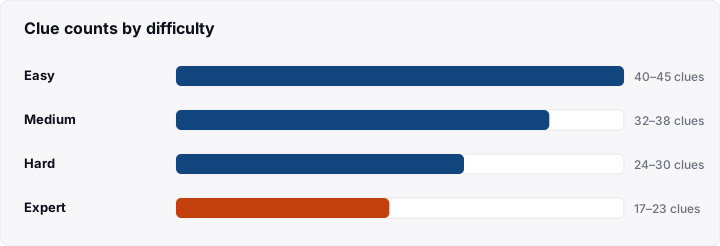
Starting too hard. An expert puzzle with 17–23 clues needs techniques beyond these four. Easy puzzles with 40–45 clues are where these become automatic.
Frequently asked questions
Is guessing ever necessary?
Not in a properly constructed puzzle, which has a single solution reachable by logic. If you need to guess, either the puzzle is poorly made or it needs a technique you have not learned yet.
What difficulty should a beginner start with?
Easy, meaning roughly 40–45 given clues. That level is generally solvable by scanning and last-free-cells alone, so you can build both techniques before pencil marks are needed.
Does Sudoku involve arithmetic?
No. The digits are just nine distinct symbols — you could play with nine colours or letters and nothing would change. It is a pure placement puzzle.
How long should a puzzle take?
An easy grid might take five to fifteen minutes once the basics are comfortable; harder ones take considerably longer. Speed is a poor measure of progress. Solving without guessing is the better one.
Before you print
Learn scanning first and stay on easy puzzles until it feels automatic, then add pencil marks and naked pairs as you move to medium. The Sudoku generator prints six puzzles per page at every level with an optional solution sheet, so you can check your work without typing a grid into a solver — and its safe mode guarantees each puzzle has exactly one logical path.
Related tools
Sudoku Generator
Generate printable Sudoku puzzles with six per page, multiple difficulty levels, and optional solutions.
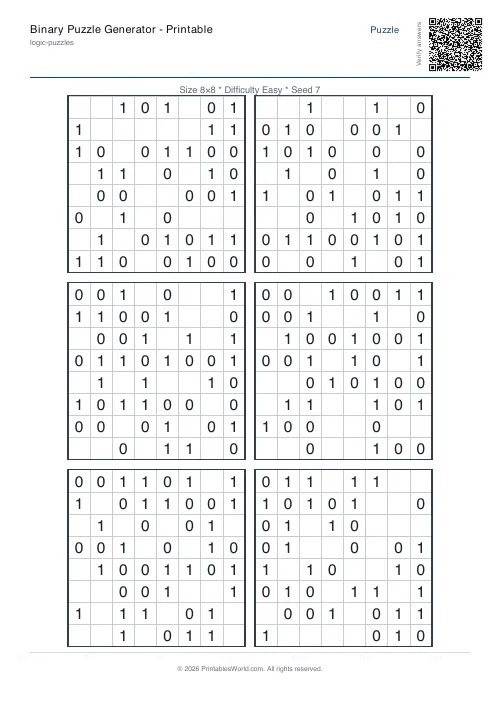
Binary Puzzle Generator: Printable
Create printable binary logic puzzles (Takuzu/Binairo) with customisable grid sizes and difficulty levels.
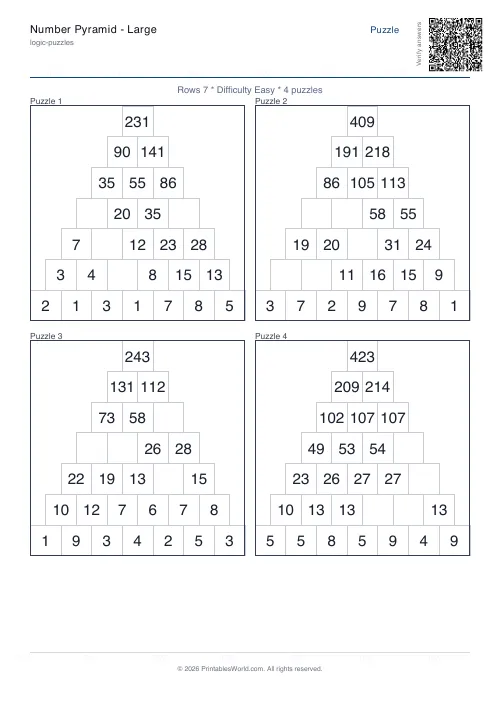
Number Pyramid Generator
Create printable addition pyramid puzzles with adjustable rows, difficulty, and optional answer keys.
Continue reading
Puzzles & Brain Games
Sudoku for kids: which difficulty to start at, by age
A practical guide to picking the right sudoku difficulty for a child by age, with a copyable first session and free printable grids in seconds.
7 min read
Puzzles & Brain Games
Printable brain games for seniors: a free puzzle pack
A free printable puzzle pack for older adults, with a sample seven-day plan, large-print and easier-difficulty tips, and how to use the Logic Puzzles collection.
7 min read