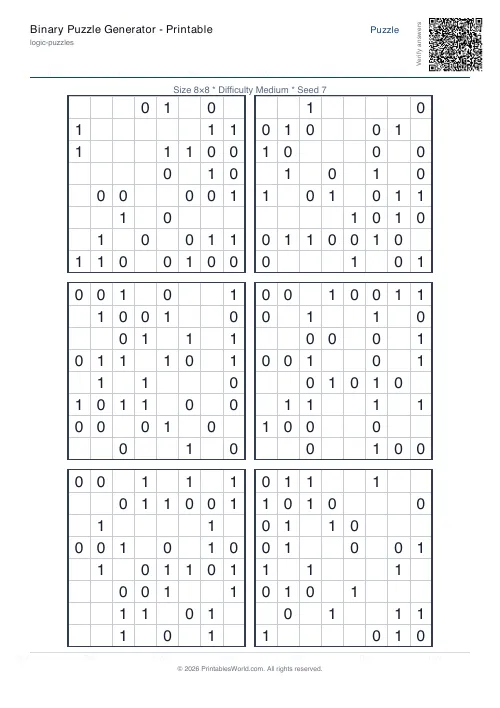
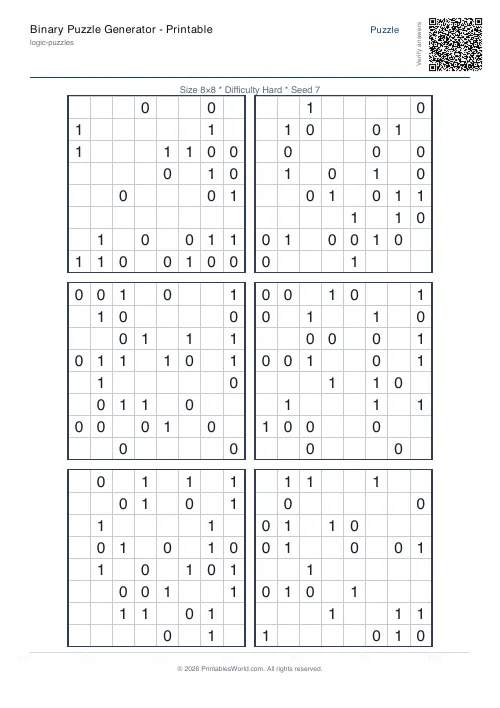
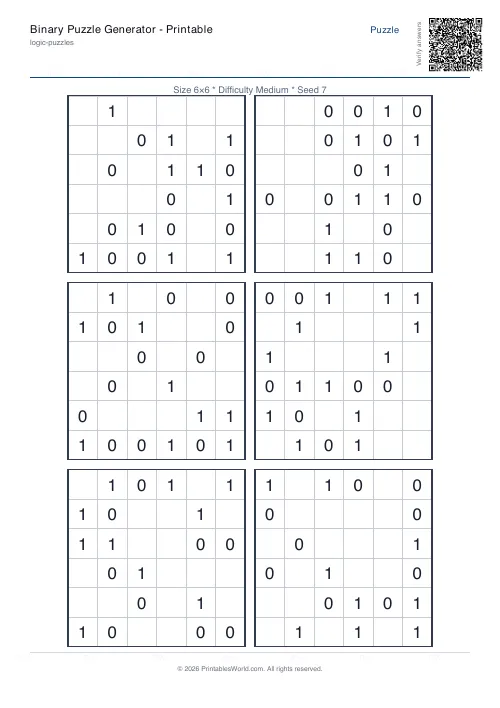
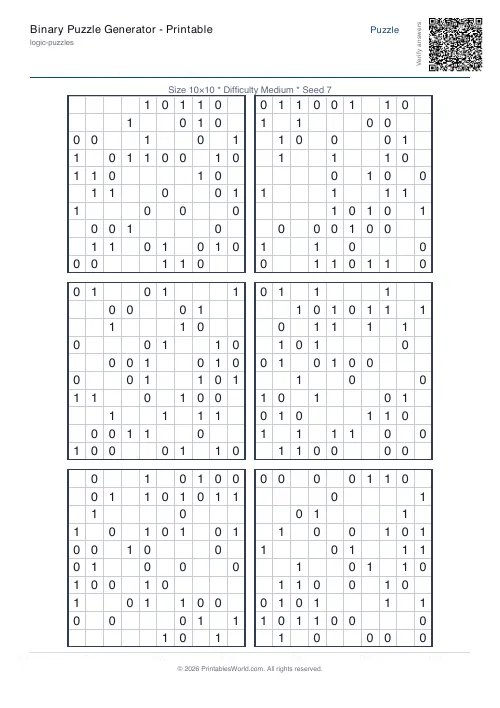
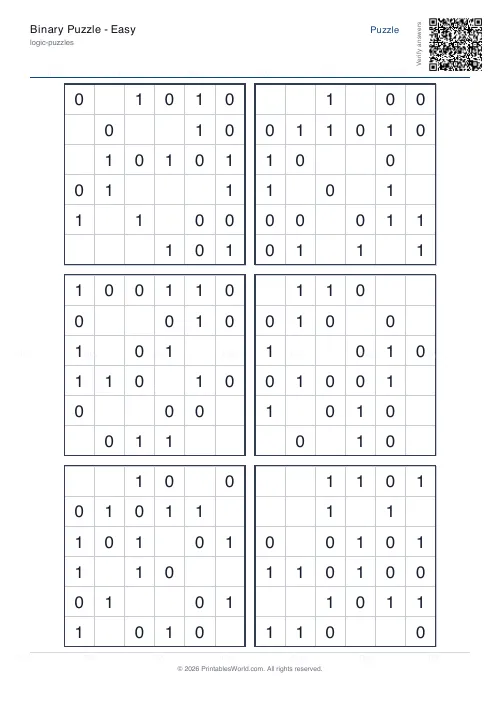
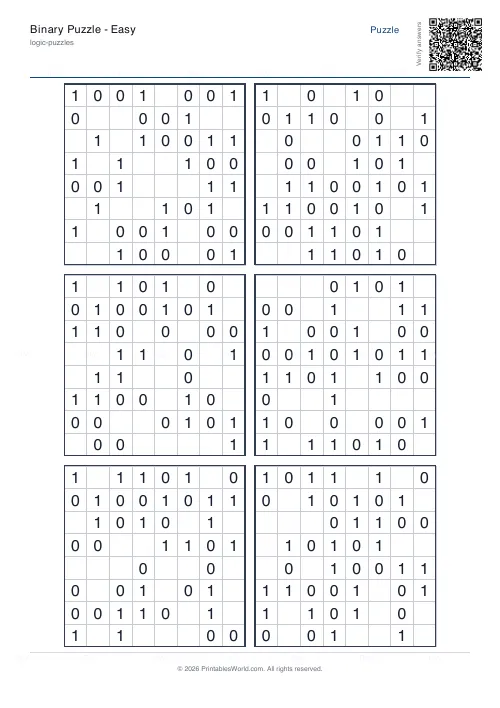
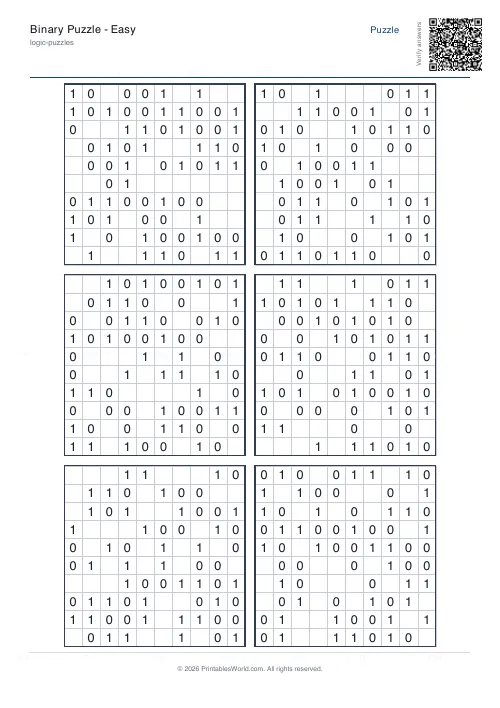
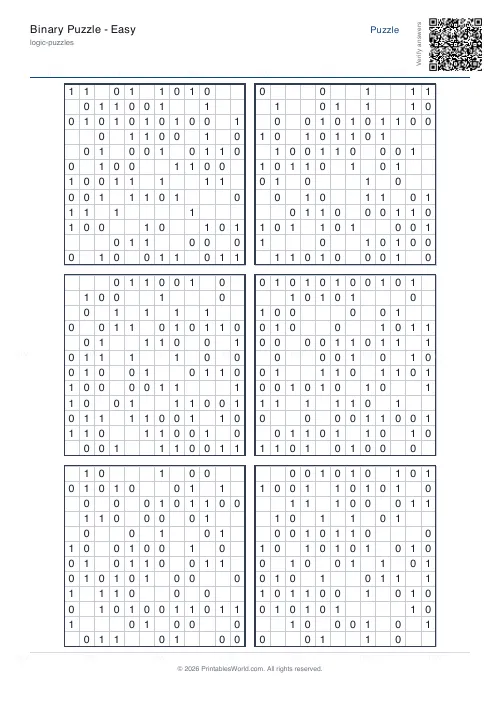
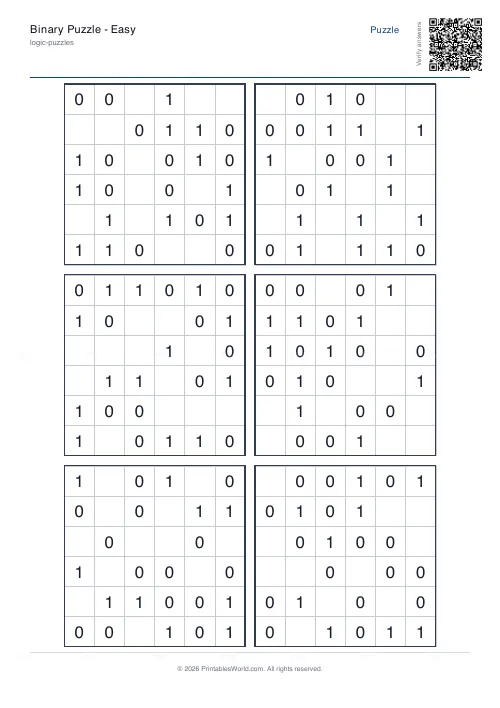
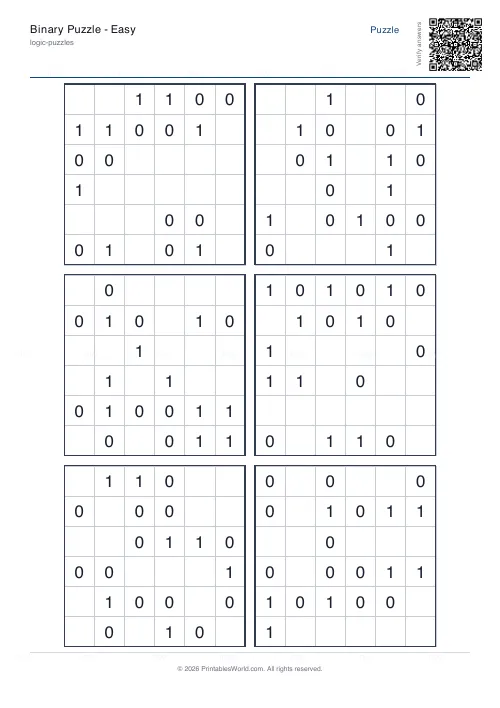
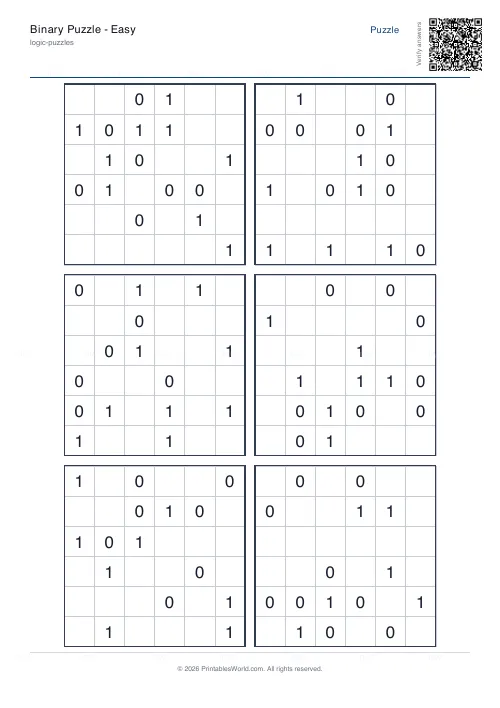
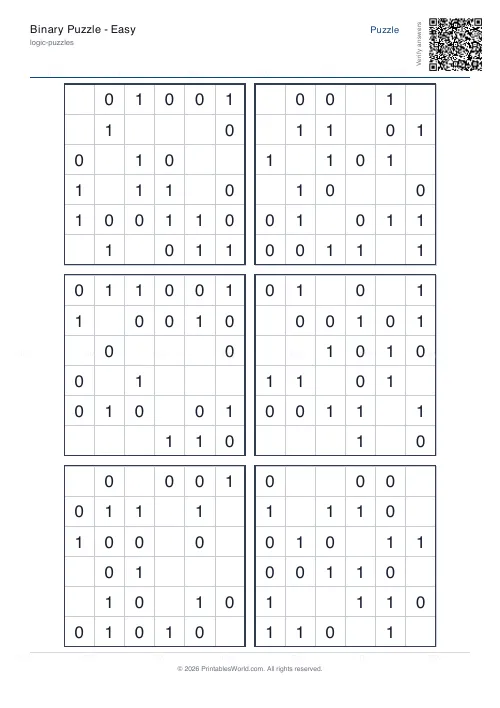
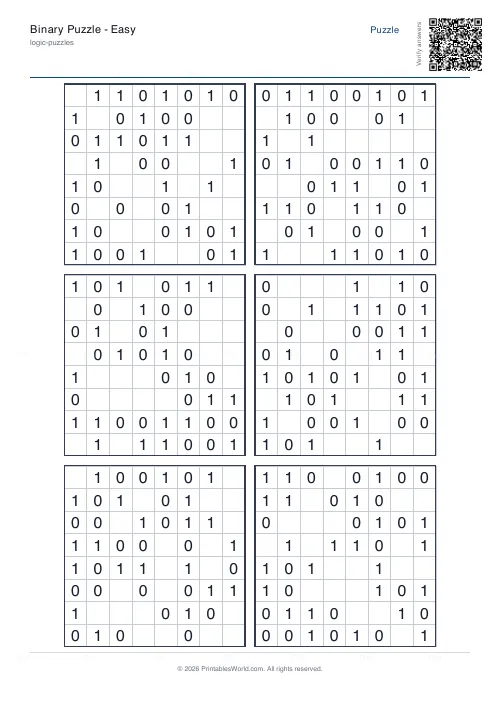
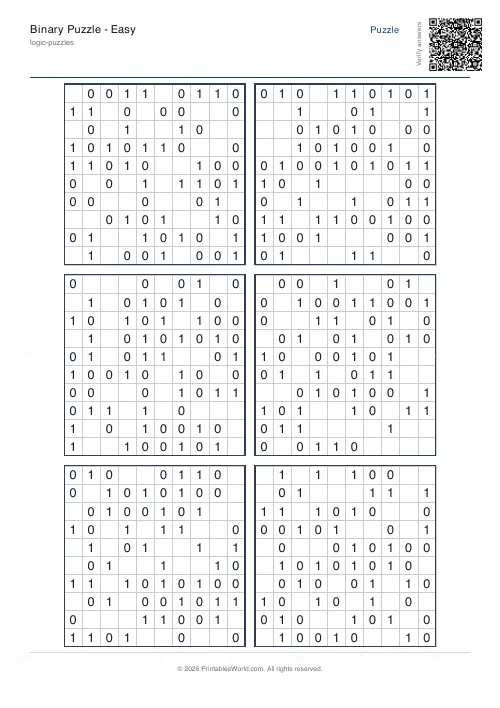
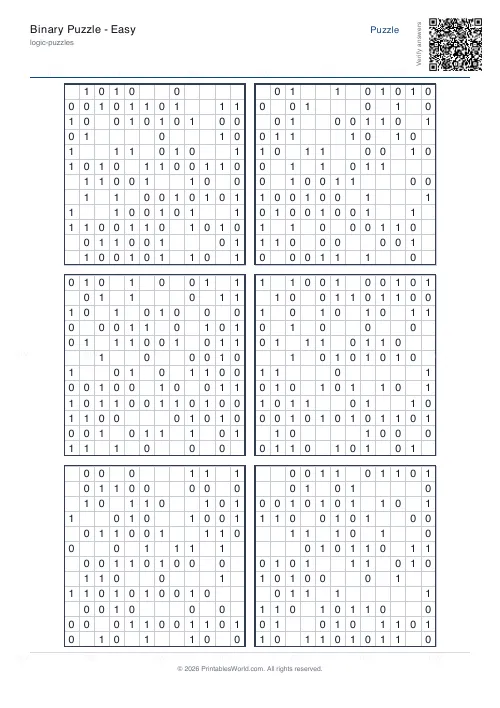
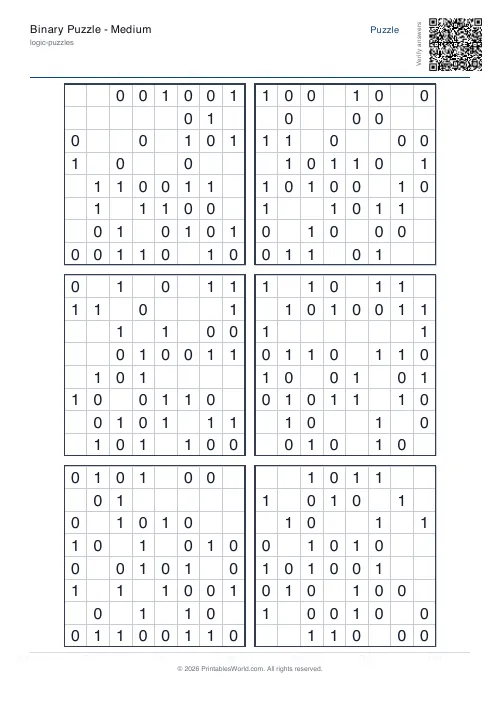
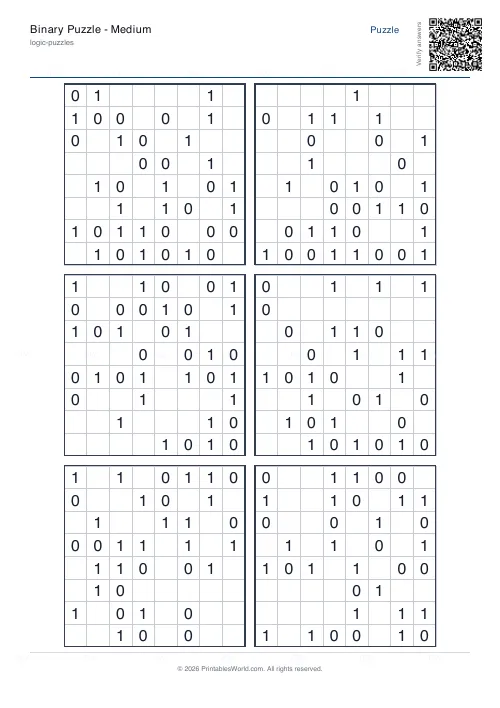
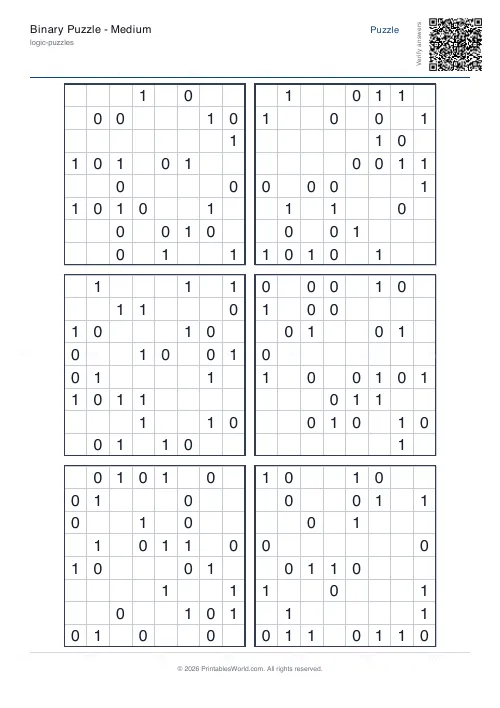
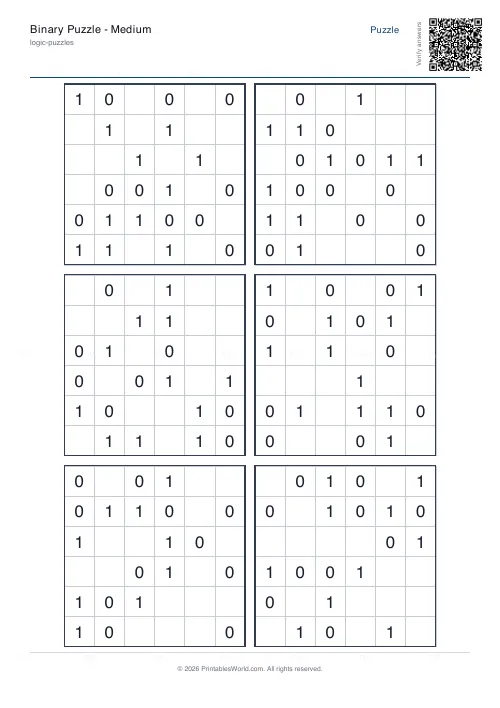
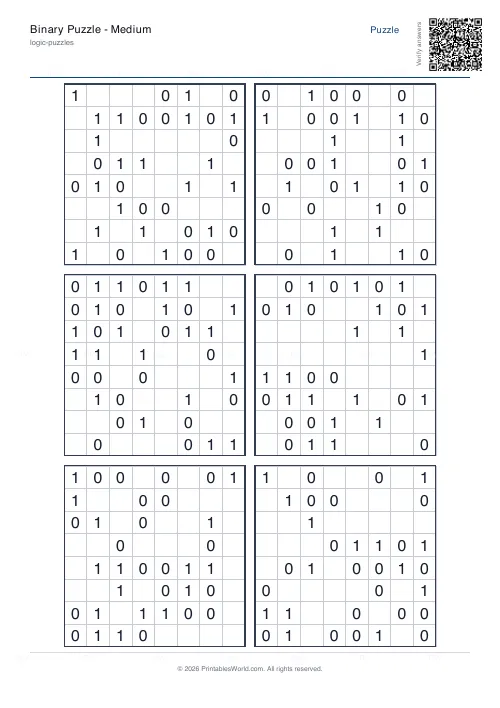
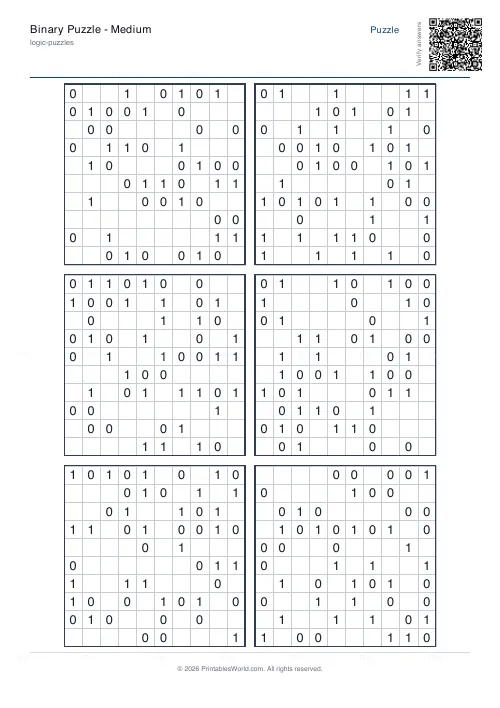
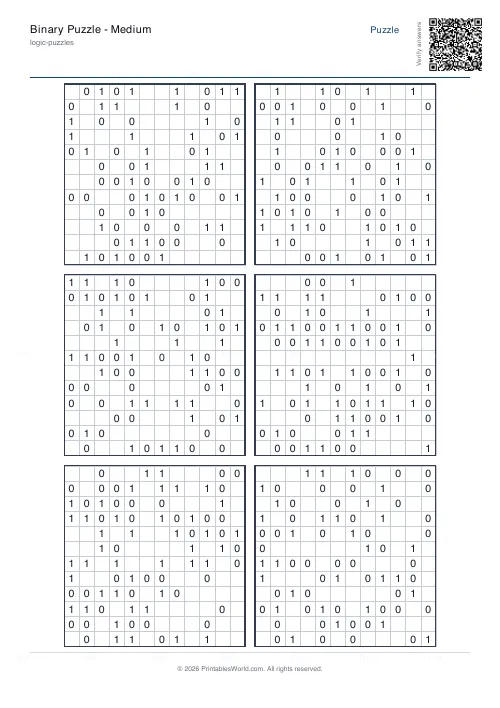
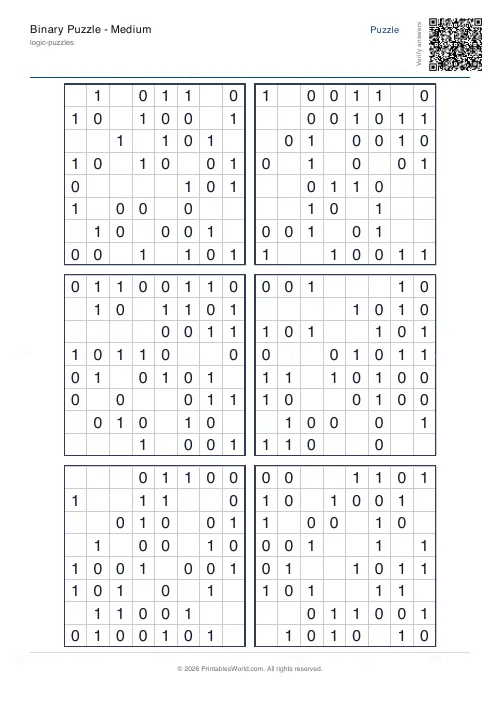
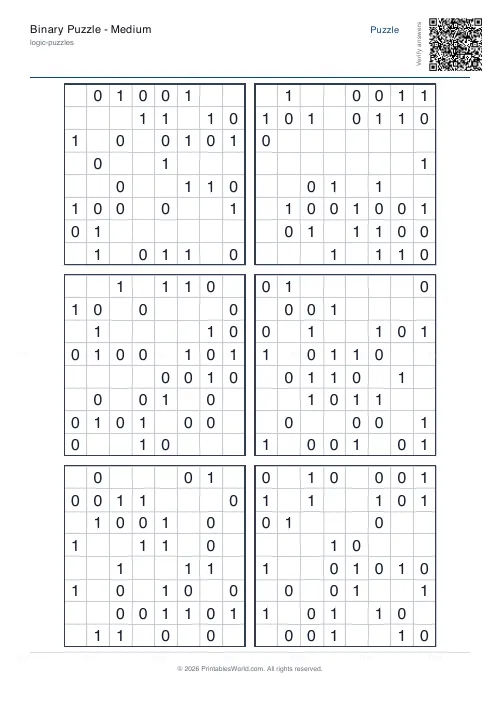
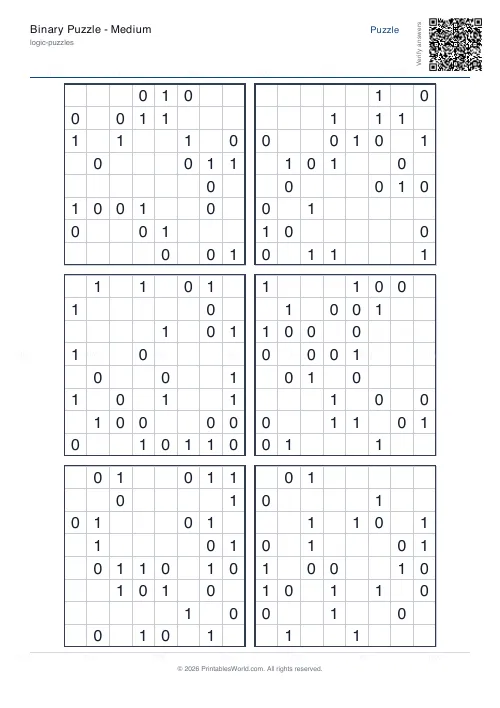
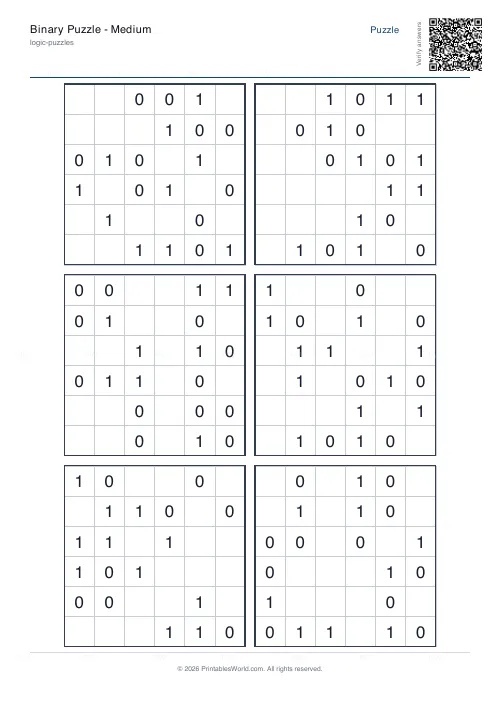
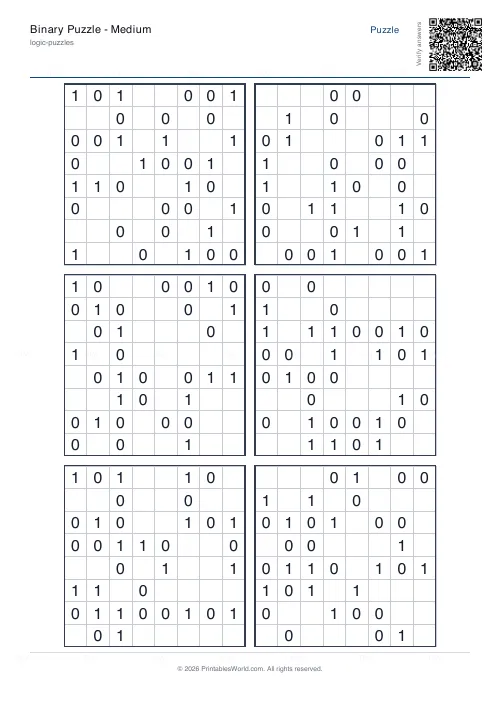
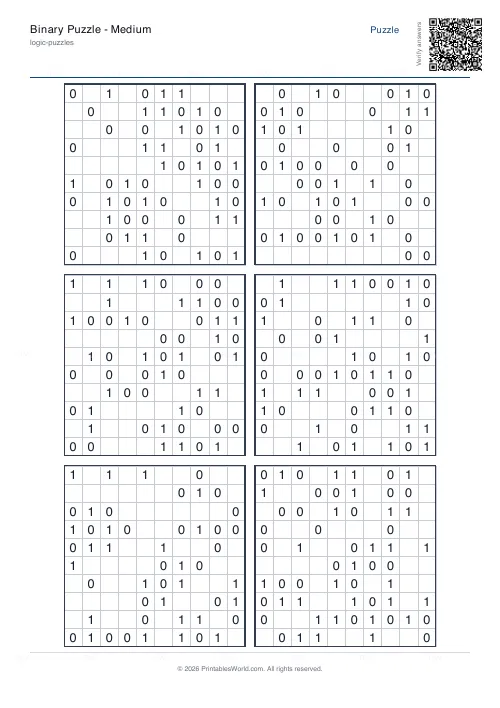
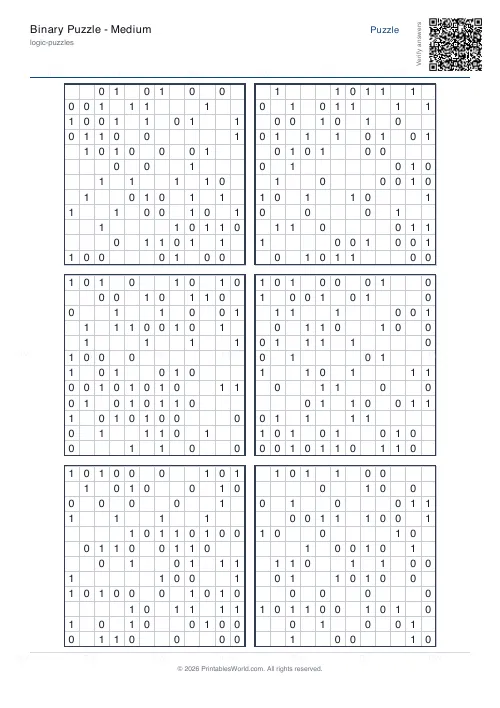
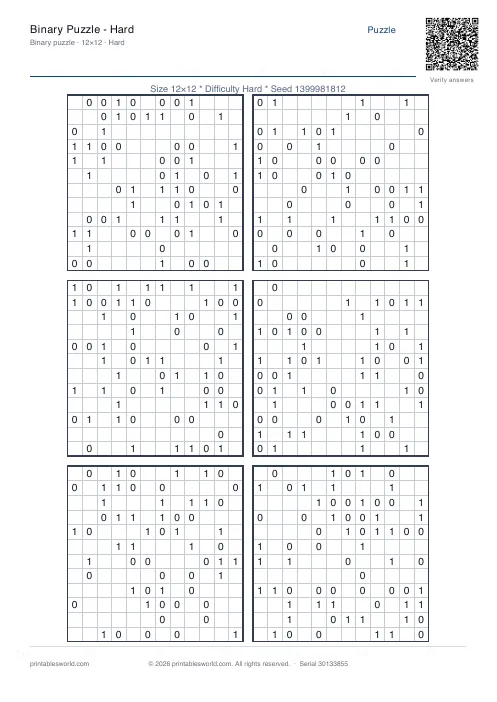
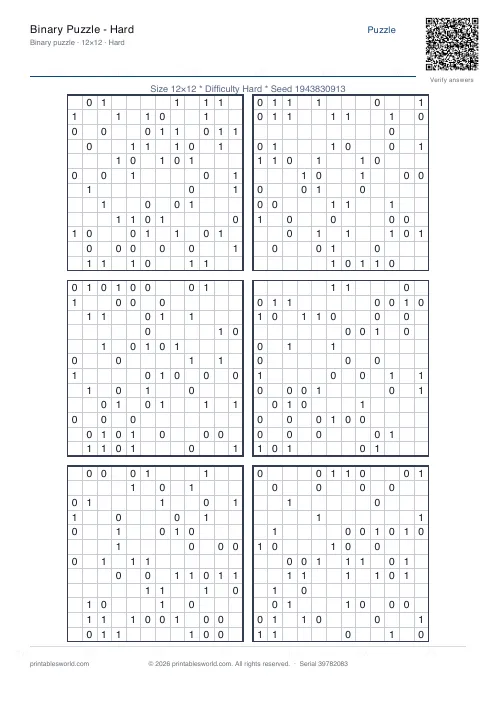
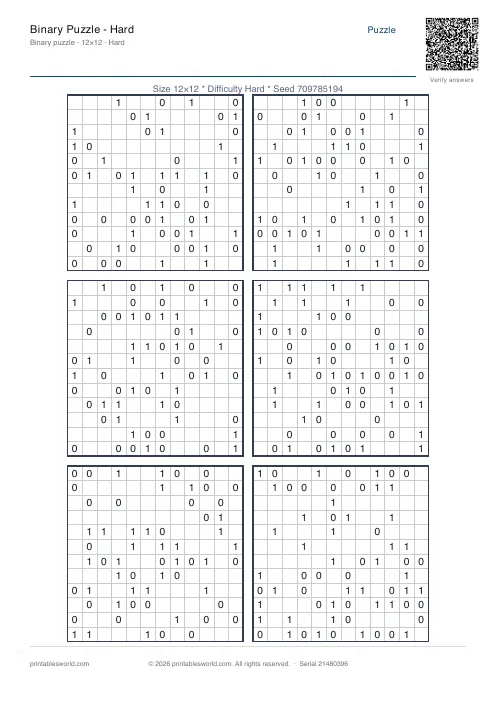
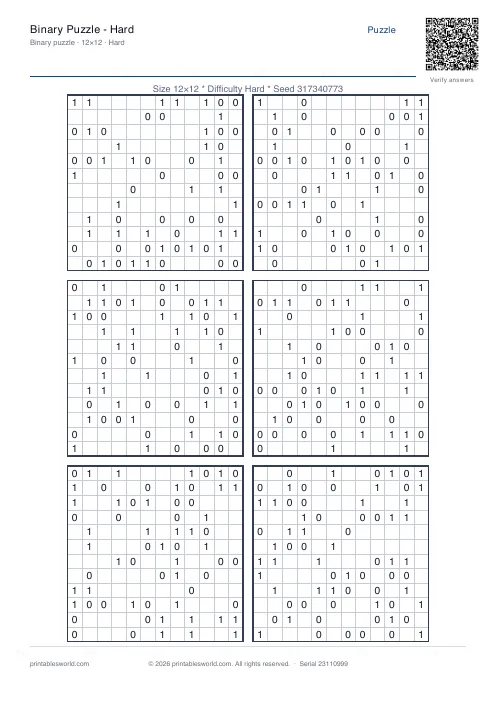
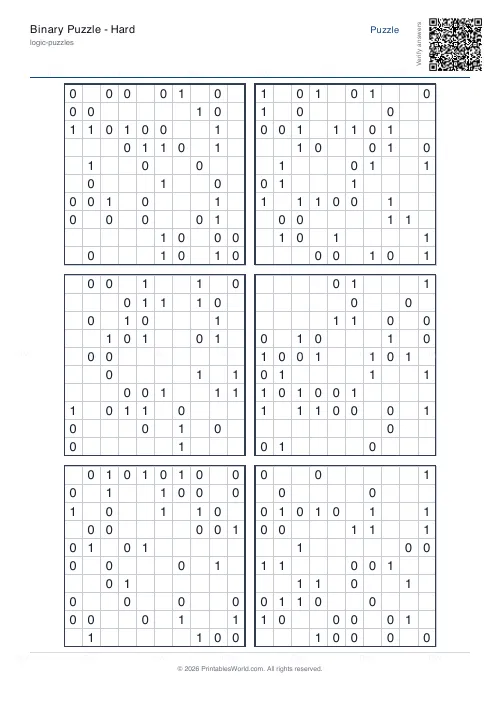
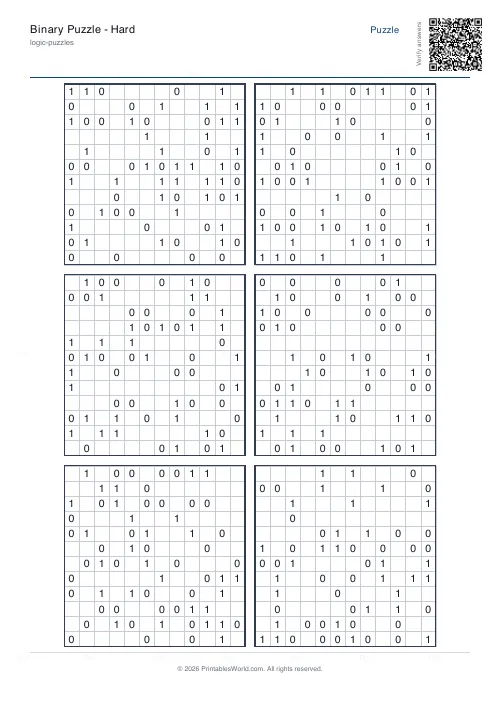
What this tool does
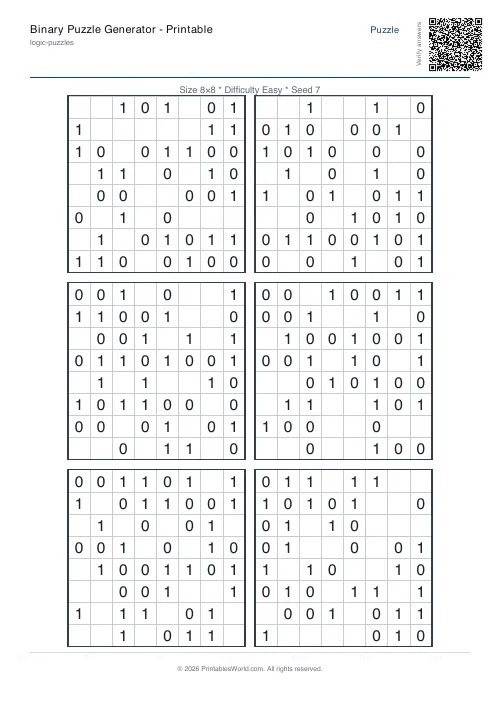
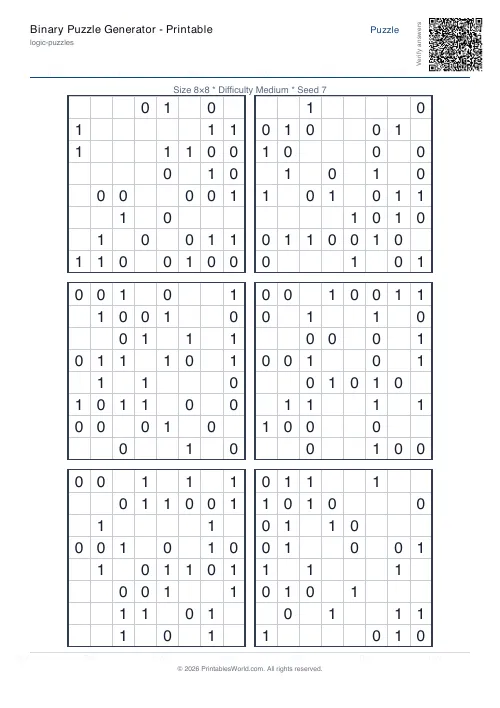
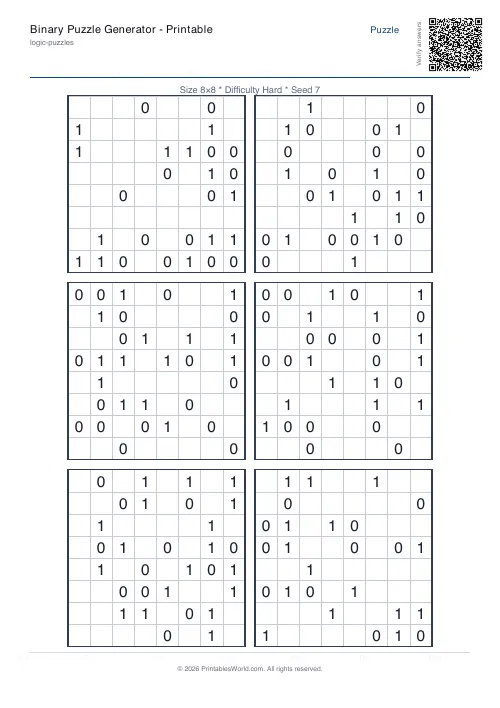
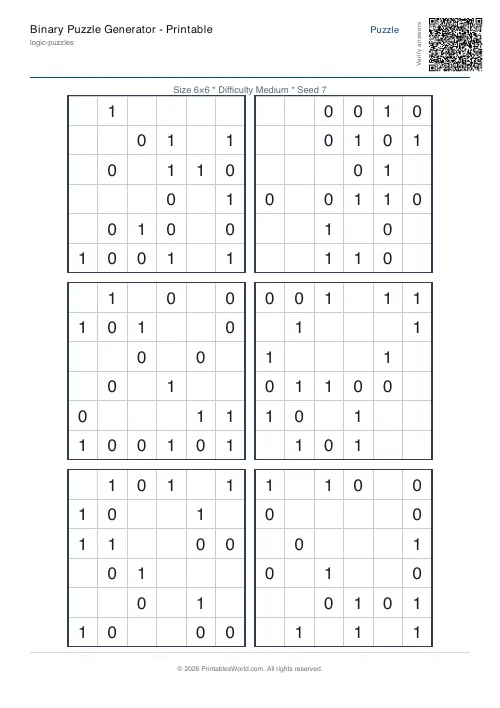
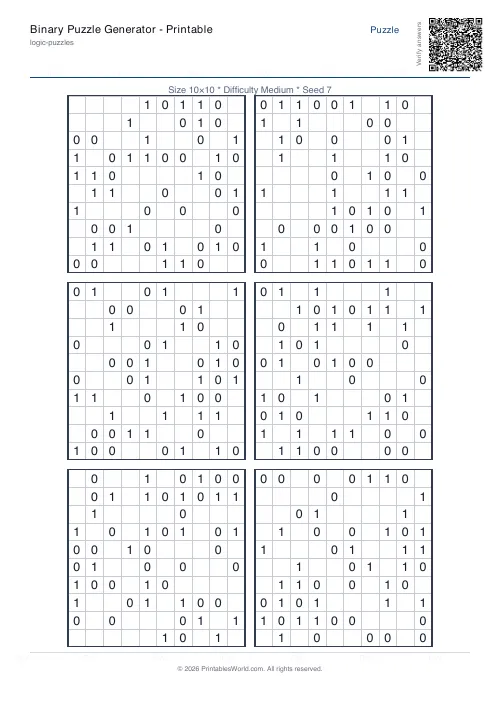
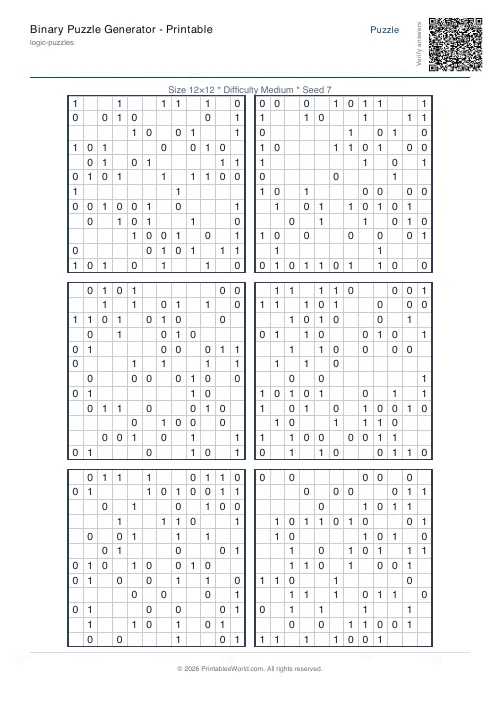
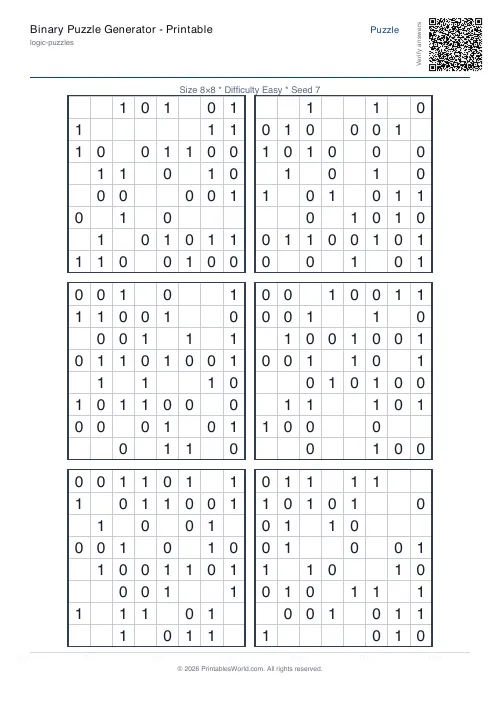
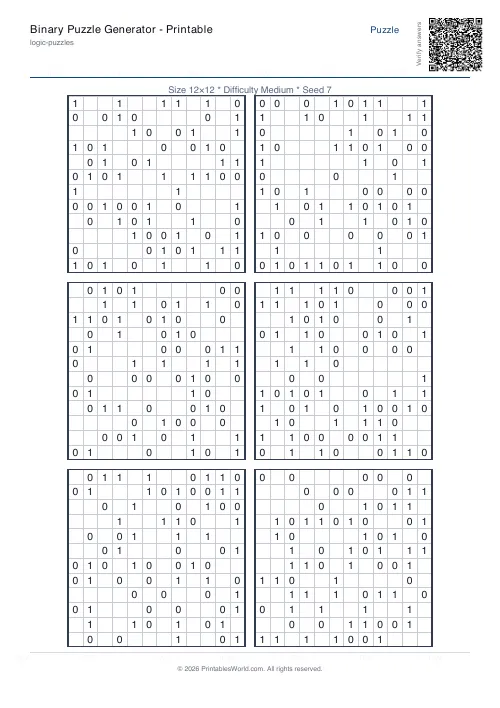
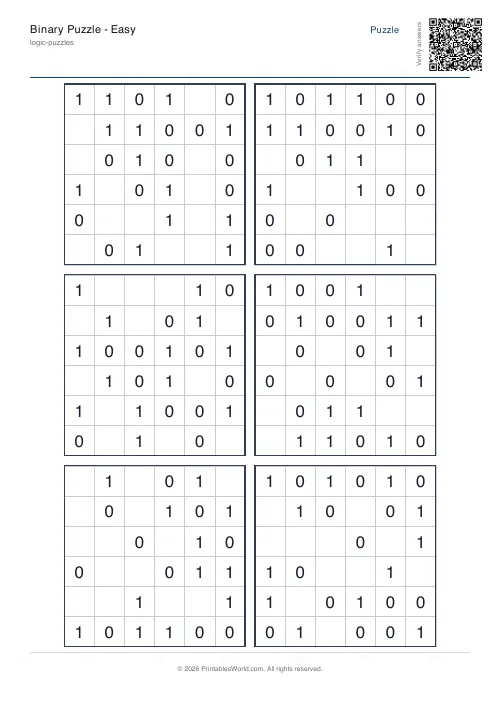
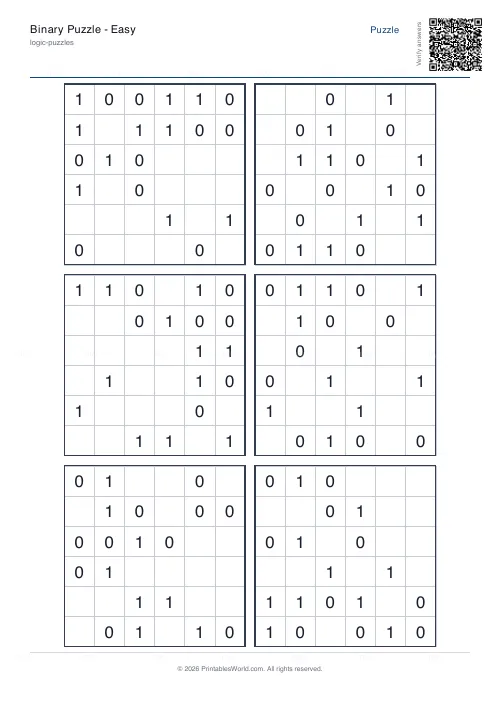
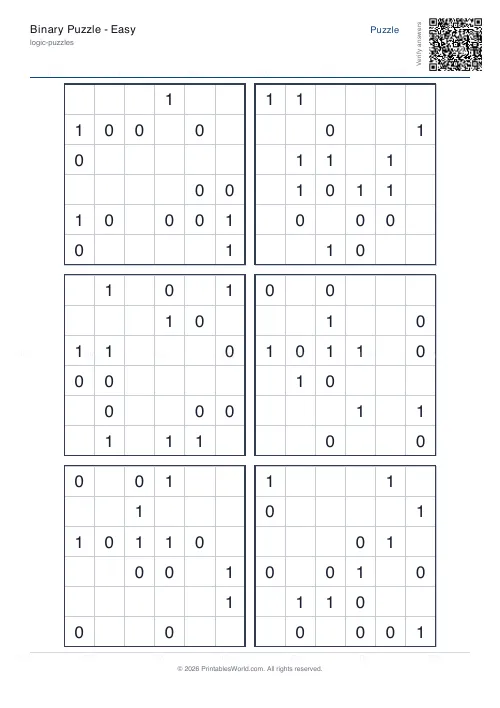
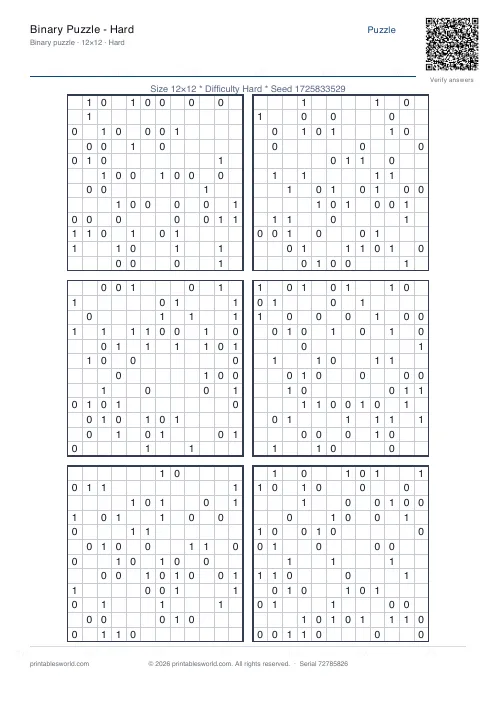
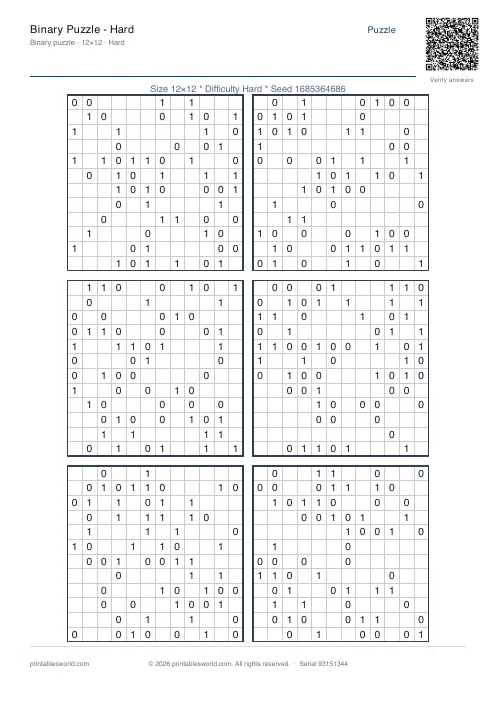
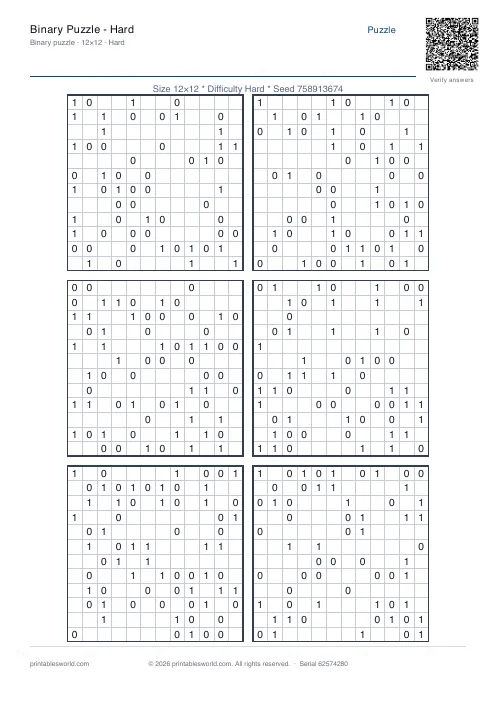
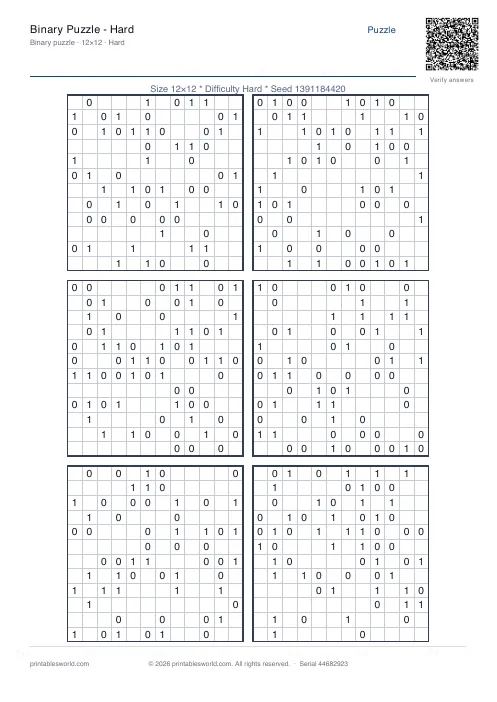
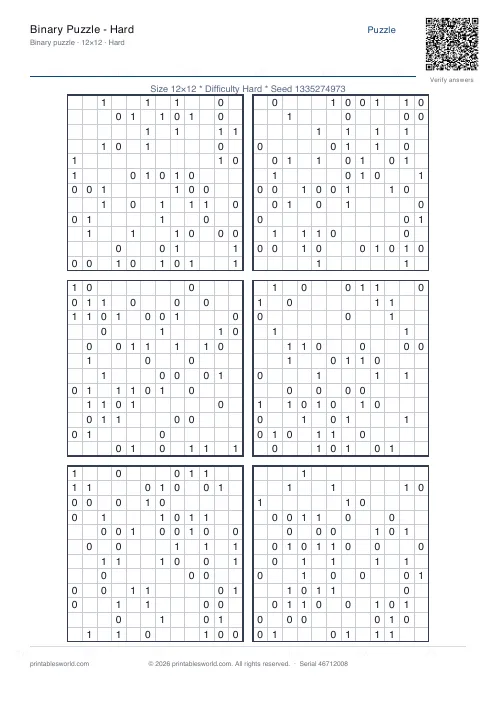
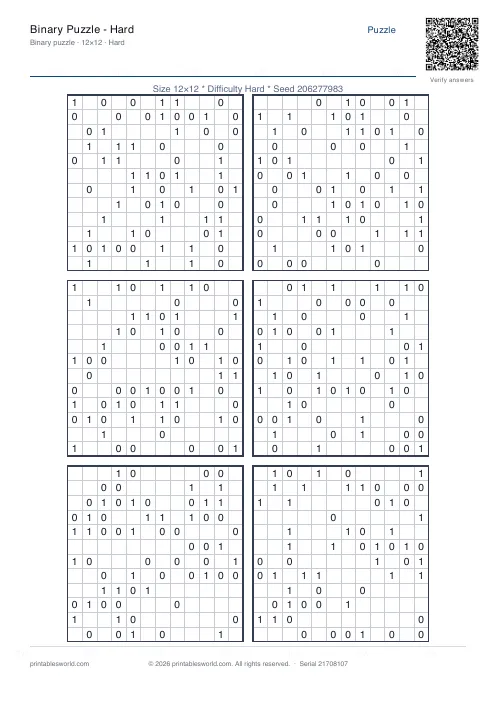
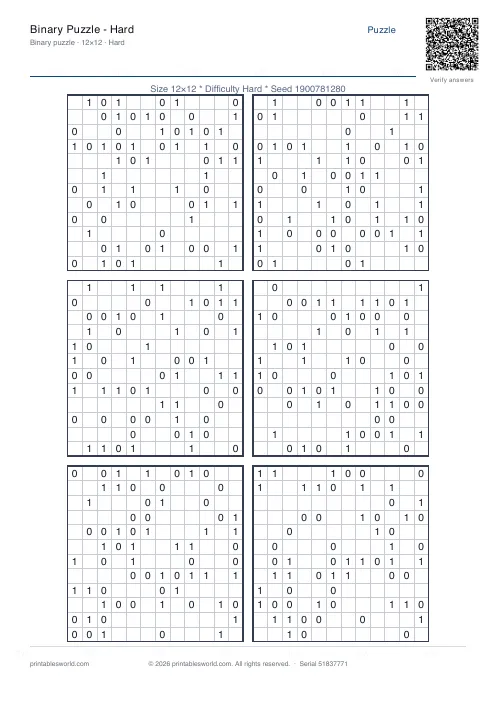
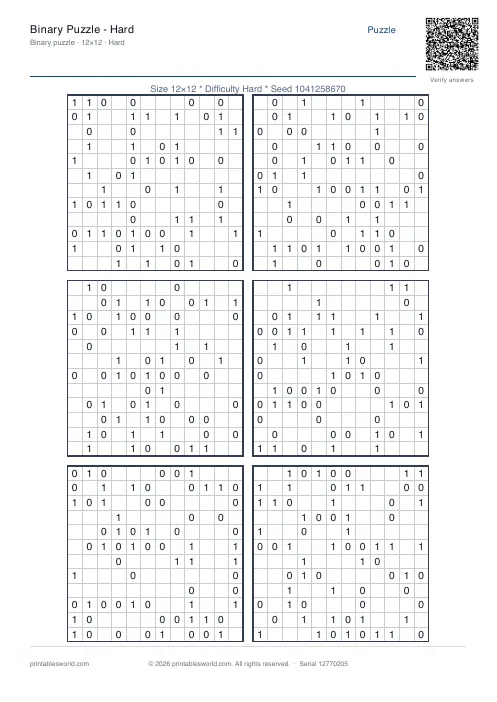
Takuzu, also called Binairo: fill a grid with 0s and 1s so no three repeat in a line, each row and column is balanced, and no two rows or columns match. Sizes 6 to 12.
People also used
Feedback
Spotted something off with this tool?
Three rules
Fill every empty cell with a 0 or a 1. Three constraints apply.
- No more than two identical digits next to each other, in a row or a column. 0 0 1 is fine; 0 0 0 is not.
- Every row and every column holds as many 0s as 1s.
- No two rows are identical, and no two columns are identical.
Sizes 6, 8, 10, 12. Three difficulties, solutions optional.
The techniques
Every puzzle is solvable by logic alone. Three moves do most of the work.
Avoiding a triple. A pair like 1 1 forces a 0 on either side of it. So does a gap between two matching digits: 0 _ 0 must have a 1 in the middle, because a 0 there would make three.
Counting. Once half a row is filled with one digit, every remaining cell in that row is the other digit. On a 10-wide grid, five 1s placed means the rest are 0s.
Uniqueness. The last rule is the one beginners forget and the one that cracks hard puzzles. If a row can only be completed one of two ways, and one of those ways duplicates a row already on the grid, it is the other way.
Why sizes matter more than difficulty here
A 6×6 is a five-minute puzzle whatever the difficulty setting claims. There are not enough cells in it to reason about for longer than that.
Ten and twelve are where the uniqueness rule starts doing real work, since there are enough rows for duplication to become a genuine constraint. If a solver reports the puzzles as too easy, raise the size before raising the difficulty.
Guessing is not necessary
Worth saying. Solvers stuck on a hard grid usually assume otherwise.
Every puzzle here is generated to have exactly one solution reachable by the three techniques above. If you are stuck, there is a deduction available — most often a uniqueness one, occasionally a counting one in a column rather than a row, which is where people forget to look.
What it is good for
Pure logic. No arithmetic, no vocabulary, so it travels across ages and across languages without translation, which makes it genuinely useful in a mixed classroom, for pupils learning English, and for anybody who has decided that sudoku is a numbers puzzle and therefore not for them.
It also introduces binary digits in a context where they mean nothing in particular, which is a quietly useful thing before a computing lesson.
Related
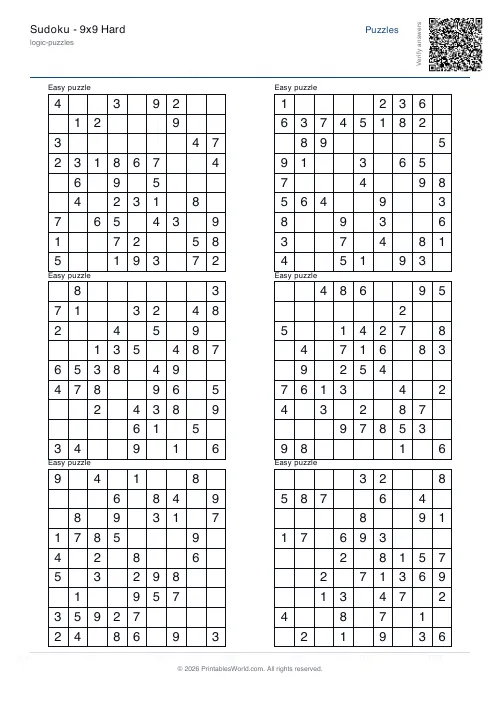
The sudoku generator for the classic, and word sudoku for the same logic with letters.
FAQs
Quick answers
How many puzzles appear on each printed page?
The generator places six puzzles per page for 6×6 and 8×8 grids. Larger 10×10 and 12×12 grids may span two pages to maintain readable cell sizes. Solution sheets follow the same layout, with each solution matching the puzzle order.
What does the seed option do?
Type any word or number into the seed field to produce a reproducible set of puzzles. The same seed always generates the same puzzles, which is useful for printing identical worksheets for multiple students or re-creating a lost handout. Leave the seed blank for random puzzles every time.
Can I print on US Letter paper, or is it A4 only?
The PDF layout automatically adjusts to fit both A4 and US Letter paper. Margins and grid scaling adapt so that puzzles print correctly on either size without clipping or distortion.
What makes a puzzle easy, medium, or hard?
Difficulty controls how many cells are revealed at the start. Easy puzzles show roughly 50–60% of the grid, giving you plenty of starting clues. Medium removes more cells, requiring multi-step deduction. Hard puzzles reveal only 30–40%, demanding lookahead, constraint chaining, and sometimes trial-and-error bifurcation.
Do the puzzles always have a unique solution?
Yes. The generator removes cells one at a time and verifies that the puzzle remains solvable through pure logic at every step. If removing a cell would create ambiguity, the algorithm leaves it filled. This guarantees that every puzzle has exactly one valid solution.
Can I turn off the metadata labels and date stamps?
Yes. Uncheck the "Show metadata" option to hide puzzle numbers, difficulty labels, and the generation date. The puzzles themselves remain unchanged; only the text annotations are removed, leaving a cleaner worksheet.
Are these puzzles the same as Sudoku?
No. Binary puzzles use only two digits (0 and 1) and enforce three rules: equal counts per row and column, no three consecutive identical digits, and no duplicate rows or columns. Sudoku uses nine digits and a different constraint system based on 3×3 boxes. Both are logic puzzles, but the solving techniques differ.
Related tools
Further reading
Logic Puzzles
The benefits of logic puzzles for developing brains
Logic puzzles teach deduction and persistence, which are worth having. The claim that they make children generally smarter is weaker than the marketing suggests.
5 min read
Logic Puzzles
How to solve Sudoku: a beginner's step-by-step guide
Four techniques, learned in order, solve almost every easy and medium Sudoku: scanning, the last free cell, pencil marks and naked pairs. Here is each one with a worked example.
6 min read
Puzzles & Brain Games
Printable brain games for seniors: a free puzzle pack
A free printable puzzle pack for older adults, with a sample seven-day plan, large-print and easier-difficulty tips, and how to use the Logic Puzzles collection.
7 min read