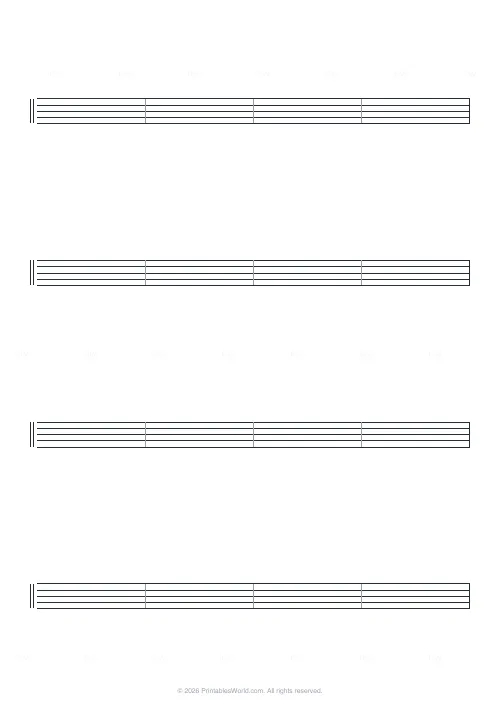
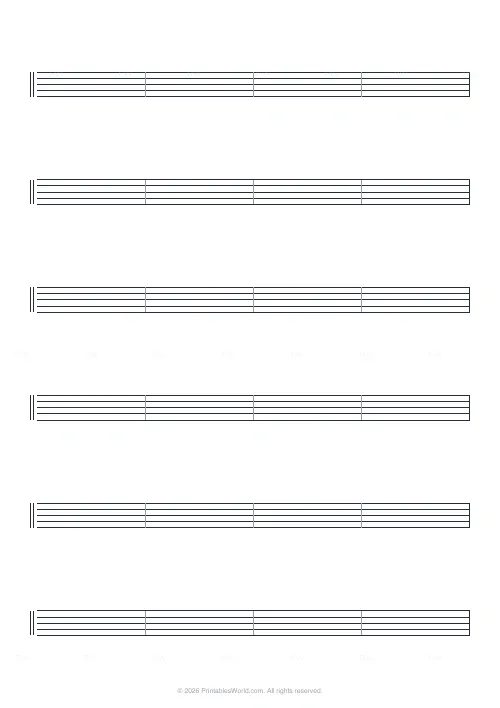
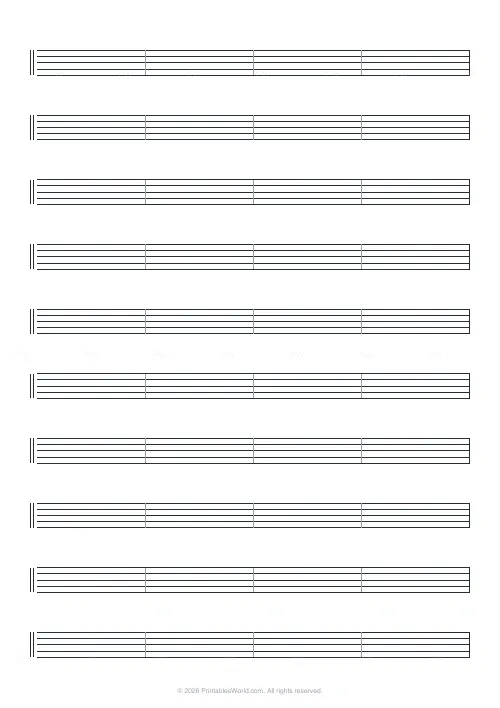
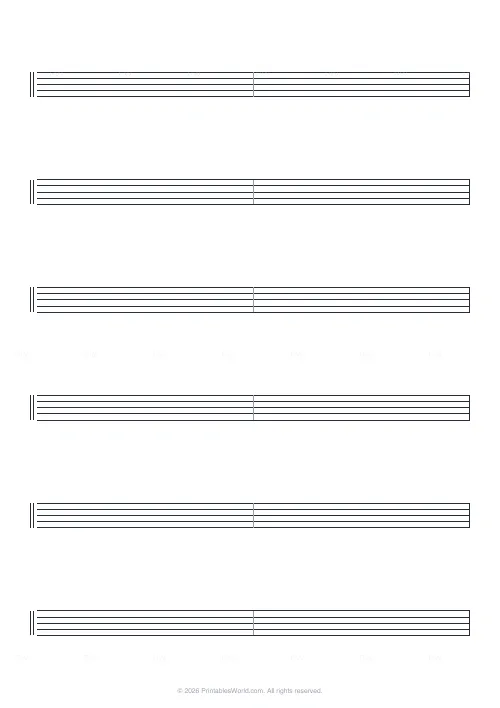
What this tool does
Blank percussion staves for writing drum parts by hand. Choose 4 to 10 staves down the page and 2 to 8 measures across each one.
People also used
Music Staff Paper
Five-line stave manuscript paper with selectable staves and clef label.
Lined Paper Generator
Generate custom ruled paper PDFs with adjustable line spacing, colours, margins, and primary ruling styles.
Graph Paper Generator
Create custom graph paper PDFs with square or rectangular grids, dot styles, and axis numbering.
Feedback
Spotted something off with this tool?
Blank staves, nothing else
Five-line percussion staves stacked down the page. Each one opens with the paired vertical bars that stand in for a neutral clef, closes with a heavier bar line, and is divided into equal measures by light rules.
No clef glyph is printed. No time signature is assumed either, because a drum part in 7/8 should not have to fight a sheet that has already committed itself to 4/4 before you have written a single note on it.
Why drum notation uses the same five lines
Drums have no pitch, so the staff positions do something else: they name instruments. Bass drum low, snare in the middle, hi-hat as a cross above the top line, toms in between, cymbals as crosses or diamonds higher still.
There is no single enforced standard. The Percussive Arts Society published a recommendation and most published music follows something close to it, but band charts and teaching material vary. Write your key on the first sheet of a set and stay consistent within it — that matters more than matching anybody else's convention.
Setting up the page
Six staves and four measures gives a 24-bar page. That is a comfortable density for handwriting.
Fewer staves means more vertical room per line, which is what you want when a part is busy with tom fills and ghost notes and everything else that needs space between the noteheads. More staves fits a longer piece on one sheet at the cost of that room.
On measures: four across is standard for straightforward time. Two across gives each bar half the page, which is the right choice for transcription work and for any bar dense enough that you will be rubbing out and rewriting inside it.
Who prints it
Drum students copying an exercise down from a lesson. Teachers writing rudiment sheets — paradiddles, flams, rolls — for one particular pupil who keeps rushing one of them. Drummers transcribing a groove off a recording, which nearly always teaches you more than reading somebody else's transcription of it. Bands writing a chart for a stand-in.
And anyone learning to read percussion notation at all, since writing it out yourself is much faster than reading it.
Related paper
For pitched instruments, music staff paper gives you ordinary staves. Guitar tab paper and bass tab paper cover the tablature side.
Print at 100% on A4, US Letter or US Legal.
FAQs
Quick answers
How many staves can I put on a page?
Between 4 and 10 five-line percussion staves per page. The default is 6, which balances writing room against how much fits on one sheet.
How many measures does each stave have?
You choose between 2 and 8 measures per stave, drawn as evenly spaced bar lines. The default is 4.
Is a drum clef printed?
Each stave opens with a percussion-clef-style pair of vertical bars, the standard neutral-clef marker for non-pitched percussion. No pitched treble or bass clef glyph is embedded, so the staff stays clean for drum notation.
Is a time signature included?
No. The measures are left blank so you can set your own time signature and subdivision. Write it in at the start of the first stave.
Will it print on A4?
Yes. A4, US Letter, and US Legal are all supported, and the stave and measure spacing stays consistent across them.
Can I use this for hand percussion or auxiliary parts?
Yes. The blank five-line staff works for drum kit, hand drums, and auxiliary percussion. You decide which line or space each voice sits on.
How should I print it for best results?
Print at 100% scale with "fit to page" turned off so the line spacing and bar widths stay accurate and identical on every sheet.
Related tools
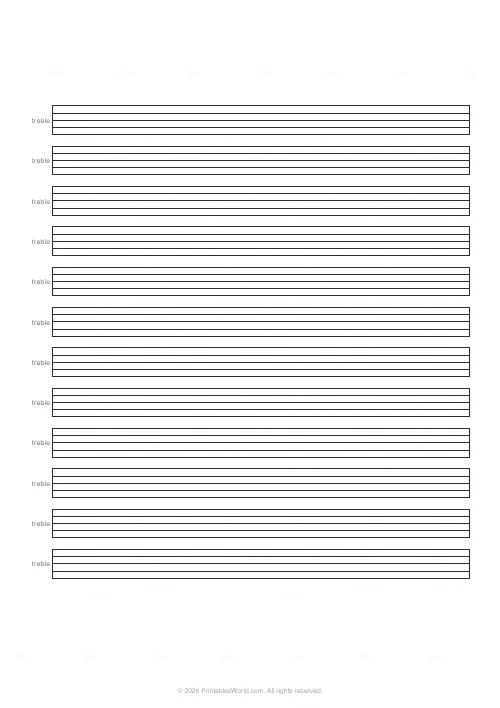
Music Staff Paper
Five-line stave manuscript paper with selectable staves and clef label.
Lined Paper Generator
Generate custom ruled paper PDFs with adjustable line spacing, colours, margins, and primary ruling styles.
Graph Paper Generator
Create custom graph paper PDFs with square or rectangular grids, dot styles, and axis numbering.
Cornell Notes Template
Classic Cornell note-taking layout with cue column and summary.
Ukulele Tab Paper
Blank 4-line ukulele tablature with measure bars.
Further reading
Printable Paper
Bullet journalling with dot grid paper: a starter guide
The bullet journal was designed to be fast, not beautiful. Here is the original system, why dot grid suits it better than lines or blank, and the four pages you actually need.
5 min read
Printable Paper
Music manuscript paper: a guide for musicians
The number of staves on a page is not a style choice. It decides how much music fits and how legible it is at a music stand.
4 min read