What this tool does
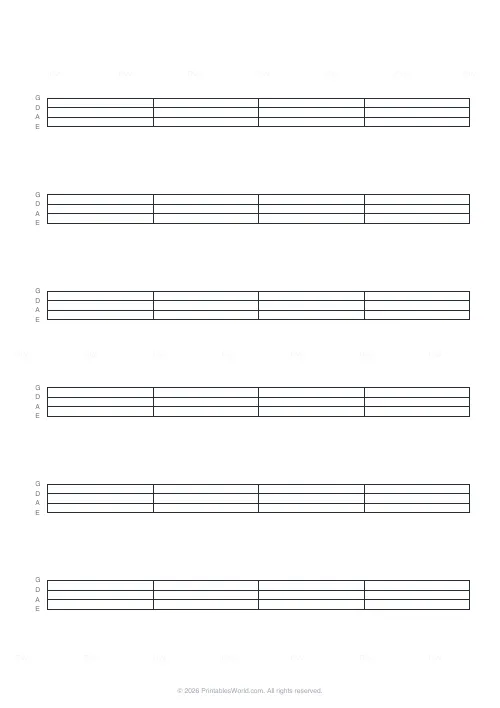
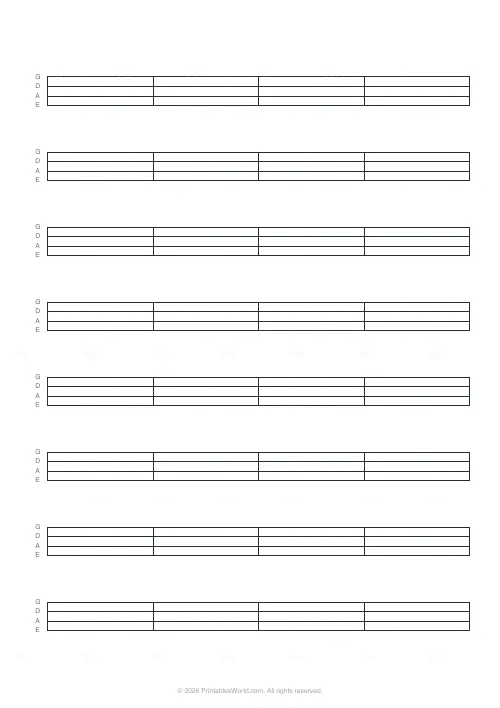
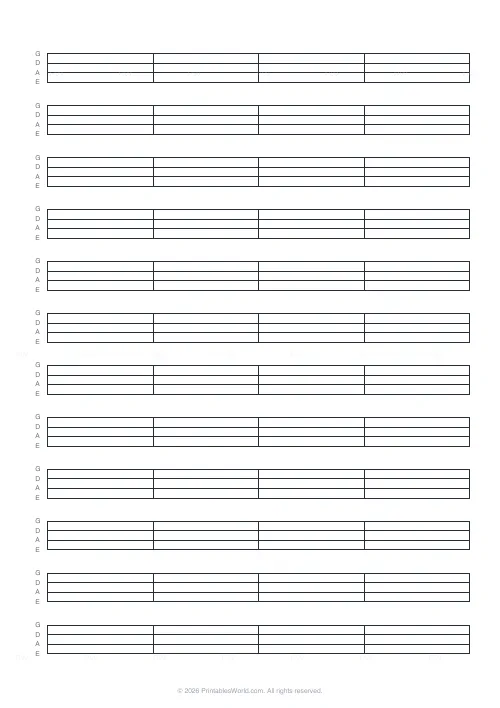
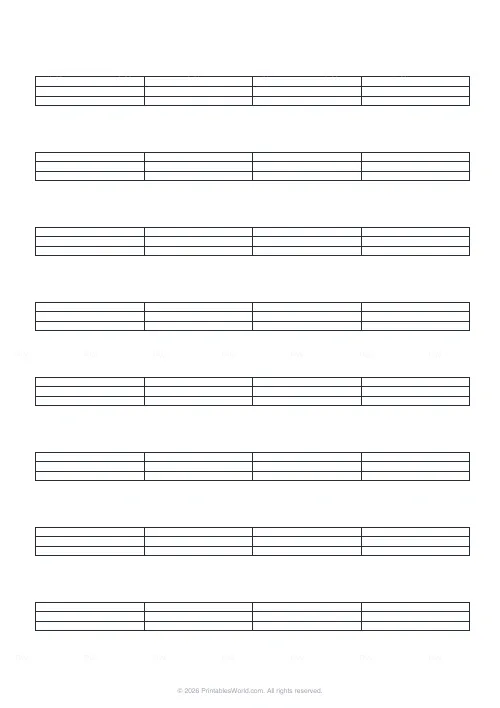
Blank four-line bass tab paper, strings labelled G, D, A and E. 6 to 12 staves a page, 0 to 8 measure bars each, tuning labels optional.
People also used
Feedback
Spotted something off with this tool?
Four lines, top string first
Each stave is four horizontal lines, labelled from the top down: G, D, A, E. Eight staves a page by default, anywhere from six to twelve, with up to eight measure bars dividing each one. The tuning labels can be switched off once you no longer need them.
The top line is the thinnest string
This catches everyone. Get it straight before you write anything down.
Tab is drawn as if you are looking down at the fretboard while holding the instrument, so the G string — the thinnest, highest-sounding one — is at the top of the stave and the fat low E is at the bottom. That is upside down relative to how the strings sit when you look at the bass in your lap, and a tab written the wrong way up is not merely wrong, it is silently wrong.
Numbers are frets, not fingers
A 5 on the A string means the fifth fret of the A string. It does not mean your fifth finger, and it does not mean a note name.
Zero is an open string. Stacked numbers are played together, and numbers running left to right are played in sequence.
What tab does not tell you
Rhythm. That is the honest limitation of the notation, and the reason tab and standard notation coexist instead of one replacing the other.
Tab tells you exactly where to put your fingers and nothing at all about how long to hold them, so a tab of a piece you have never heard is close to unusable. Most players work around it by writing rhythm slashes or note stems above the stave, or by simply knowing the song already.
Write the count above the stave if the piece is unfamiliar. It takes seconds and it is the difference between a transcription you can read next month and one you cannot.
Measure bars
Four to a stave suits most rock and pop. Go lower for something dense, where one busy bar needs room for slides and hammer-ons as well as the numbers.
Set it to zero for a continuous stave with no divisions, which suits scale and exercise work where bars mean nothing.
What people write on it
Lines transcribed off recordings, which is how most bassists learn. Original parts. Scale and arpeggio patterns. Exercises from a teacher, written out in the lesson.
Five strings? This sheet is four-line, so a low B has nowhere to go — mark it in the margin, or use standard music staff paper instead.
Related: guitar tab paper has six lines, and ukulele tab has four tuned G, C, E, A.
FAQs
Quick answers
Why are the lines labelled G, D, A, E?
Those are the four strings of a standard bass guitar, read from the top line to the bottom line of the tab. The high G string is at the top and the low E string is at the bottom. You write a fret number on a line to show which string to play and where to press.
Can I hide the tuning labels?
Yes. Turn off the tuning labels and the staves print with no G D A E letters, leaving a clean grid of four-line staves and measure bars.
What do the measure bars do?
The light vertical bar lines divide each stave into equal measures so your rhythm stays organised. You can set anywhere from 0 to 8 bars per stave, and choosing 0 gives you open staves with no internal dividers.
How many staves fit on a page?
You choose between 6 and 12 staves per page, and the sheet spaces them evenly to fill the page. Fewer staves give you more room to write; more staves fit a longer piece on a single sheet.
Is this for four-string or five-string bass?
This template is for standard four-string bass, so each stave has four lines. If you play five-string bass you can still use it and simply add the low B notes above the top line by hand.
Is the paper blank or does it include notes?
It is completely blank. The tool only prints empty labelled staves with optional measure bars so you can write your own fret numbers, riffs, and bass lines by hand.
Will it print correctly on A4 and US Letter?
Yes. Both A4 and US Letter are supported and the stave spacing stays consistent on each. Print at 100% scale with "fit to page" turned off for the cleanest, most consistent results.
Related tools
Guitar Tab Paper
Six-line guitar tablature paper with string labels.
Ukulele Tab Paper
Blank 4-line ukulele tablature with measure bars.
Music Staff Paper
Five-line stave manuscript paper with selectable staves and clef label.
Lined Paper Generator
Generate custom ruled paper PDFs with adjustable line spacing, colours, margins, and primary ruling styles.
Chord Chart Sheets
Blank chord-diagram boxes for guitar and ukulele.
Further reading