What this tool does
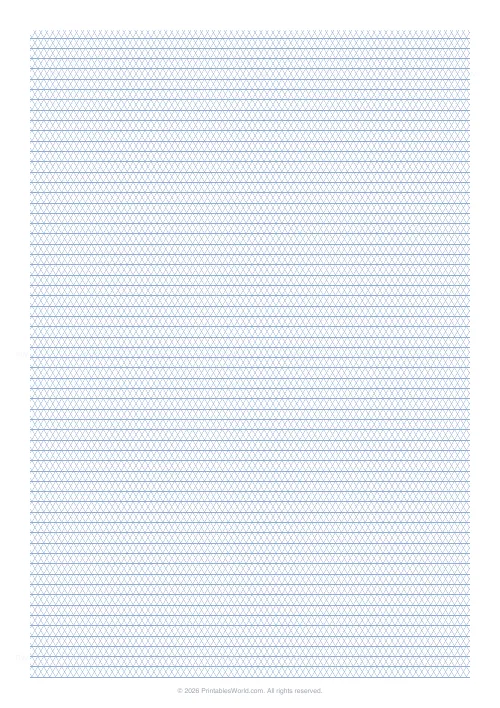
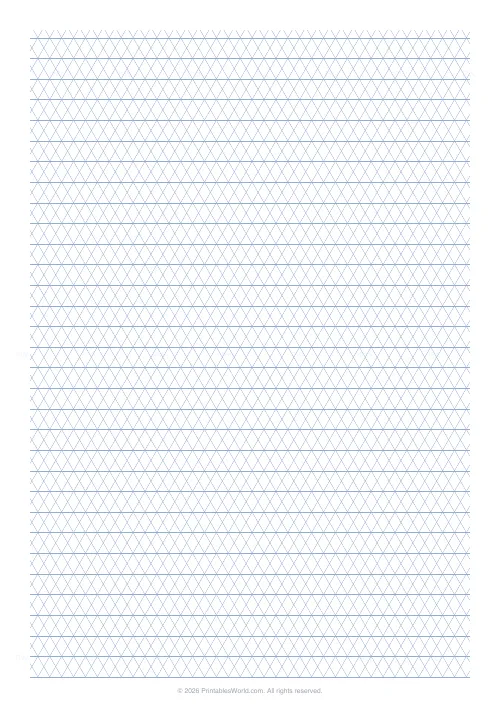
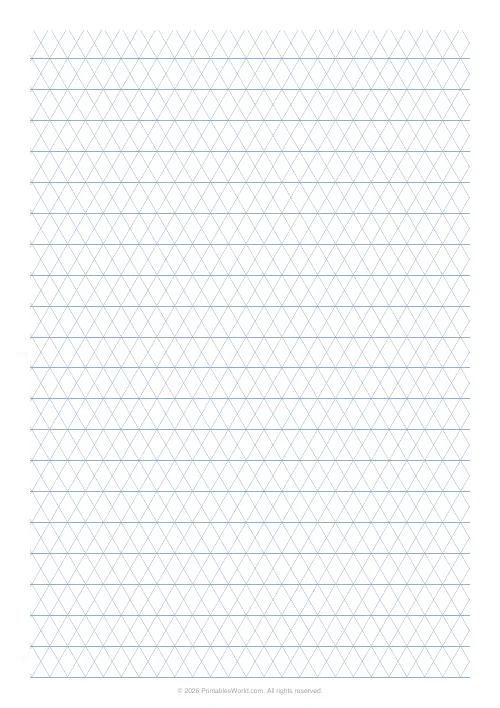
A full mesh of equilateral triangles from three line families at 0°, 60° and 120°. Triangle side 5 to 20 mm, in a light or medium line weight.
People also used
Feedback
Spotted something off with this tool?
Every edge drawn, not just the corners
Three families of parallel lines cross to make a complete mesh of equilateral triangles: one horizontal, one at 60 degrees, one at 120. Set the side length anywhere from 5 to 20 mm.
This is the difference from isometric dot paper, where only the vertices are marked and every line is imagined. Here the lines are printed, so you draw along them rather than between dots.
Which of the two you want
Printed edges suit anything where the triangle itself is the unit: tessellation work, triangular tiling patterns, quilting layouts, and geometry where you need to see the shape rather than construct it.
Dots suit isometric drawing, where the grid is scaffolding for something else and printed lines get in the way of the object. If you are drawing a cube, the last thing you want is a mesh through it.
So: triangles for pattern work, dots for drawing. They look similar and are not interchangeable.
The 60-degree property that makes it useful
Every angle in the grid is a multiple of 30 degrees, and every line runs in one of three directions. That means an equilateral triangle, a rhombus, a hexagon and a trapezium can all be drawn accurately without a protractor — you follow the lines.
It is also why hexagons appear for free. Six triangles round a point make one. Children discover that on this paper rather than being told it, and afterwards the honeycomb, the snowflake and the hexagonal floor tile have stopped being three separate facts.
Choosing a size
Ten millimetres is the default and covers most classroom work. Five gives fine detail on a busy page. Useful for a tessellation design, hard on the eye for anything longer.
Twenty is generous, and it is the one to use with younger children or for a diagram that will be photographed or shown on a screen.
Line weight
Light keeps the grid quiet underneath a drawing. Medium makes it part of the finished page.
Pick light if the grid is a tool and medium if it is the point. For anything being scanned or photocopied, light can disappear entirely, so test one page before printing thirty.
Where it gets used
Maths: tessellation, angle work, area by counting triangles, hexagonal number patterns.
Outside maths: quilting and patchwork layouts, charts for knitting or beadwork on a triangular grid, pattern design generally. Also board-game maps — a hex map is drawn on exactly this paper.
Print at 100% on A4, US Letter or US Legal. At 100% the triangle side really is the millimetres you asked for, which matters the moment you are measuring anything on it.
FAQs
Quick answers
What is triangular grid paper?
It's a sheet tiled edge-to-edge with equilateral triangles, drawn from three line families at 0°, 60° and 120°. Every triangle edge is printed, so you can colour, cut and trace individual triangles.
How is it different from isometric grid paper?
They share the same lattice of points. Isometric grid paper is tuned for sketching 3D solids along three axes; triangular grid paper foregrounds the triangle faces themselves, which suits tessellations, quilting and geometry.
What triangle sizes can I choose?
Any side length from 5 mm to 20 mm. Around 5–7 mm is fine and dense, 10 mm is the everyday default, and 15–20 mm gives roomy cells for young learners and bold pattern work.
Can I change the line weight?
Yes. Light keeps the grid quiet so it sits behind your own marks; Medium makes the mesh read more clearly for tracing and cutting.
Will the triangles stay the exact size I pick?
Yes, as long as you print at 100% scale with 'fit to page' turned off. The side length is held exact across A4, US Letter and US Legal.
What is it good for?
Tessellation art, quilt and beadwork planning, geometric pattern design, symmetry and area lessons, low-poly illustration, and triangular-tile game boards.
Does it print on A4 and US Letter?
Yes. A4, US Letter and US Legal are all supported, with the triangle size kept constant across them.
Related tools
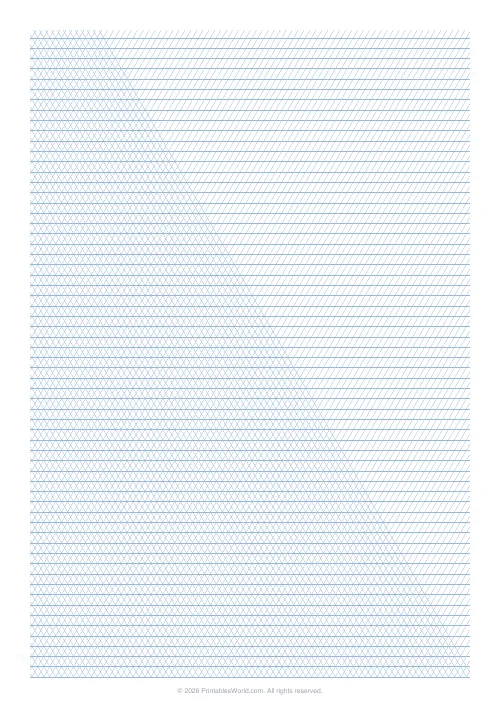
Isometric Grid Paper
Triangular line grid at 30°/60° for isometric drawing.
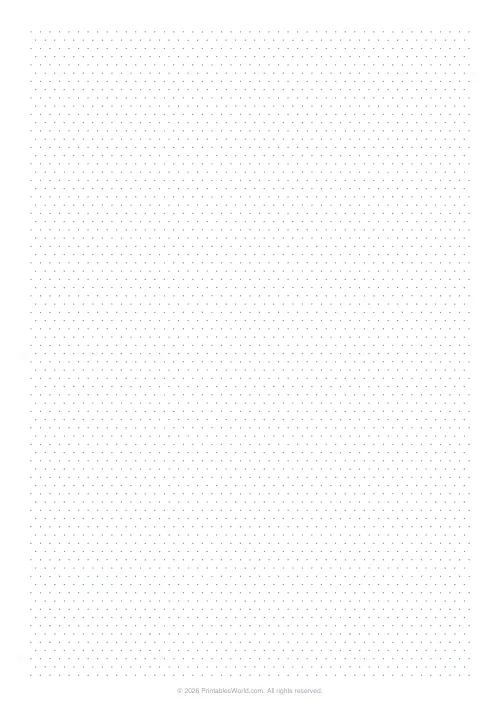
Isometric Dot Paper
Triangular dot grid for sketching 3D shapes and isometric art.
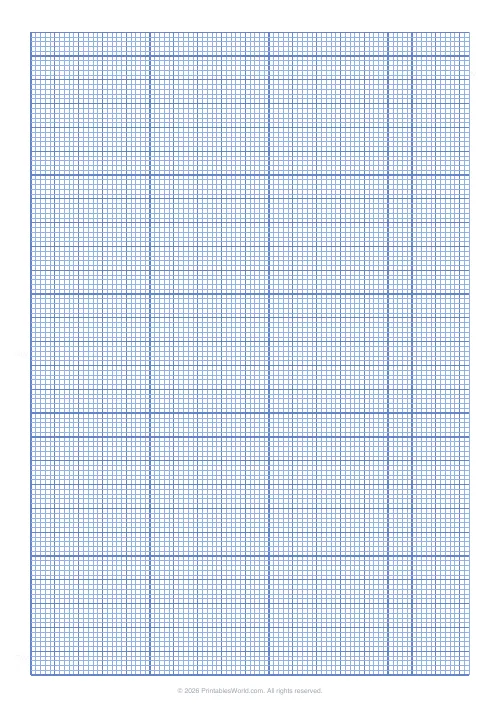
Graph Paper Generator
Create custom graph paper PDFs with square or rectangular grids, dot styles, and axis numbering.
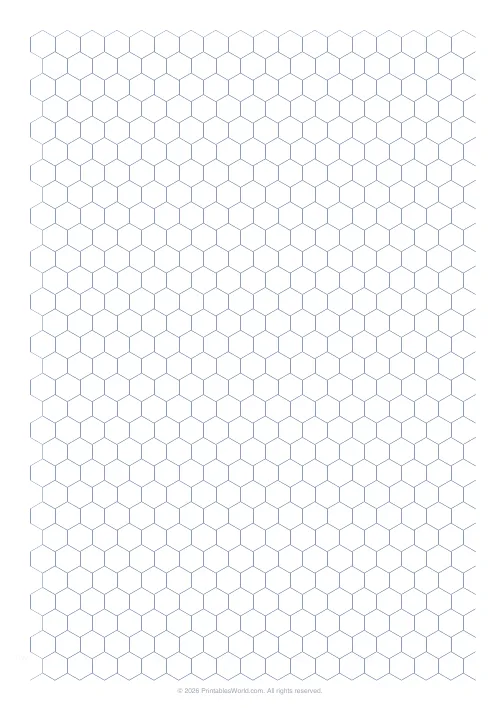
Hex Grid Paper
Hexagonal grid for board game design, mapping, and strategy games.
Further reading
Printable Paper
Bullet journalling with dot grid paper: a starter guide
The bullet journal was designed to be fast, not beautiful. Here is the original system, why dot grid suits it better than lines or blank, and the four pages you actually need.
5 min read
Printable Paper
Graph paper sizes: which grid for which task
What graph paper sizes and grid spacings mean, how to match a grid to maths, art or design, and how to set it all in the free graph paper generator.
7 min read
Printable Paper
The best note-taking paper for students (Cornell, grid, lined)
The paper you take notes on quietly decides how you review them. Here is what each format is actually for, and which subjects each suits.
4 min read