What this tool does
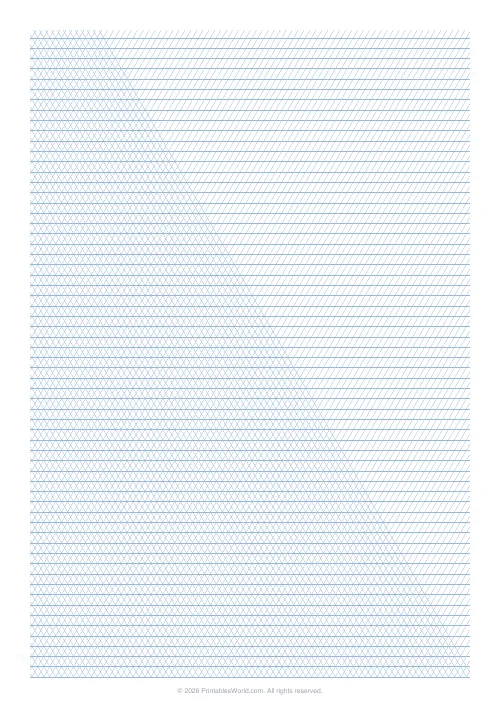
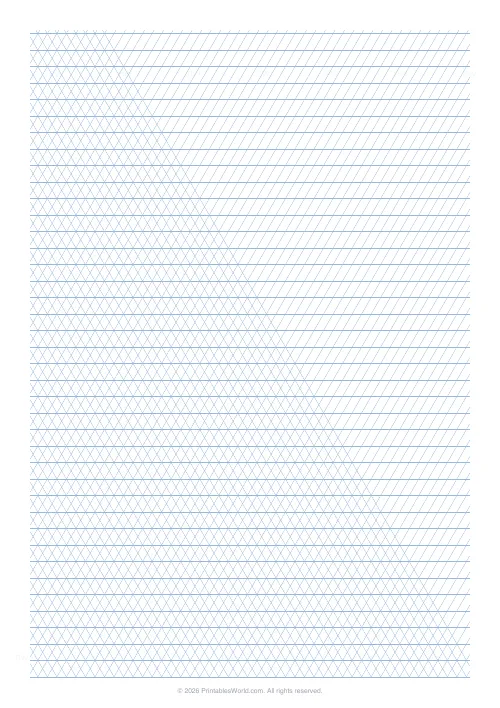
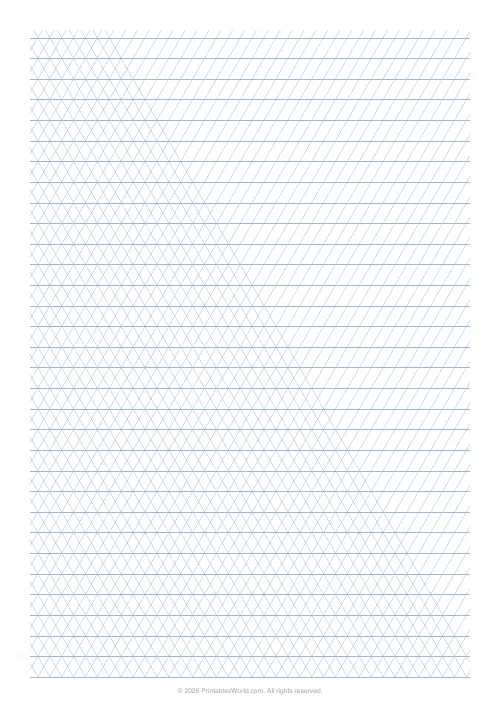
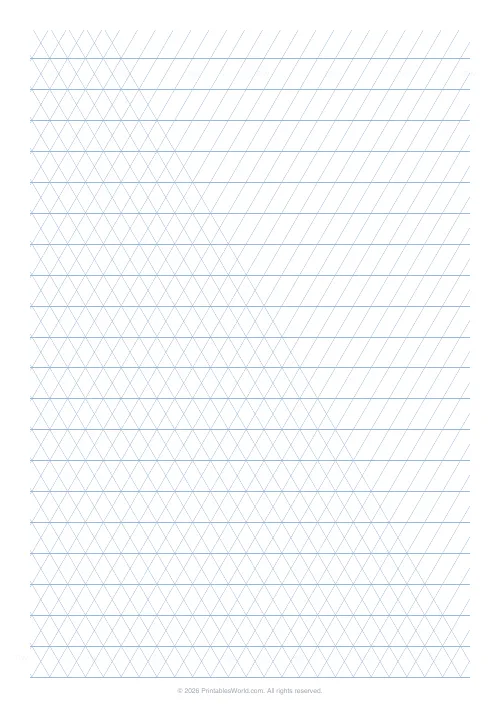
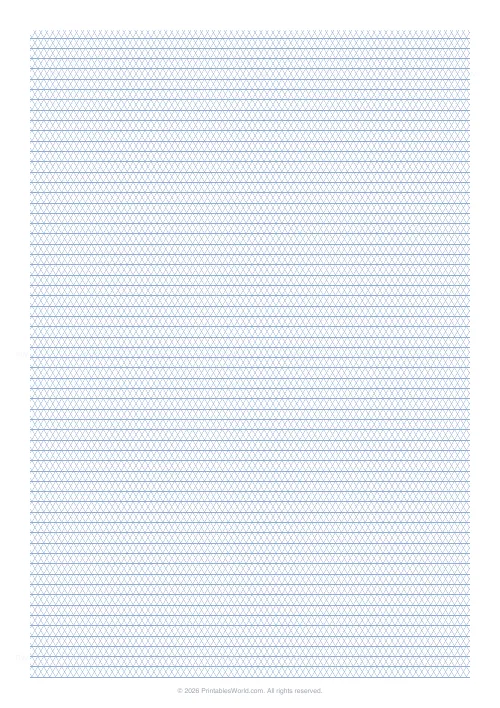
A full triangular mesh from three line families at 0, 60 and 120 degrees. Every edge printed, at your chosen triangle edge length.
People also used
Feedback
Spotted something off with this tool?
The complete mesh
Three families of parallel lines, crossing to tile the page with equilateral triangles. Set the edge length. Print.
Every triangle edge is drawn, which is the difference from isometric dot paper, where only the vertices are marked.
Which one you want
Lines suit work where the triangles are the subject. Tiling patterns, tessellation, anything you want to colour in, and any layout at all where following an existing line beats judging a distance between two dots by eye.
Dots suit drawing. There the grid is scaffolding, and a cube drawn on lined isometric paper ends up with a mesh running through every one of its faces, competing with the drawing in a way that a field of dots never does.
So: lines for patterns, dots for objects. They look similar and they are not interchangeable, and picking the wrong one is the commonest complaint about both.
Every angle is a multiple of 30 degrees
Which is what makes this paper worth having in a maths lesson.
An equilateral triangle, a rhombus, a trapezium and a regular hexagon can all be drawn accurately without a protractor, because you follow lines that are already at the right angle. Hexagons in particular come free — six triangles around any point make one, and children find that themselves rather than being told.
It is also the paper for showing that equilateral triangles tessellate, that hexagons do, and that pentagons do not, all on the same page.
Edge length
Ten millimetres is the default and suits most work. Smaller gives you fine detail on a busy page — right for a tessellation design, hard on the eye for anything sustained.
Go larger for younger children, and for any diagram that will be photographed or projected.
Where it turns up outside maths
Quilting and patchwork, where the triangle is a standard block. Knitting and beadwork charts. Pattern and textile design generally, where a 60-degree repeat is close to the entire vocabulary of the craft and this sheet gives it to you for nothing.
And hex map making — a hexagonal grid is exactly this triangular one with two thirds of the lines removed, so a hex map can be laid out on this paper and traced.
Print at 100% on A4, US Letter or US Legal. At any other scale the edge is no longer the length you set, which matters the moment anything is measured.
FAQs
Quick answers
What is isometric grid paper?
A triangular line grid where three line families cross at every vertex. Perfect for isometric (3D) sketching.
How big are the triangles?
Choose 7 mm, 10 mm, or 14 mm edge length depending on the level of detail you need.
Should I use lines or dots?
Lines are great for technical drawing where you trace edges; dots leave more room for shading and detail.
Will it work on US Letter?
Yes. A4, US Letter, and US Legal are supported.
Related tools

Isometric Dot Paper
Triangular dot grid for sketching 3D shapes and isometric art.
Hex Grid Paper
Hexagonal grid for board game design, mapping, and strategy games.
Engineering Paper
Classic green-tinted engineering grid for technical work.
Perspective Drawing Grid
Printable one-point and two-point perspective guides with a horizon line, vanishing points, and radiating guide lines.
Triangular Grid Paper
Full equilateral-triangle mesh with three line families at 0°, 60° and 120°.
Further reading
Printable Paper
Bullet journalling with dot grid paper: a starter guide
The bullet journal was designed to be fast, not beautiful. Here is the original system, why dot grid suits it better than lines or blank, and the four pages you actually need.
5 min read
Printable Paper
Graph paper sizes: which grid for which task
What graph paper sizes and grid spacings mean, how to match a grid to maths, art or design, and how to set it all in the free graph paper generator.
7 min read
Printable Paper
The best note-taking paper for students (Cornell, grid, lined)
The paper you take notes on quietly decides how you review them. Here is what each format is actually for, and which subjects each suits.
4 min read