What this tool does
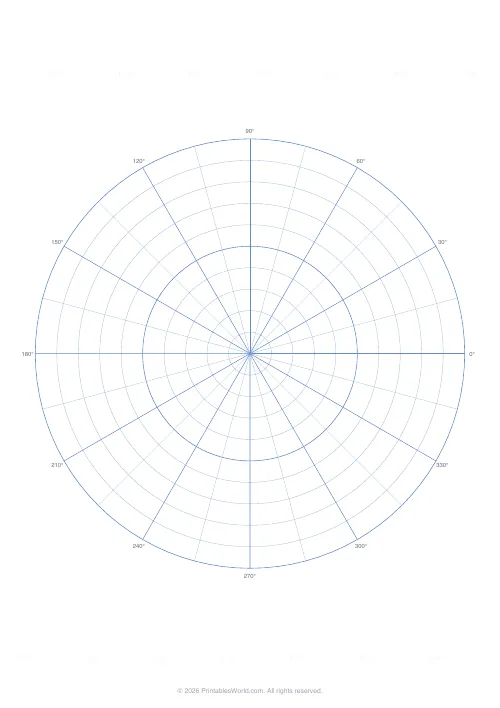
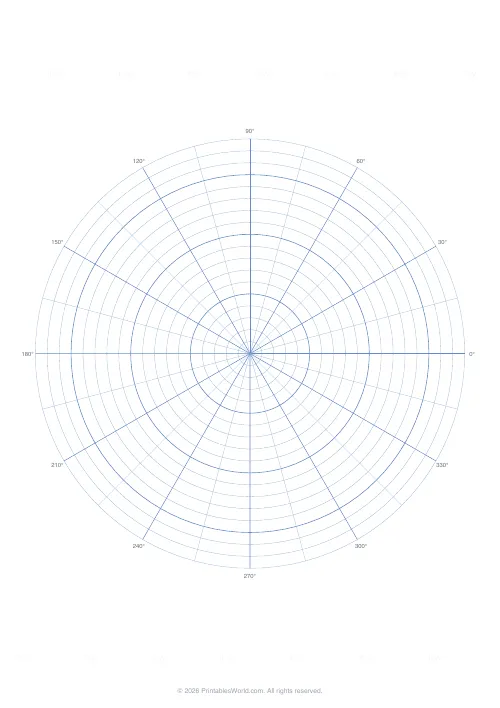
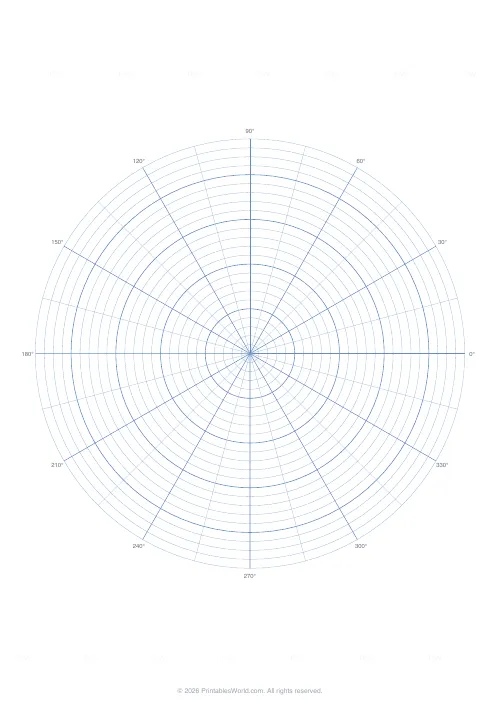
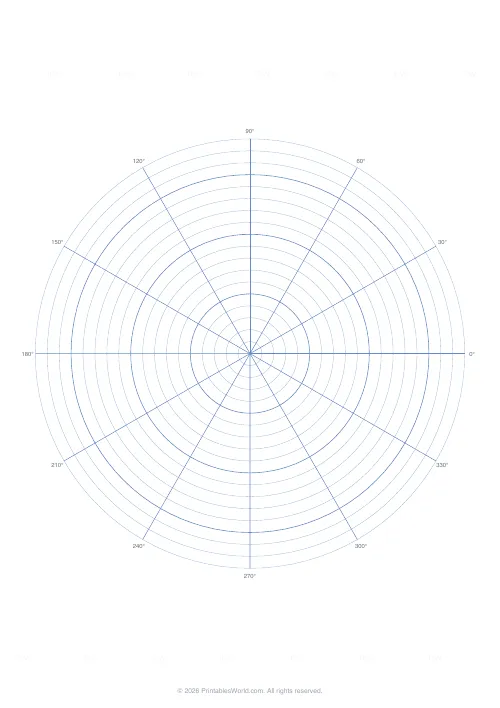
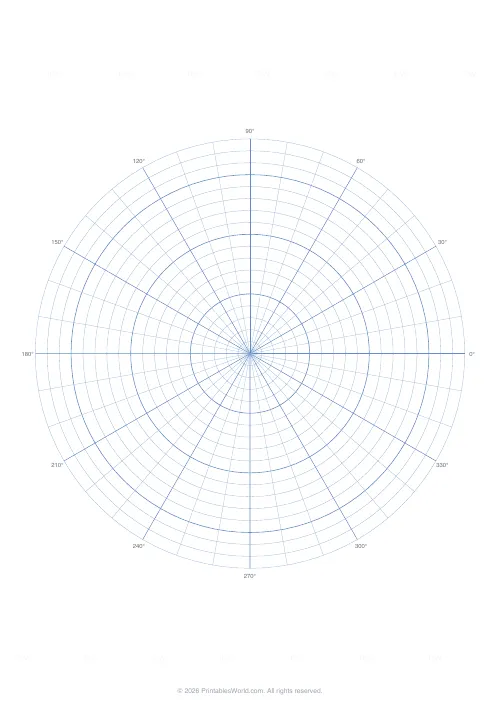
Polar coordinate paper: concentric rings crossed by radial spokes, with the angles labelled. Ring and spoke counts are both adjustable.
People also used
Feedback
Spotted something off with this tool?
Rings and spokes
Concentric circles crossed by lines radiating from the centre. Choose how many of each — 24 spokes puts one every 15 degrees, 12 puts one every 30 — and the angles are labelled around the edge.
A different way of naming a point
Cartesian paper locates a point by how far across and how far up. Polar paper locates it by how far out and at what angle.
Both describe the same plane, and each makes different things easy. A straight line is trivial in Cartesian coordinates and awkward in polar; a circle is the reverse — on this paper a circle of radius 5 is simply "r = 5", which needs no working at all.
Anything built around a centre is easier here — rotation, radiation, anything that repeats its way around — and that covers a surprising amount.
The curves worth plotting
Polar equations produce shapes that are difficult to reach any other way, and plotting one by hand on this paper is the fastest route to understanding why.
r = a is a circle. r = θ is an Archimedean spiral, the shape of a coiled rope. r = a(1 + cos θ) is a cardioid, which is heart-shaped and turns up in microphone pickup patterns. r = a·cos(nθ) gives a rose with n petals if n is odd and 2n if n is even, which is a genuinely surprising result and one students remember.
Plot the rose by hand once. It is worth the twenty minutes.
Choosing spoke count
Twelve spokes, one every 30 degrees, keeps the page clear and covers the angles most trigonometry uses.
Twenty-four, every 15 degrees, gives more resolution and a busier sheet. For plotting a curve rather than a handful of points, more spokes is better; for a diagram somebody has to read, fewer is.
Beyond mathematics
Radar and wind-rose plots, where direction and magnitude are the two variables. Antenna and speaker polar patterns. Circular timetables and 24-hour clock diagrams. Radial charts of anything cyclical — a year, a day, a tide.
Also design work: mandalas, rose windows, anything with rotational symmetry. The spokes give you the divisions and the rings give you the proportions.
Print at 100% on A4, US Letter or US Legal.
FAQs
Quick answers
What is polar paper used for?
Plotting polar functions, complex numbers, antenna patterns, and any data with circular symmetry.
How many rings should I pick?
12 for sketches, 18 for general work, 24 if you need fine radial resolution.
Are angles labelled?
Yes. Every 30° around the outer circle.
Will it print on A4?
Yes. A4, US Letter, and US Legal are supported.
Related tools
Further reading