What this tool does
Enter a cartridge's price and rated page yield to get the cost per page, then optionally enter a project's page count to see how many cartridges you'll need and the total cost.
People also used
Print Cost Estimator
Estimate the per-job cost of printing based on pages, paper, ink, and quantity.
Ink Coverage Estimator
Estimate ink usage in millilitres and cost from CMYK page coverage.
Print Quality Reference Guide
A printable reference for DPI standards, paper weights, bleed defaults, and common pitfalls.
Feedback
Spotted something off with this tool?
Know your true cost per printed page
The sticker price of a printer rarely tells you what printing actually costs, the cartridges do. This calculator turns a cartridge's price and rated yield into a cost per page, the number that lets you compare ink against toner, genuine against compatible, and standard against high-yield cartridges fairly. Enter the price and the rated yield, and optionally a project size, to see cost per page, cartridges needed, and total cost.
Why cost per page matters more than cartridge price
A cheaper cartridge with a low yield can cost more per page than a pricier high-yield one. Cost per page is simply cartridge price divided by rated yield. Comparing that single figure across options reveals the real running cost. High-yield (XL) cartridges almost always win on cost per page even though they cost more up front.
- Inkjet colour: often $0.05–$0.15 per page.
- Inkjet black: often $0.02–$0.05 per page.
- Laser/toner: frequently under $0.03 per page mono.
How people use it
- Enter the cartridge price and its rated page yield (printed on the box or spec sheet).
- Read the cost per page.
- Optionally enter a project's total pages to see cartridges needed and total cost.
- Repeat for a second cartridge to compare options on cost per page.
Why the rated yield is optimistic
- Rated yields assume about 5% page coverage (the ISO standard). Heavy graphics, photos, or dense text use far more, so real-world yield is lower.
- Colour pages draw from several cartridges at once; mono-only printing is cheaper per page.
- This estimates consumable cost only. It excludes the printer, paper, and electricity.
What "page yield" actually means
Cartridge yields are quoted against a standard, usually ISO/IEC 24711 for inkjets, which measures pages at roughly 5% coverage — about the density of a short double-spaced letter.
Almost nothing real is 5% coverage. A worksheet with a grid, a photograph, or any page with a coloured header uses far more, so a cartridge rated at 300 pages may deliver a fraction of that on the work you actually print.
The standard is still useful, because it is consistent: it lets you compare two cartridges fairly. It is simply not a prediction of how many of your pages you will get. Treat quoted yields as a comparison figure and your own observed count as the truth.
The costs the sticker price hides
Cost per page is the number that matters, and several things push it above the simple cartridge-price-divided-by-yield figure.
- Cleaning cycles. Inkjets use ink to maintain the print head, including when idle. A printer used occasionally can consume a noticeable share of a cartridge on maintenance alone.
- Colour used for black. Many printers mix colour inks into composite blacks unless told otherwise, so colour cartridges drain on mono documents.
- The starter cartridge. Cartridges shipped with a new printer are often lower yield than the replacements, which makes the first refill arrive sooner than expected.
- Drum and waste units. On lasers these are consumables with their own replacement cost, separate from toner.
Reducing cost per page
- Buy XL cartridges. Almost always a lower cost per page than standard capacity, provided you print enough to use them before they dry out.
- Print draft or economy mode for anything internal. Often a large saving for a small quality drop.
- Set greyscale as the default so colour is a deliberate choice rather than an accident.
- Print double-sided — halves the paper, which is a real part of the per-page cost.
- Leave the printer on if you print regularly. Powering an inkjet up and down triggers cleaning cycles.
- Compare laser against inkjet honestly for volume mono work. Lasers cost more upfront and usually far less per page.
Third-party and refilled cartridges cut the headline cost substantially, with the trade-off of variable quality and possible warranty implications — worth knowing before deciding, rather than after.
A worked comparison
Two black cartridges for the same printer:
- Standard: £18 for 250 pages → 7.2p per page
- XL: £29 for 600 pages → 4.8p per page
The XL costs 60% more and delivers 140% more pages, so it is a third cheaper per page. Over 600 pages that is roughly £14 saved.
Now add paper at about 1p per sheet, and mono cost per page becomes 5.8p with the XL against 8.2p with the standard. Printing 600 pages double-sided saves another 150 sheets' worth.
The point of running the numbers is that the cheaper cartridge on the shelf is usually the more expensive one to own — and the gap widens the more you print.
FAQs
Quick answers
How is cost per page calculated?
Divide the cartridge price by its rated page yield. A $40 cartridge rated for 500 pages costs 8 cents per page. Lower is better when comparing options.
Why is my real yield lower than the rating?
Rated yields assume about 5% coverage per page (the ISO test standard). Photos, bold graphics, and dense text use much more ink or toner, so you get fewer pages in practice.
Are high-yield (XL) cartridges cheaper?
Almost always on a cost-per-page basis. They cost more up front but the price per page is usually lower, so they pay off if you print regularly.
Is toner cheaper than ink?
For mono printing, laser toner is usually cheaper per page and lasts longer between changes. Inkjets can be competitive for colour and photos but cost more per page for text volume.
Related tools
Print Cost Estimator
Estimate the per-job cost of printing based on pages, paper, ink, and quantity.
Ink Coverage Estimator
Estimate ink usage in millilitres and cost from CMYK page coverage.
Print Quality Reference Guide
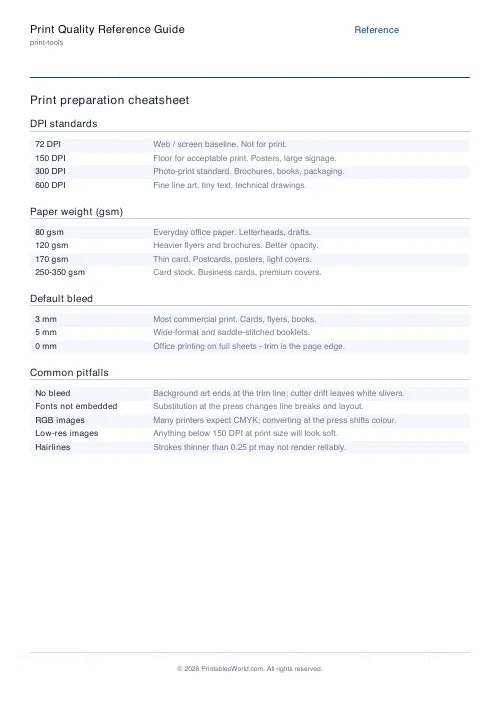
A printable reference for DPI standards, paper weights, bleed defaults, and common pitfalls.