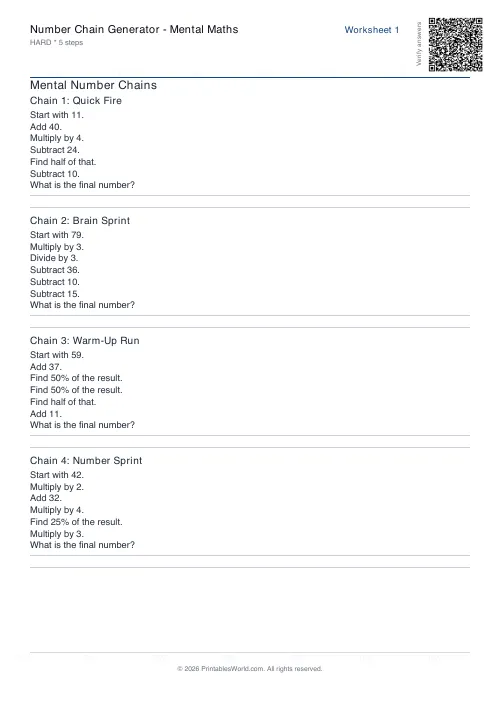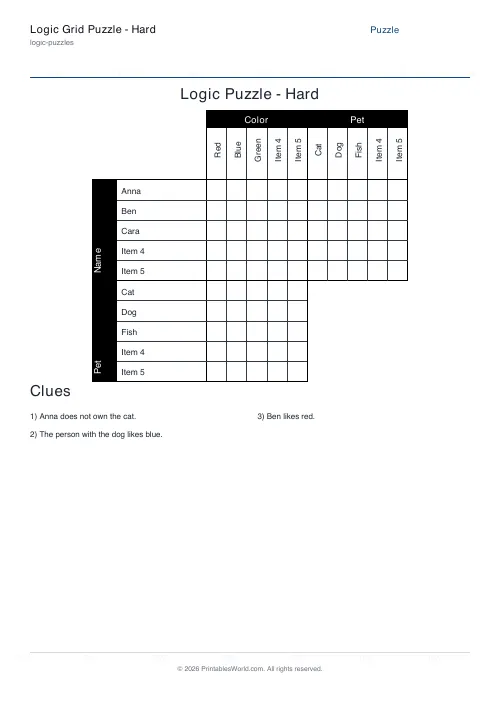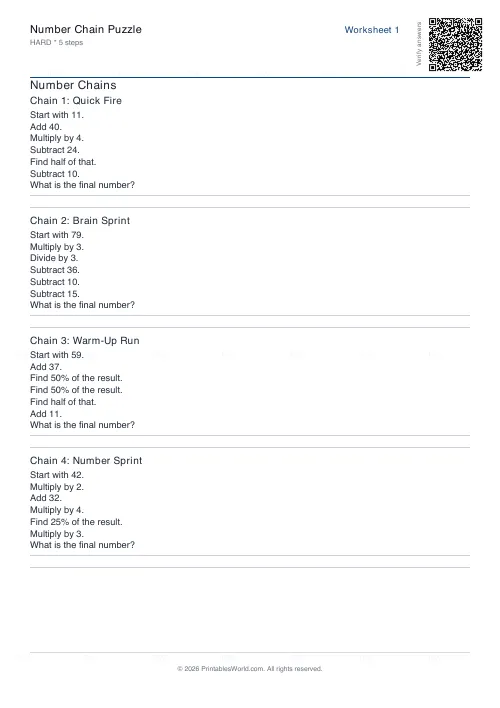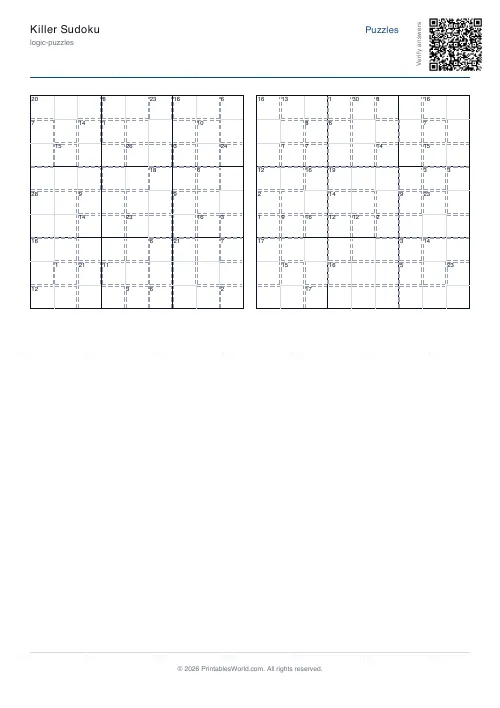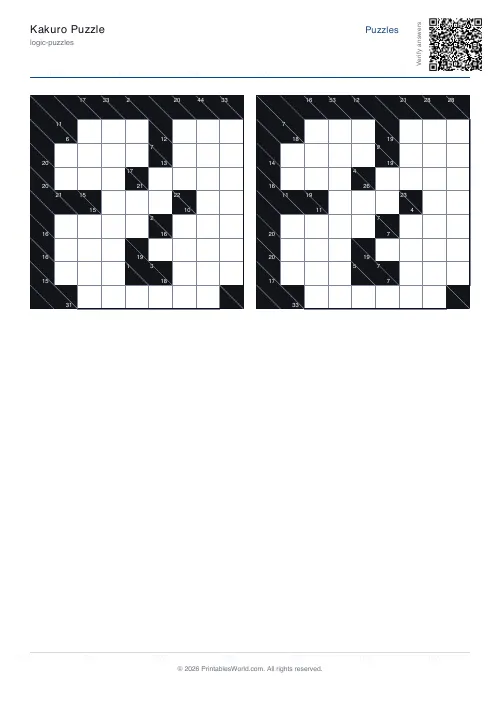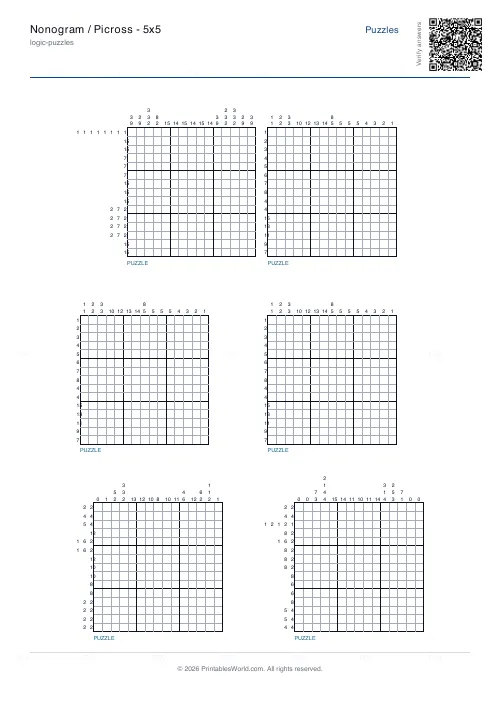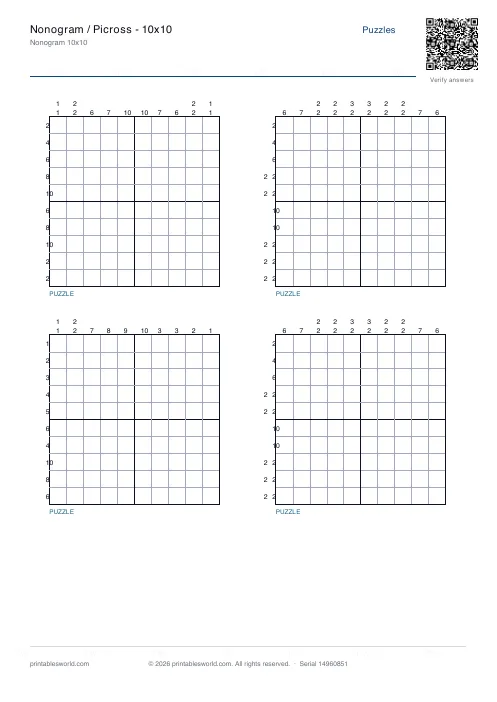
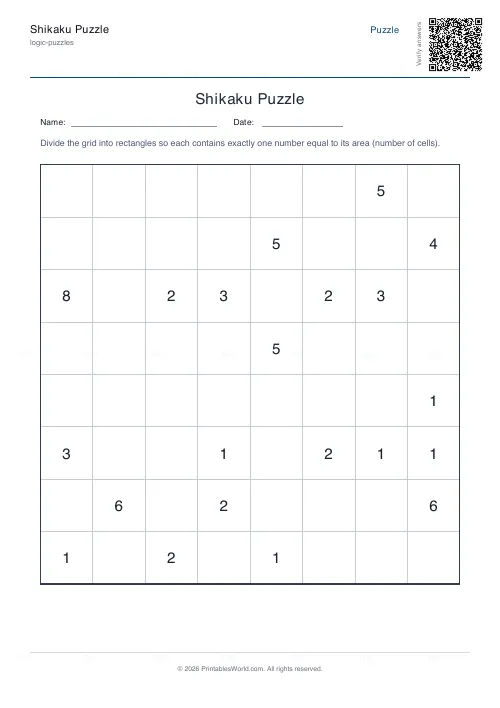
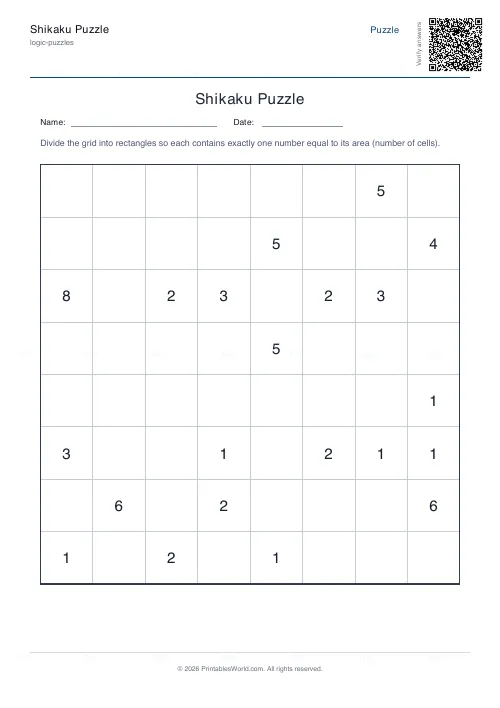
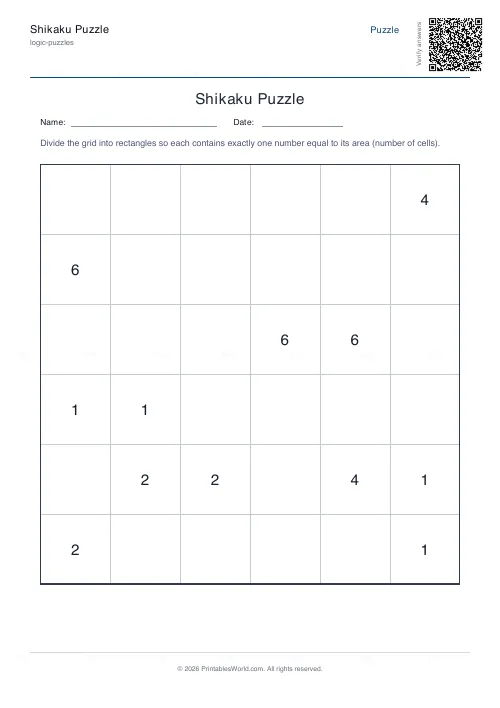
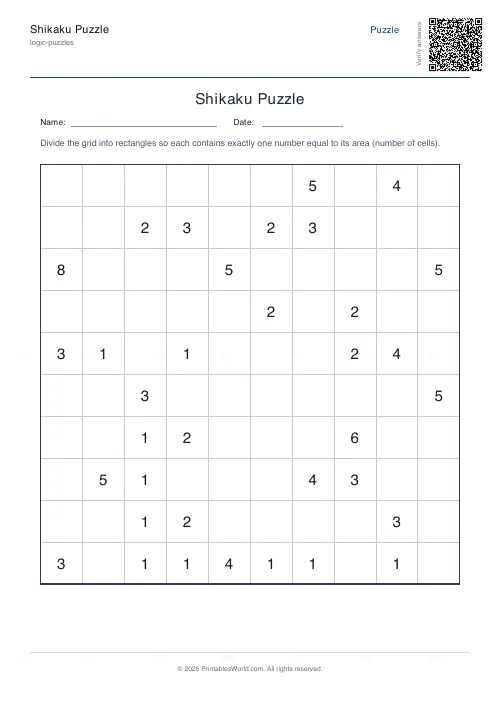
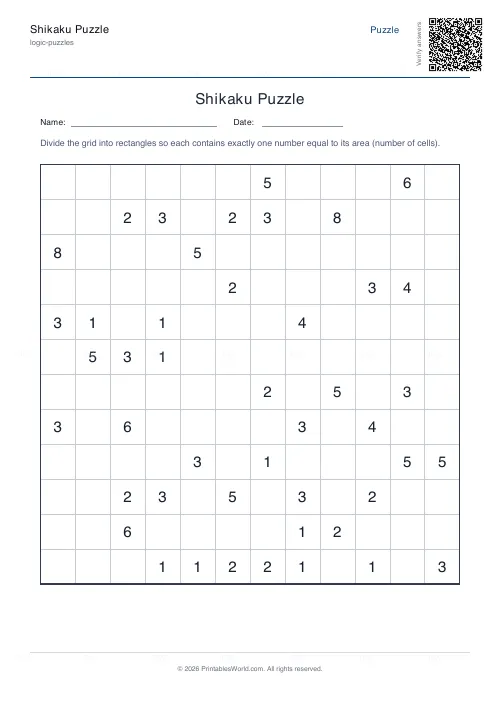
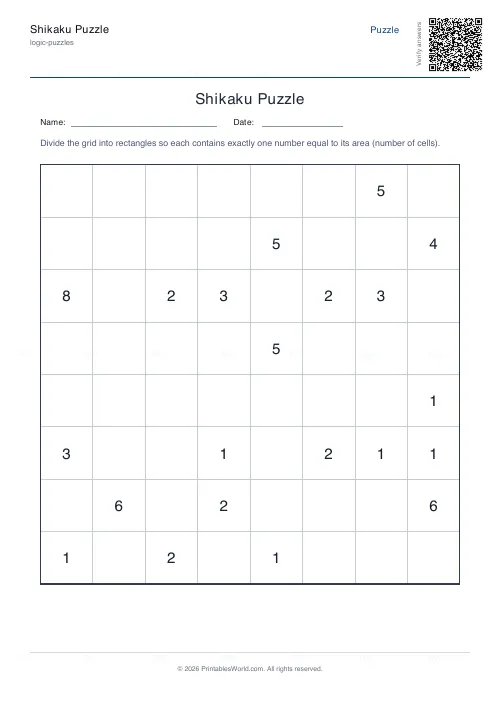
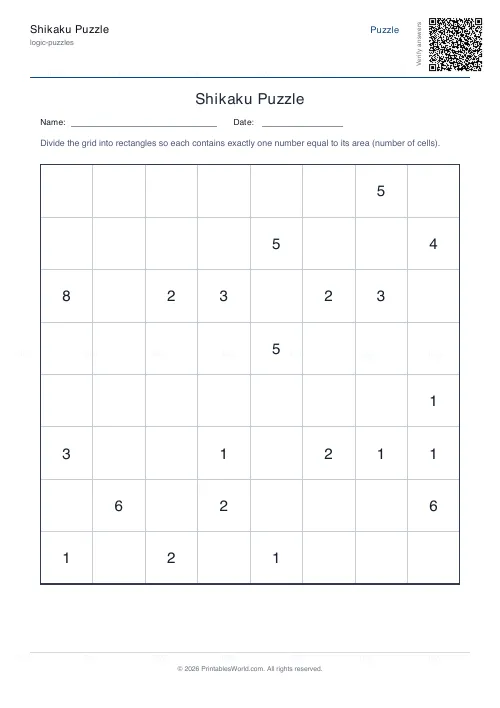
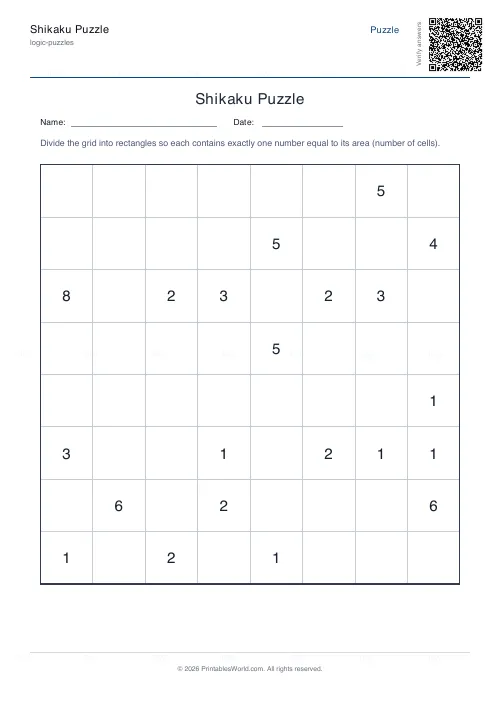
What this tool does
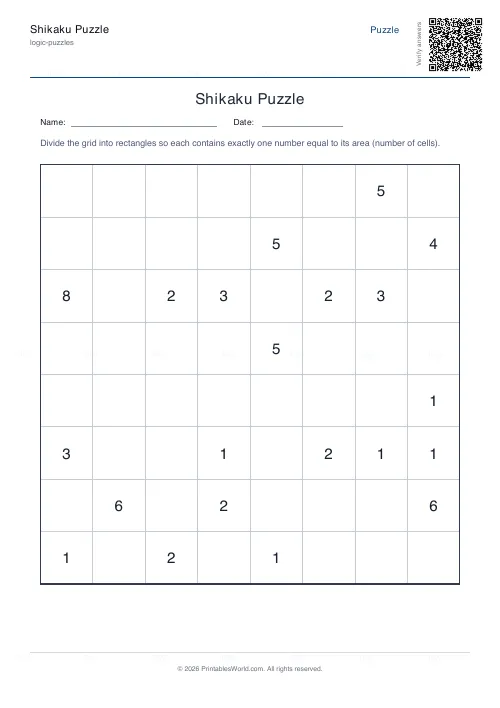
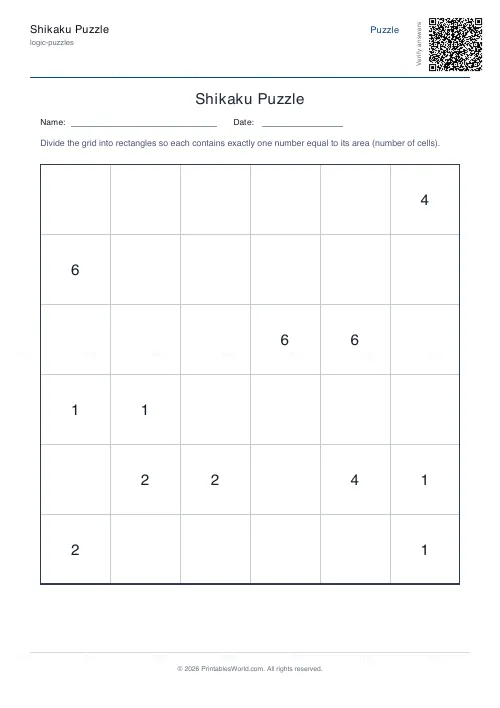
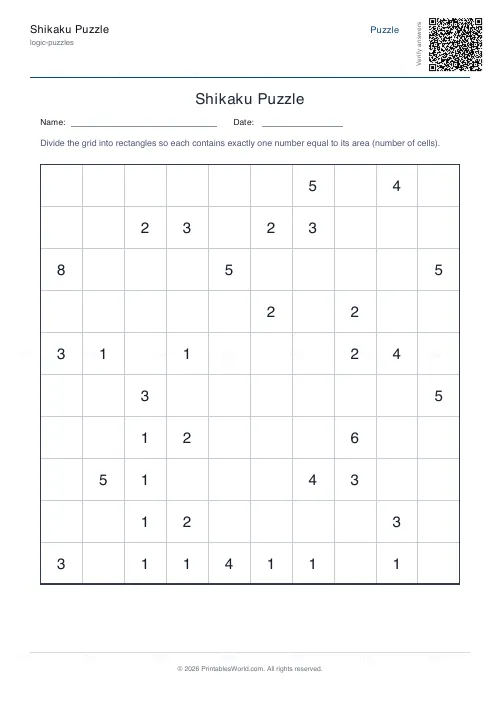
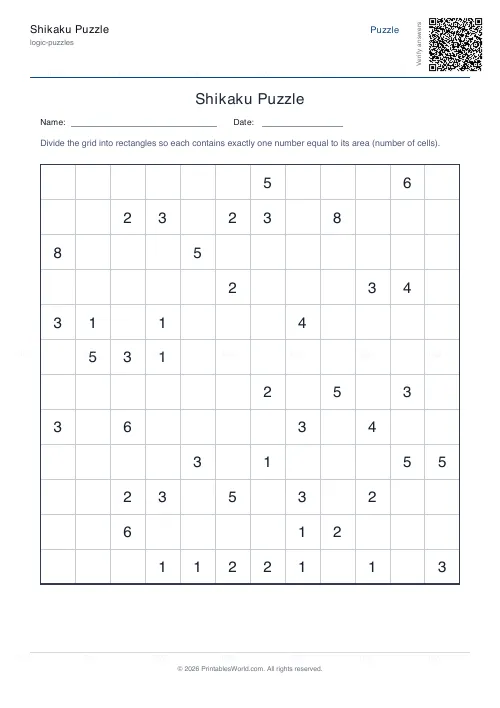
Generate printable Shikaku (Divide by Squares) puzzles. Each grid is split into rectangles, and every rectangle holds exactly one number equal to how many cells it covers. Choose the grid size, then download a clean PDF with an optional answer key.
People also used
Sudoku Generator
Generate printable Sudoku puzzles with six per page, multiple difficulty levels, and optional solutions.
Binary Puzzle Generator: Printable
Create printable binary logic puzzles (Takuzu/Binairo) with customisable grid sizes and difficulty levels.
Number Pyramid Generator
Create printable addition pyramid puzzles with adjustable rows, difficulty, and optional answer keys.
Feedback
Spotted something off with this tool?
What is Shikaku?
Shikaku, also known as Divide by Squares or Rectangles, is a Japanese logic puzzle published by Nikoli, the same studio that popularised Sudoku. You start with a square grid in which some cells contain numbers. Your task is to cut the whole grid into rectangles (squares count as rectangles too), so that every rectangle contains exactly one number, and that number equals the number of cells the rectangle covers. When you finish, every cell belongs to exactly one rectangle and no part of the grid is left over. There is no arithmetic beyond counting cells, which makes Shikaku friendly for children while still giving adults a genuinely satisfying spatial challenge.
The rules in full
The rules are short and strict. First, each rectangle you draw must contain one clue number and no more. Second, the area of that rectangle, its width multiplied by its height, must equal the clue. A clue of 6, for example, can be a 1×6 strip, a 6×1 strip, a 2×3 block, or a 3×2 block, and you must work out which orientation lets every other rectangle fit. Third, rectangles may never overlap, and together they must tile the entire grid with no gaps. Because the rectangles must cover every cell exactly once, the puzzle has a single correct answer, and each clue you place narrows the options for its neighbours.
How to solve a Shikaku
Begin with the clues that have the fewest possible shapes. A 1 can only be the single cell it sits in, so shade those immediately. A prime number such as 2, 3, 5, or 7 must form a straight strip, it has no square option, so its orientation is often forced by the grid edge or a neighbouring clue. Next, look at corners and edges: a clue near a wall has limited room to grow, which frequently fixes its rectangle. As you commit rectangles, mark the cells they claim; every claimed cell removes an option from the clues around it. Keep alternating between the most constrained clues and the shrinking pool of free cells, and the grid resolves itself without any guessing. If two rectangles ever compete for the same cell, one of your earlier choices was wrong. Back up and try the other orientation.
Why Shikaku is great practice
Shikaku builds multiplication sense in a hands-on way: to place a clue of 12 a solver instinctively runs through 1×12, 2×6, and 3×4, reinforcing factor pairs without a worksheet. It also trains spatial reasoning, area as a concept, and the disciplined elimination that underpins all good logic puzzling. Because the only operation is counting squares, the puzzle is accessible from upper primary upwards, yet larger grids stay challenging for adults. Teachers can use small grids as a starter activity, while parents will find a printed Shikaku a quiet, screen-free way to keep older children thinking.
Printing and customising
This generator constructs a complete, valid tiling first and then reveals one number per rectangle, so every puzzle you print is solvable and has exactly one answer. Pick a grid size to suit the solver, smaller grids for a gentle introduction, larger grids for a longer sitting, and toggle the answer key to print a marked copy alongside. Every sheet uses the same clean, branded layout with a how-to-play banner and optional Name and Date fields, so it is ready to hand out in a classroom or drop into a puzzle pack. Press Generate New for a fresh grid whenever you want a different challenge.
FAQs
Quick answers
What is the goal of a Shikaku puzzle?
Divide the whole grid into rectangles so that each rectangle contains exactly one number, and that number equals the rectangle's area. The count of cells it covers. Rectangles must not overlap and together must fill the grid.
Do I need to do any arithmetic?
Only counting. You match each number to a rectangle whose width times height equals that number, so a clue of 6 could be 1×6, 6×1, 2×3, or 3×2. Working out which shape fits is the puzzle.
Does every puzzle have just one solution?
Yes. The generator builds a complete valid tiling first, then shows one number per rectangle. Because the rectangles must cover every cell exactly once, the printed puzzle resolves to a single correct answer.
Is there an answer key?
Yes. Toggle the answer key on and the PDF adds a second page that draws the rectangle borders over the same grid, so you can check or mark the solution at a glance.
Related tools
Sudoku Generator
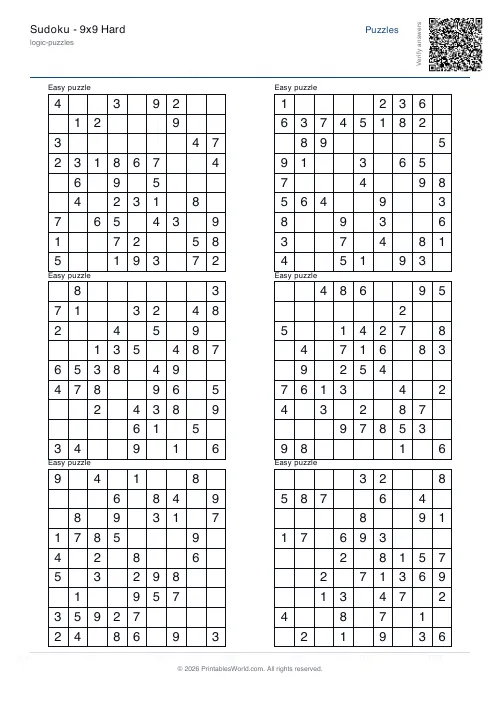
Generate printable Sudoku puzzles with six per page, multiple difficulty levels, and optional solutions.
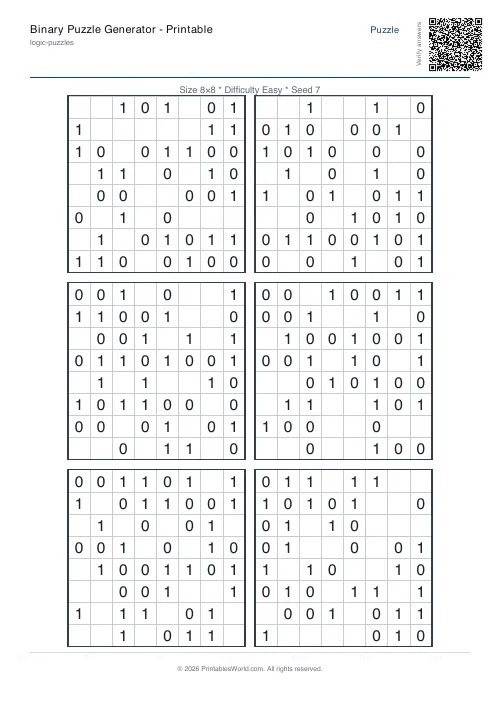
Binary Puzzle Generator: Printable
Create printable binary logic puzzles (Takuzu/Binairo) with customisable grid sizes and difficulty levels.
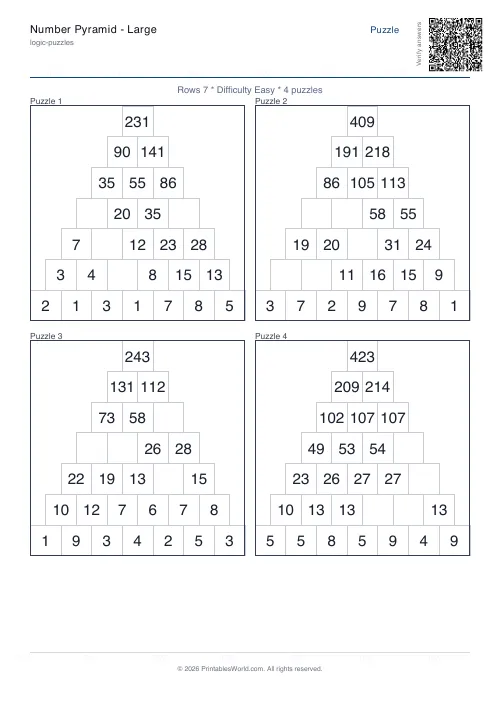
Number Pyramid Generator
Create printable addition pyramid puzzles with adjustable rows, difficulty, and optional answer keys.
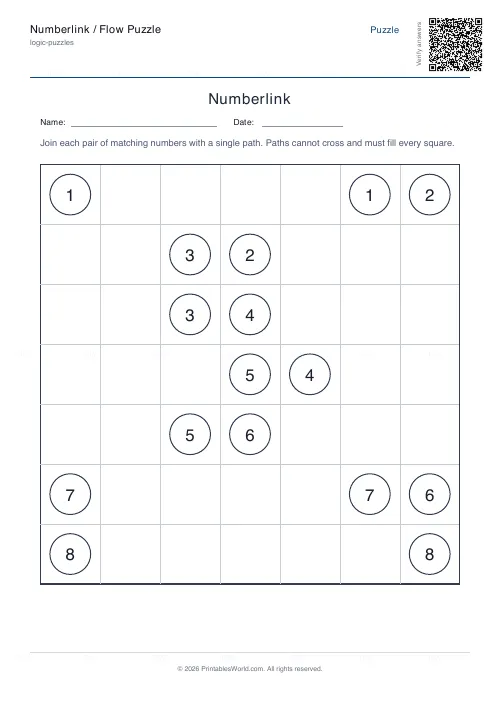
Numberlink / Flow Puzzle
Connect matching numbers with paths that fill the grid.
Further reading
Logic Puzzles
The benefits of logic puzzles for developing brains
Logic puzzles teach deduction and persistence, which are worth having. The claim that they make children generally smarter is weaker than the marketing suggests.
5 min read
Logic Puzzles
Kakuro, killer sudoku and other number puzzles explained
If sudoku has stopped being a challenge, these are the natural next steps. And unlike sudoku, most of them genuinely involve arithmetic.
5 min read
Puzzles & Brain Games
Printable brain games for seniors: a free puzzle pack
A free printable puzzle pack for older adults, with a sample seven-day plan, large-print and easier-difficulty tips, and how to use the Logic Puzzles collection.
7 min read