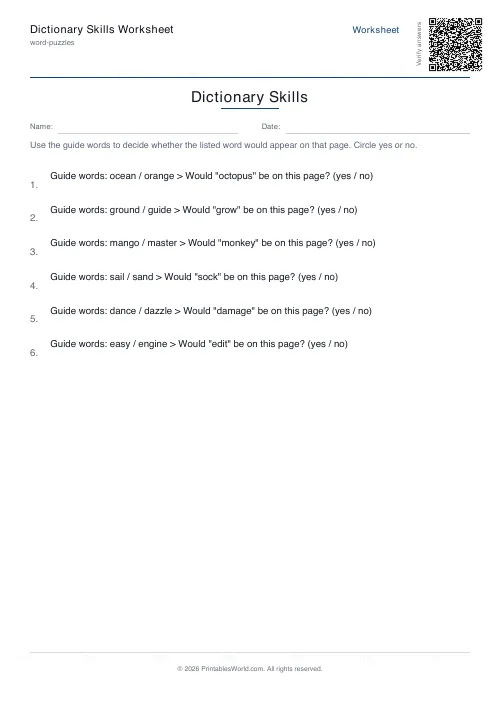
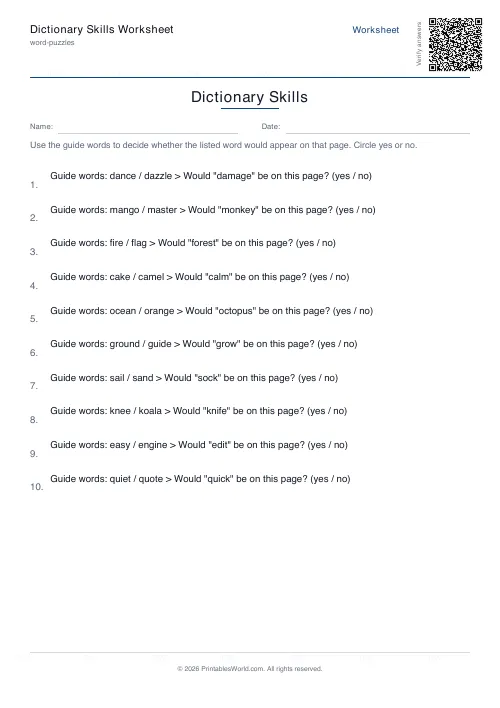
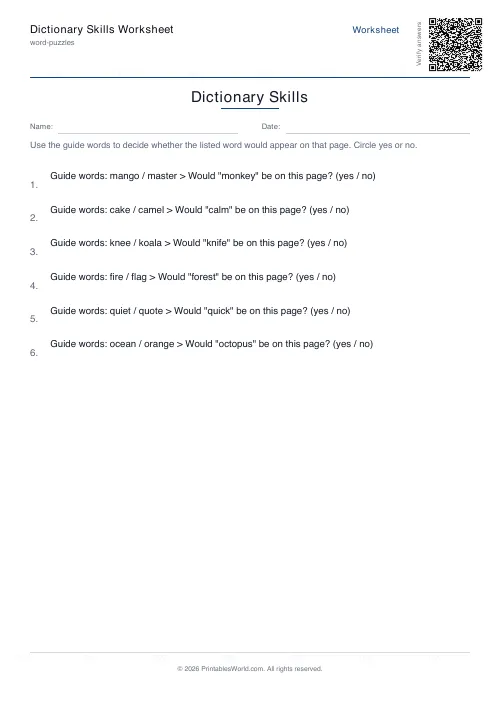
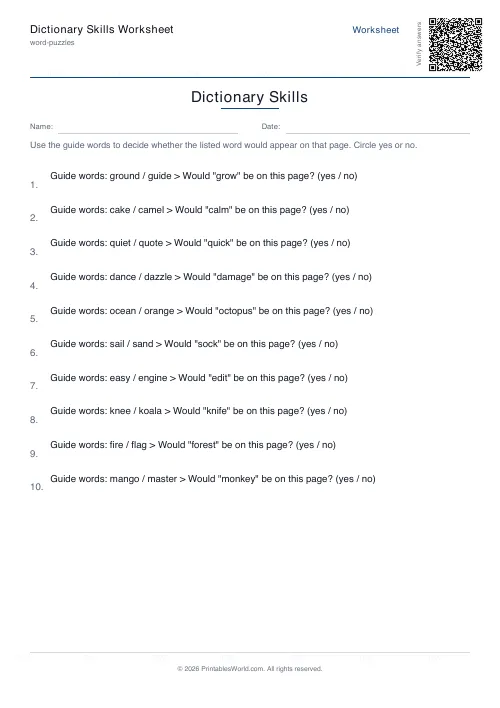
What this tool does
A dictionary skills worksheet built on guide words. Each problem gives the two words at the top of a dictionary page and asks whether a third word would appear there. Five to ten problems a sheet, drawn from a checked bank and reshuffled each time, with a yes-or-no answer key.
People also used
Feedback
Spotted something off with this tool?
Would this word be on this page?
Every problem is the same shape. Two guide words, one target, circle yes or no. Given a page running from marble to margin, would march be on it?
Answering means comparing at the third or fourth letter rather than the first. March falls between them because c comes after b and before g, and the first three letters are identical in all three words. That is the whole skill, and it is considerably finer-grained than the alphabet work most children arrive with.
Worth saying out loud to a class: this is a search skill, not a vocabulary one. You can decide whether a word is on a page without having the faintest idea what it means, and separating those two things makes the task much clearer.
The sub-skills children skip
Alphabetical order looks like one skill and is several. Nearly all the difficulty sits in the later ones.
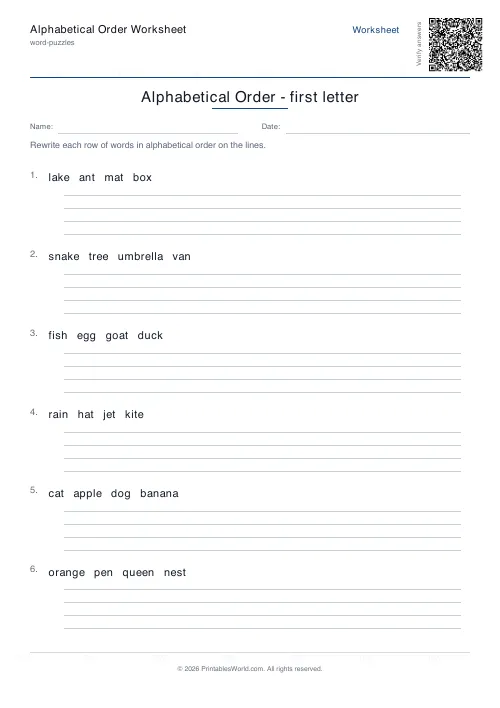
- First letter. Secure in most children long before any dictionary work begins, which is why it gets mistaken for the whole skill.
- Second letter. Cat before cot. The first real step up, and where a child who chants the alphabet rather than knowing it begins to come unstuck.
- Third and fourth letter. Stream, street, strength. This is the level guide words actually demand.
- Shorter word first. Car before card.
- Identical prefixes. The un- words fill pages, so every comparison happens deep inside the word.
Diagnose before you practise. Hand over ten words to sort and watch where the errors start. It is almost always the second or third letter, and that is the level to work at.
A teaching sequence beyond this sheet
These worksheets do the first and most important of four question types. The other three are worth building towards by hand once this one is secure, and they go in this order:
- Would it be on this page? Guide words and a target, yes or no. What this generator prints.
- Which page? Several pages with their guide words; place one word on the right one. Adds a search across options.
- Sort into a page. Given guide words, pick which of several words belong. Reverses the direction of the reasoning.
- Supply the guide words. Given a list of entries, write what the guide words would be. Much the hardest, because it requires sorting the whole list first.
Reaching type four is the goal, because it is the one that proves alphabetical ordering is genuinely secure, and not simply recognised on sight.
Does any of this matter with a search box?
A fair question, and it deserves an honest answer rather than a defensive one.
It still matters, for two reasons. The underlying skill is alphabetical searching, which turns up in indexes, glossaries, directories, contact lists and filing systems. And a search box needs you to already know roughly how a word is spelled, whereas a child who cannot quite spell it can still hunt through the sk- pages and find it.
But the case is narrower than it was, and the better move is to teach both together. Use the print dictionary for navigation and the online one for pronunciation and current usage; each does something the other does not.
The persuasive version is a race. Find six words in a printed dictionary and six online. Print is often faster than children expect once the skill is there, and discovering that themselves beats being told it is useful.
FAQs
Quick answers
What are guide words?
The two words printed at the top of every dictionary page. The first and last entries on that page. Words alphabetically between them appear on the page; others do not.
How many problems per page?
Five to ten problems per sheet. Eight is the comfortable default.
Is there an answer key?
Yes. Toggle the answer-key option and the second page prints "yes" or "no" for each item.
What age is this for?
Best for ages 8–11 who are learning to use a printed dictionary or thesaurus.
Related tools
Further reading
Word Puzzles
Sight words: the complete teaching guide
Sight words are usually taught as words to memorise. Most of them are partly decodable, and treating them that way works better. Here is how, and how many to teach at once.
6 min read
Literacy & Spelling
Do word searches help spelling? What works
Do word searches help spelling, or just fill time? What they practise, what the evidence suggests, and how to turn a spelling list into useful recall practice.
8 min read
Word Puzzles
Phonics at home: CVC words, blends and beyond
The order matters more than the materials, and one small thing, saying pure sounds rather than "buh" and "cuh", makes blending dramatically easier.
6 min read
More like this
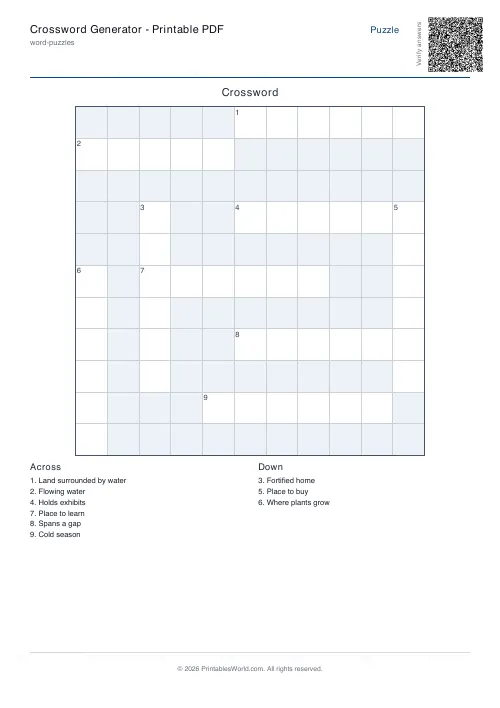 Crossword Generator: Printable PDF
 Word Scramble Generator: Printable
 Cryptogram Generator: Printable PDF
 Missing Letter Generator
 Word Search: Custom Words
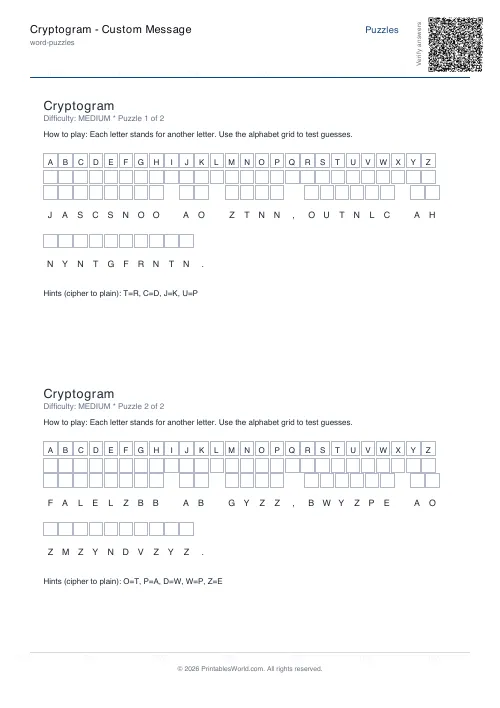 Cryptogram: Custom Message
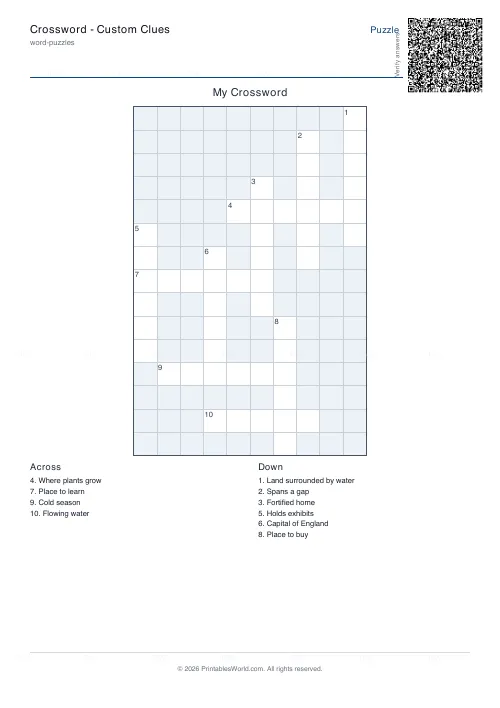 Crossword: Custom Clues
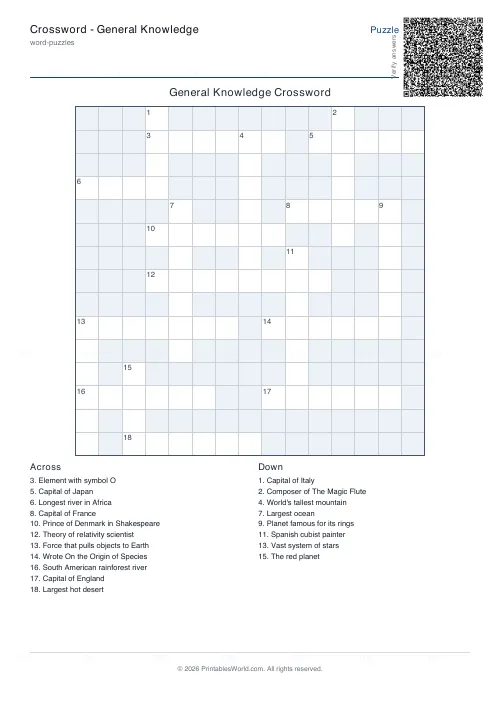 Crossword: General Knowledge
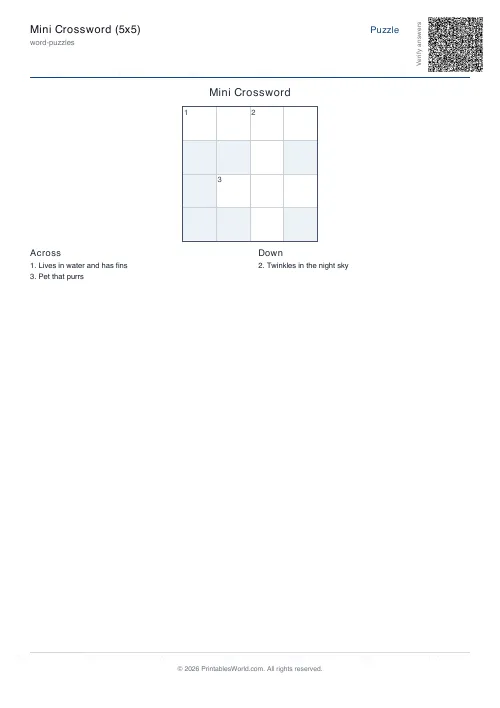 Mini Crossword
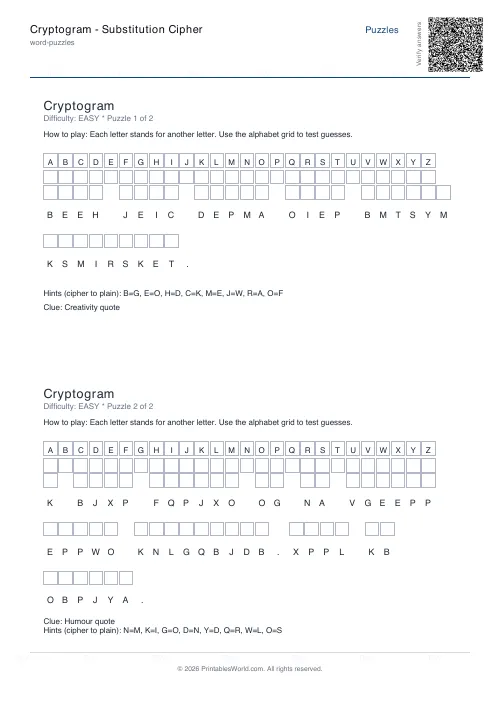 Cryptogram: Substitution Cipher
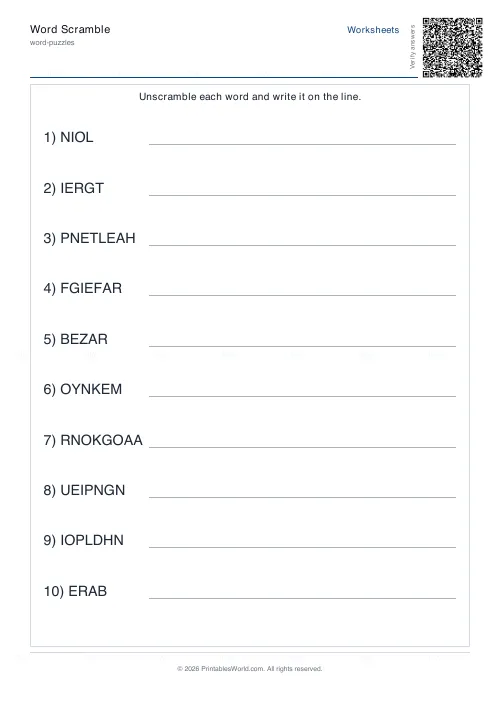 Word Scramble Generator
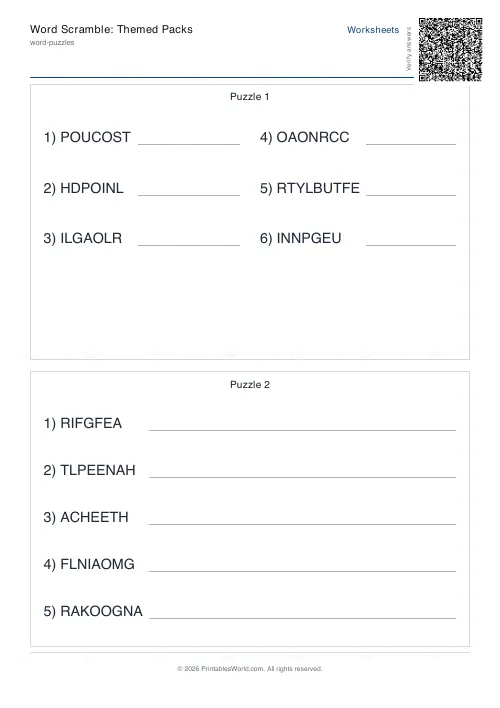 Word Scramble: Themed Packs
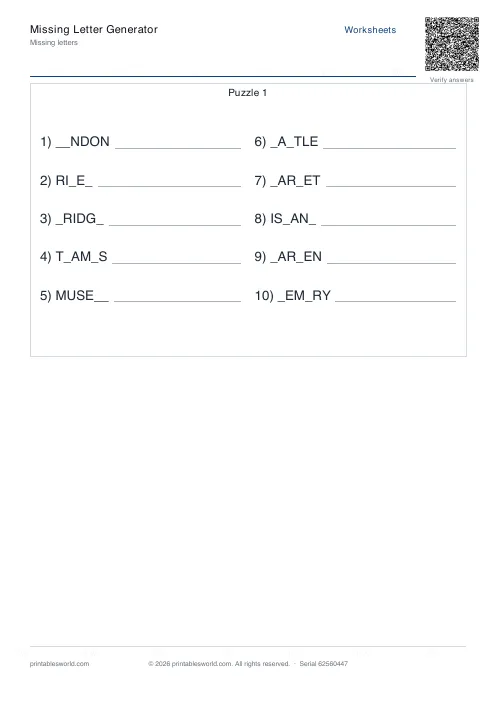 Missing Letters Puzzle
 Acrostic Poem Template