Word Puzzles
Sight words: the complete teaching guide
By Jobi · Creator & Maintainer, PrintablesWorld · Updated 2026-07-03 · 6 min read
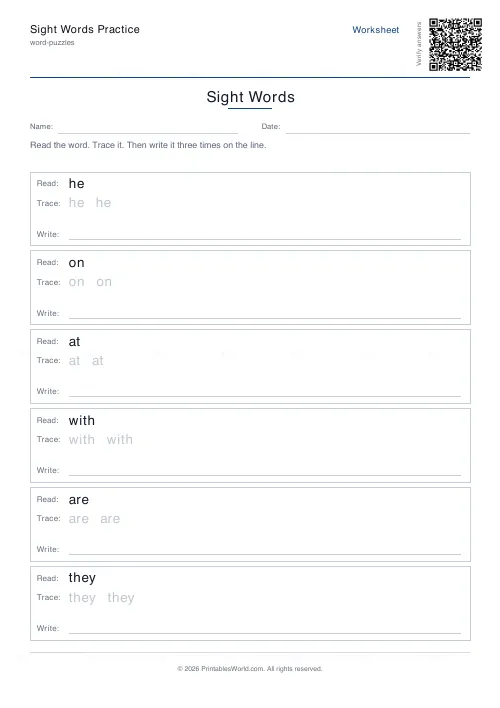
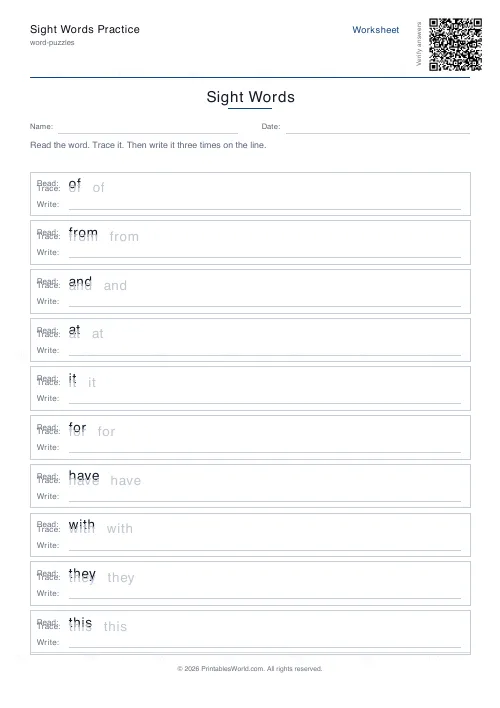
Sight words are the words that appear most often in written English, the, said, was, you, and a child who can read them instantly can read a surprising proportion of any page. Free printable sight word sheets make the practice easy. The part worth getting right is how they are taught, because the traditional method is partly wrong.
What sight words actually are
Two different meanings get tangled together, and it is worth separating them.
High-frequency words are simply the commonest words in print. Some are perfectly regular, and, it, on, can, and a child can sound them out from the start.
Irregular or tricky words do not follow the usual letter-sound patterns a beginner has been taught: said, one, who, eye. These are the ones needing something beyond straight decoding.
In the widest sense, a "sight word" is any word a reader recognises instantly without effort. Which, for a fluent adult, is nearly every word. That is the actual goal: not a memorised list, but words that have become automatic.
Dolch, Fry and the others
The Dolch list (Edward Dolch, 1930s) contains 220 service words plus 95 nouns, graded from pre-primer upwards. Still the most widely used list in schools despite its age.
The Fry list (1950s, updated later) gives 1,000 words in frequency order, in groups of 100. More modern and extends further.
Many countries and schemes have their own. England's national curriculum, for instance, has its own common exception words for each year.
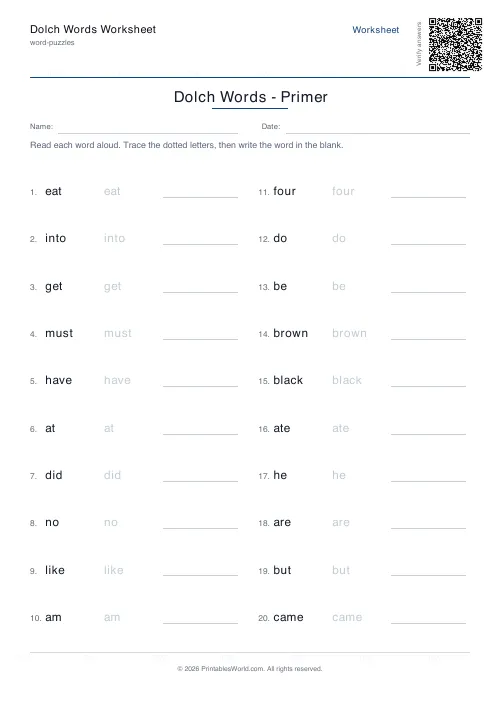
The differences matter less than people think: all these lists overlap heavily at the top, which is where beginners work. Use whichever your school uses, and do not switch mid-year. A Dolch word list sheet is the usual starting point if you have a free choice.
Most of them are decodable after all
This is the part traditional teaching gets wrong. Sight words were long taught purely by memorisation, look, say, repeat, on the assumption they cannot be sounded out.
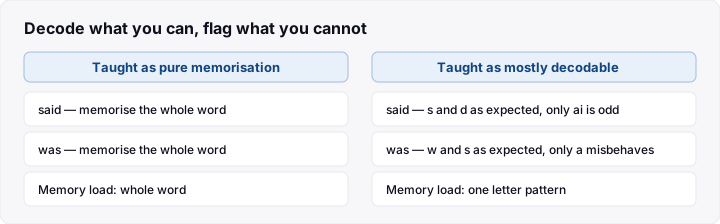
In fact most are partly or wholly decodable, and only a small part of a so-called tricky word is usually irregular. In said, the s and d are exactly what a child expects; only ai is unusual. In was, only the a misbehaves.
So a more effective approach is: decode what you can, flag what you cannot. Sound out the regular letters, then mark the odd part, many schemes have children underline or circle it, and note that this bit is the surprise.
Two advantages. The child keeps using their decoding skills instead of switching them off for certain words, and the memory load drops from a whole word to one letter pattern. It also stops the confusing message that some words are read a completely different way from all the others.
How many to teach at once
Three to five new words a week for most beginners. Fewer than feels efficient, and far fewer than most lists imply.
Teaching ten at once produces recognition that lasts until Friday's test and is gone by the following month. The words need to reappear repeatedly across weeks, which cannot happen if you are always introducing new ones.
Two guards worth applying:
- Do not introduce visually similar words together. was and saw, on and no, then and them, where and were. Taught in the same week they interfere with each other and both take longer.
- Keep reviewing old words. A word learned in September needs to reappear in October and December, or it quietly disappears.
Methods that work
Read it in context. Words in sentences transfer to reading; words on cards sometimes only transfer to cards. Whatever else you do, make sure the word is met in a real sentence.
Retrieval, not recognition. Cover the word and ask the child to write or say it, rather than showing it and asking what it is. Producing is harder and does considerably more.
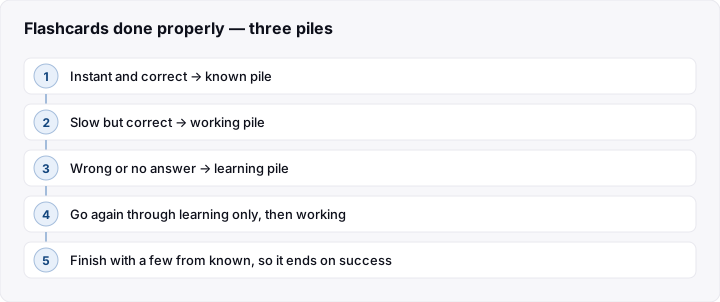
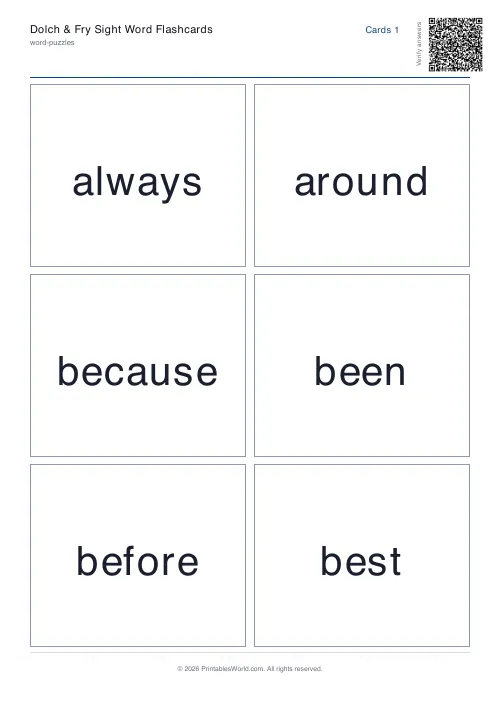
Flashcards done properly: three piles, not one. Instant goes in known; slow but right in working; wrong in learning. Then go again through learning only. Sight word flashcards print a set in a couple of minutes.
Write it, do not just trace it. Tracing can become a motor exercise the eyes barely follow. Copying from a model, then from memory, engages more.
Puzzles for review, not introduction. A word search or scramble made from words already taught is genuine review; a puzzle using words a child has never seen teaches nothing except frustration.
Little and often. Five minutes daily beats half an hour on Sunday, as with anything memory-based.
When a word will not stick
Every child has two or three that resist for months.
Check it is not a lookalike problem. If was and saw keep swapping, separate them: park one for a fortnight and work only on the other.
Say what is regular about it. "The s and the d are what you expect. Only the middle is odd." Reducing the problem to one letter pattern often unsticks it immediately.
Give it a hook. A silly sentence using the word, or a drawing. Slightly ridiculous is more memorable.
Leave it. Genuinely. Drop it for a month and come back. Reading develops unevenly, and a word that is a wall in October is often free in December.
Watch for a wider pattern. If many words are not sticking, and reading is effortful in general, that is worth raising with the school rather than solving with more flashcards.
Frequently asked questions
Should sight words be memorised or sounded out?
Both, in that order. Sound out the parts that follow the usual patterns, which is most of most words, and memorise only the irregular bit. Pure whole-word memorisation is the less effective approach.
How many sight words should a child know?
Expectations vary between curricula and schools, so the honest answer is to ask your child's teacher what is expected for their year. More useful than a number is whether the words they know are instant rather than worked out.
Do sight words conflict with phonics?
They should not. The two work together when tricky words are taught as mostly-decodable with a flagged irregular part. The conflict only arises when sight words are taught as a separate memorisation system running alongside phonics.
What age do children start?
Usually alongside early phonics, around ages four to six, starting with a handful of the very commonest words. Exact timing varies by country and scheme.
Before you print
Teach three to five words a week, decode what is regular and flag only the odd part, keep lookalike words apart, and review old words regularly. Print sight word sheets and flashcards from the list your school uses, and save puzzles for words already learned.
Related tools
Continue reading
Word Puzzles
Phonics at home: CVC words, blends and beyond
The order matters more than the materials, and one small thing, saying pure sounds rather than "buh" and "cuh", makes blending dramatically easier.
6 min read
Literacy & Spelling
Do word searches help spelling? What works
Do word searches help spelling, or just fill time? What they practise, what the evidence suggests, and how to turn a spelling list into useful recall practice.
8 min read