








What this tool does
A first sudoku: 4×4 with 2×2 boxes and the digits 1 to 4. Easy leaves 10 to 12 of the 16 cells filled, so it can be finished by looking rather than by reasoning. Six puzzles a page.
People also used
Sudoku: 6x6 Medium
Six-by-six Sudoku grid. Ideal for children learning Sudoku before the full 9x9.
Sudoku Generator
Generate printable Sudoku puzzles with six per page, multiple difficulty levels, and optional solutions.
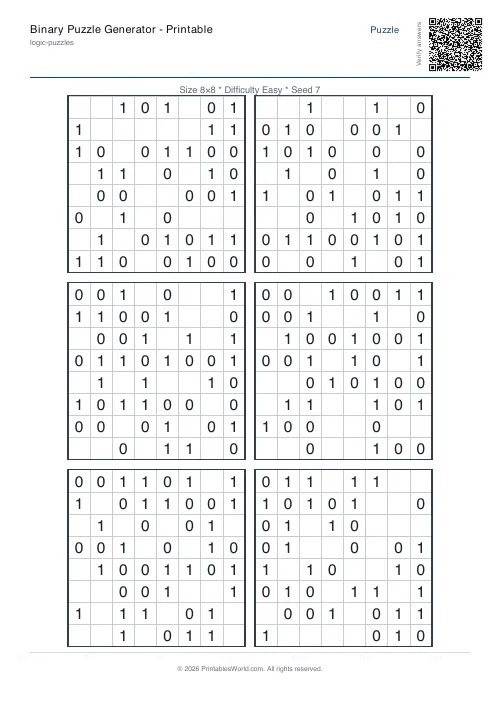
Binary Puzzle Generator: Printable
Create printable binary logic puzzles (Takuzu/Binairo) with customisable grid sizes and difficulty levels.
Feedback
Spotted something off with this tool?
4×4 sudoku for a first-time solver
Sixteen cells. Four digits. Four square boxes. Every digit appears once in each row, once in each column and once in each 2×2 box, which is the whole of sudoku with none of the intimidating size.
On easy, 10 to 12 of the sixteen cells are already filled. That leaves four to six to find, and almost all of them can be found by looking rather than by thinking — which is exactly what a five-year-old needs from a first puzzle. The reasoning comes later, and it comes much more willingly after a few completed grids.
What a child is actually learning
Not arithmetic. There is no adding here and the digits could as easily be four colours or four animals.
What is being practised is the constraint itself: this row already has a 3, so no other cell in it can be a 3. That is a genuine piece of logical reasoning and it is the same one an adult uses on a 9×9 grid. The small grid means a child can hold the whole board in their head, and holding the whole board is what makes the reasoning visible to them.
It also builds the habit of checking. A finished 4×4 can be verified in about fifteen seconds by reading four rows and four columns, and a child who gets into that habit here will carry it upward.
Every puzzle has exactly one answer
Clues are removed one at a time from a complete grid, and after each removal the puzzle is re-solved. If two answers become possible, the clue goes straight back.
This matters at 4×4 more than anywhere else. A small grid with a clue too few has a symmetric pair of solutions, and a child who fills it in "wrongly but validly" and is then told they are wrong learns the opposite of what the puzzle is for.
Six on a page, and the harder rungs
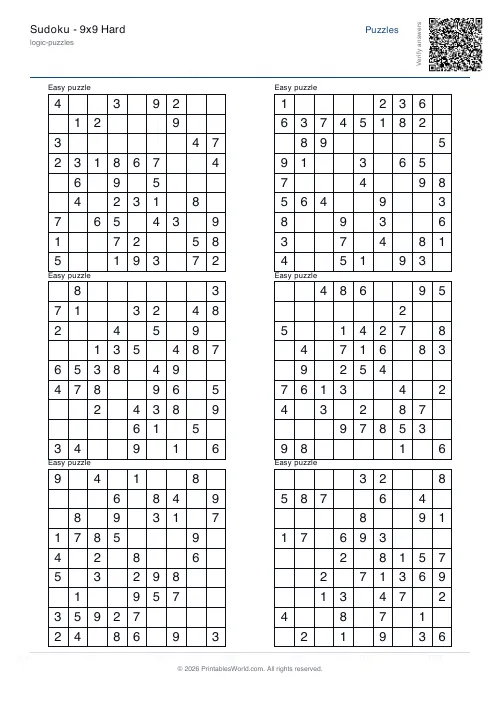
Each sheet carries six puzzles. The solutions toggle adds a page with all six completed, and it is worth having, because checking six small grids by eye turns out to be more tedious than checking one big one.
When these stop being a challenge, the honest next step is not a harder 4×4 but a 6×6, where the boxes stop being square and scanning alone no longer finishes the grid.
Print at 100% on A4 or US Letter. The grids are drawn large on purpose — a five-year-old's handwriting needs the room.
FAQs
Quick answers
What age is this for?
Children age 5 and up who recognise the digits 1 to 4, perfect first sudoku.
How many puzzles per page?
Six small grids per page in a 2×3 layout, sized for A4 or US Letter.
Can I print the answers?
Yes. Toggle the solutions option to print a second page with the completed grids.
What's the next step up?
Try the 6x6 medium variant for a slightly bigger grid before tackling 9x9.
Related tools

Further reading
Logic Puzzles
How to solve Sudoku: a beginner's step-by-step guide
Four techniques, learned in order, solve almost every easy and medium Sudoku: scanning, the last free cell, pencil marks and naked pairs. Here is each one with a worked example.
6 min read
Logic Puzzles
Kakuro, killer sudoku and other number puzzles explained
If sudoku has stopped being a challenge, these are the natural next steps. And unlike sudoku, most of them genuinely involve arithmetic.
5 min read
Puzzles & Brain Games
Sudoku for kids: which difficulty to start at, by age
A practical guide to picking the right sudoku difficulty for a child by age, with a copyable first session and free printable grids in seconds.
7 min read