








What this tool does
6×6 sudoku using the digits 1 to 6 in 2×3 boxes. Medium leaves 18 to 22 clues of 36, so scanning alone will not finish it. Six puzzles a page with an optional solutions sheet.
People also used
Sudoku: 4x4 Easy
Simple 4x4 Sudoku for beginners and young children. Generates unique puzzles each time.
Sudoku Generator
Generate printable Sudoku puzzles with six per page, multiple difficulty levels, and optional solutions.
Word Sudoku (Letter Sudoku)
Classic 9x9 Sudoku played with nine letters instead of numbers. Pick your alphabet, print, and solve.
Feedback
Spotted something off with this tool?
6×6 sudoku, medium: the size where scanning stops being enough
Thirty-six cells and the digits 1 to 6, in boxes two rows deep and three columns wide rather than square. The rules are the familiar ones. Each digit once per row, once per column, once per box.
Medium gives you between 18 and 22 clues. On an easy 6×6 you would get 22 to 26, and that difference of a handful of digits is the whole point of the setting — below about 22 clues, pure scanning runs out and you have to start reasoning about where a digit cannot go.
The 2×3 box is the thing that catches people
On a 9×9 the boxes are square, so a box spans three rows and three columns and the symmetry lets you think about rows and columns interchangeably.
A 2×3 box does not. It spans two rows and three columns, which means a box overlaps three cells of a row but only two of a column, and the scanning technique that works down a column is weaker than the one that works along a row. Children arriving from 4×4 puzzles notice this as the puzzle "feeling lopsided", and it is the single most useful thing to point out when they get stuck.
Uniqueness, and why the clue count varies
Every puzzle starts as a complete solved grid. Clues are then removed one at a time, and after each removal the grid is re-solved: if a second solution has appeared, the clue goes back. Removal stops when the target clue count is reached or nothing more can go.
That is why two medium sheets are not identical in difficulty. One may sit at 18 clues and another at 22, both correctly labelled medium, because the number that could be removed depends on the grid.
Six to a page
The default sheet carries six puzzles. That suits a class, a car journey, or a week of one a day. The solutions toggle adds a page with all six completed.
Where 6×6 sits in the progression
It is the rung between the 4×4 and the full 9×9, and it is the rung people skip.
A child who can do 4×4 puzzles fluently is doing something closer to pattern-matching than deduction, because four digits in sixteen cells rarely require more. Nine by nine is a long way from there. The 6×6 introduces genuine elimination, non-square boxes, and a grid big enough that you have to keep track of what you have already worked out, all while still finishing inside ten minutes.
Print at 100% on A4 or US Letter.
FAQs
Quick answers
How is 6x6 different from 9x9?
The boxes are 2 rows by 3 columns and the digits run 1 to 6, but the rules are otherwise identical.
Who is this for?
Solvers age 8 and up who already know how to do 4x4 sudoku and want a sturdier challenge.
How many puzzles?
Six puzzles per page, with optional solutions on a separate page.
Does the engine guarantee one solution?
Not in v1. Small puzzles often have only one practical solution but uniqueness is not enforced.
Related tools

Sudoku: 4x4 Easy
Simple 4x4 Sudoku for beginners and young children. Generates unique puzzles each time.
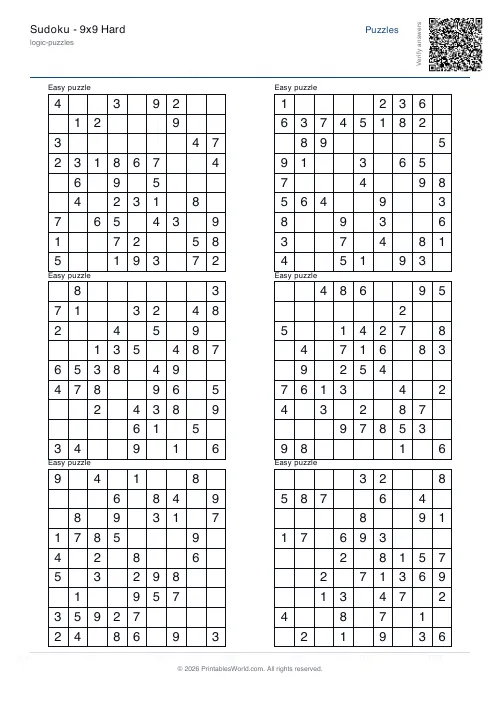
Sudoku Generator
Generate printable Sudoku puzzles with six per page, multiple difficulty levels, and optional solutions.
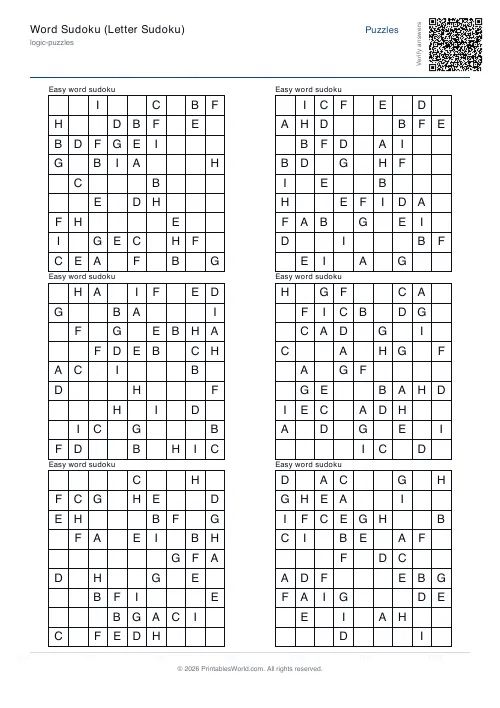
Word Sudoku (Letter Sudoku)
Classic 9x9 Sudoku played with nine letters instead of numbers. Pick your alphabet, print, and solve.
Further reading
Logic Puzzles
How to solve Sudoku: a beginner's step-by-step guide
Four techniques, learned in order, solve almost every easy and medium Sudoku: scanning, the last free cell, pencil marks and naked pairs. Here is each one with a worked example.
6 min read
Puzzles & Brain Games
Sudoku for kids: which difficulty to start at, by age
A practical guide to picking the right sudoku difficulty for a child by age, with a copyable first session and free printable grids in seconds.
7 min read
Logic Puzzles
Kakuro, killer sudoku and other number puzzles explained
If sudoku has stopped being a challenge, these are the natural next steps. And unlike sudoku, most of them genuinely involve arithmetic.
5 min read