Puzzles & Brain Games
Sudoku for kids: which difficulty to start at, by age
By Jobi · Creator & Maintainer, PrintablesWorld · Updated 2026-07-30 · 7 min read
Picture a six-year-old at the kitchen table, pencil hovering over a full 9x9 grid, going quieter by the second. That blank stare is the most common reason a first try at sudoku ends in a shrug, and it is almost always a difficulty problem, not an ability one. Match a child to the right grid size and sudoku for kids turns from a frustration into a request to play again. A printable sudoku generator makes printing a board at the right level quick.

What is kids' sudoku and how does it work?
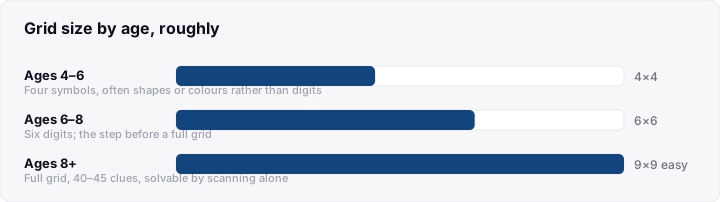
Sudoku is a logic puzzle on a square grid split into smaller boxes. Each row, column, and box must hold a set of symbols once, with no repeats. Sudoku for kids shrinks the board and sometimes swaps numbers for shapes or colours. A 4x4 grid uses 1 to 4, a 6x6 uses 1 to 6, and the classic 9x9 uses 1 to 9. There is no arithmetic, only spotting what is missing, so young children can succeed before they are confident with sums.
Why sudoku suits children
The puzzle is self-checking. A child can see when a row has two of the same number, so feedback is immediate and needs no adult marking it. That quick loop of try, notice, adjust is the kind of practice many teachers value for building patience.
Research on puzzles and reasoning suggests logic games can support working memory and pattern spotting. A grid will not make a child cleverer overnight, but enjoyable practice may support the focus other learning leans on.
How to choose the right sudoku difficulty by age
Difficulty comes from two dials: grid size and how many squares are already filled in. Work through these in order.
- Start one level below where you think they are. An early win builds appetite better than a near miss.
- Pick the grid by stage, not just age. A 4x4 suits most children around age 4 to 6, a 6x6 around age 6 to 8, and a 9x9 once a child reads numbers to 9, often age 8 and up.
- Keep the givens generous at first. More starting numbers means fewer dead ends.
- Watch the first two minutes. A quick move means the level is right; a freeze means drop a size.
A simple starter sequence for a first sudoku
Begin with a 4x4 grid.
Puzzle (4x4)        Solution
1 2 . 4             1 2 3 4
. 4 1 .             3 4 1 2
2 . . 3             2 1 4 3
. 3 . 1             4 3 2 1
Point to the top-left box, the four squares in the upper-left corner. It already holds 1, 2 and 4, so the empty square there can only be the missing 3. That single, certain move is the whole idea of the puzzle in one step. Let the child place it, then look for the next box or row with one gap.
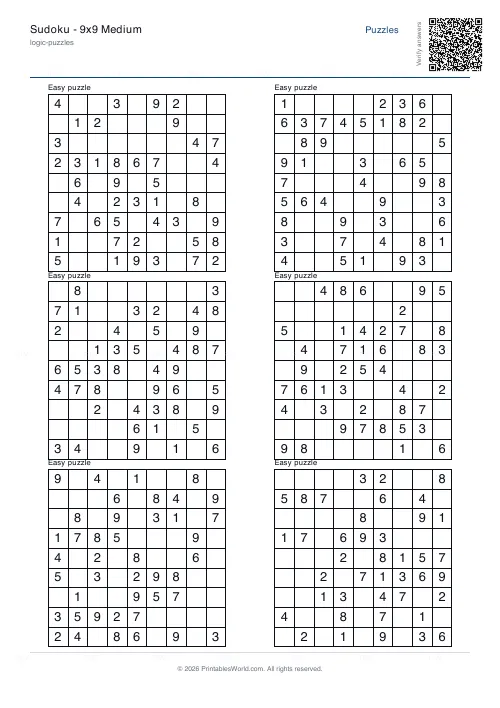
Once a 4x4 feels easy, move to a 6x6 grid. It uses 1 to 6, and its boxes are wide rectangles, two squares tall and three across, the only new idea to name. After a few confident 6x6 puzzles, try an easy 9x9 with a generous fill, about 38 of the 81 squares given. With that many starting numbers, there is nearly always a row, column, or box with one missing value, so the child keeps finding safe moves.
How to use the sudoku generator
The printable sudoku generator lets you set the grid size and difficulty, then download a clean PDF with no sign-up. Choose 4x4, 6x6, or 9x9, pick an easy setting for a first run, and select how many puzzles fit the page.
The PDF is sized for A4 or US Letter, so it prints cleanly wherever you are. An optional answer key lets a child or a busy adult check the finished grid without fuss.
Sudoku for kids by age
Ages 4 to 6: shapes and 4x4 numbers
A 4x4 grid with shapes or a heavily filled number grid works well. The goal is recognising the no-repeats rule, not speed.
Ages 6 to 8: confident 4x4 into 6x6
Children who read numbers happily can move to 6x6 grids with most squares given. The rectangular boxes are the new step, so name them the first time.
Ages 8 and up: easy 9x9
An easy 9x9 with a generous fill is a fair first full-size board. Keep difficulty low until a child can finish unaided, then thin the givens slowly.
Common mistakes to avoid
- Starting on a full 9x9. The classic grid overwhelms a beginner; shrink the board first.
- Too few given numbers. A sparse grid forces guessing, which teaches the wrong habit.
- Turning it into a test. Timing or correcting every move drains the fun that brings a child back.
- Jumping sizes too soon. A few easy wins at each size build the confidence the next step needs.
Frequently asked questions
What age can a child start sudoku?
Most children can start a 4x4 around age four or five, and a shapes version brings that forward because nothing depends on reading numbers. Age is only a rough guide, though. The first two minutes with a puzzle tell you far more: a child who spots a confident move quickly is at the right level, while one who freezes needs a smaller grid or more filled-in squares. An early win builds appetite. A near miss on a board that was too hard mostly builds resistance.
Are 4x4 sudoku puzzles good for beginners?
A 4x4 grid is the standard gentle entry point. It uses only the numbers 1 to 4, splits into four small boxes, and lets a child meet the core rule, no repeats in any row, column, or box, on a board small enough to scan at a glance. With so few squares, a beginner can usually see the next move without feeling lost. Once a child finishes several 4x4 puzzles without help, that is the natural signal to try a 6x6 grid.
How do you explain sudoku to a child?
Skip the word logic and use the no-repeats idea. Show one row and say each number appears once, never twice, and that the same holds down each column and inside each little box. Then find a box missing only one number and let the child name it. That single, certain move shows the whole puzzle in one step. Many children grasp it faster from doing one square than from any explanation, so start the pencil moving early and talk through what you are checking.
What is the easiest sudoku for kids to start with?
The easiest start is a 4x4 grid on its lowest difficulty, with most squares already filled in. Numbers 1 to 4, four small boxes, and a generous set of givens mean there is almost always a row or box with a single gap, so the child keeps finding safe moves rather than guessing. A shapes or colours version is gentler still for a pre-reader. From there the path is a confident 4x4, then a filled 6x6, then an easy 9x9.
Sources and further reading
Two reputable starting points are worth a look for deeper reading on problem solving and reasoning in children.
- NRICH, University of Cambridge, which publishes free problem solving and reasoning activities for learners of all ages.
- OECD, which publishes international research on education, skills, and problem solving.
The bottom line
The difficulty of a first puzzle matters more than a child's age. Start a size below where you expect, keep the givens generous, and watch the first two minutes for the signal to move up or down. Build from a 4x4 to a 6x6, then an easy 9x9, letting comfort rather than a calendar set the pace. When the level fits, the printable sudoku generator keeps an engaged child supplied with puzzles they can finish. A printable maze generator or a word search generator pairs neatly with a sudoku habit.
Related tools
Continue reading
Logic Puzzles
How to solve Sudoku: a beginner's step-by-step guide
Four techniques, learned in order, solve almost every easy and medium Sudoku: scanning, the last free cell, pencil marks and naked pairs. Here is each one with a worked example.
6 min read
Logic Puzzles
The benefits of logic puzzles for developing brains
Logic puzzles teach deduction and persistence, which are worth having. The claim that they make children generally smarter is weaker than the marketing suggests.
5 min read