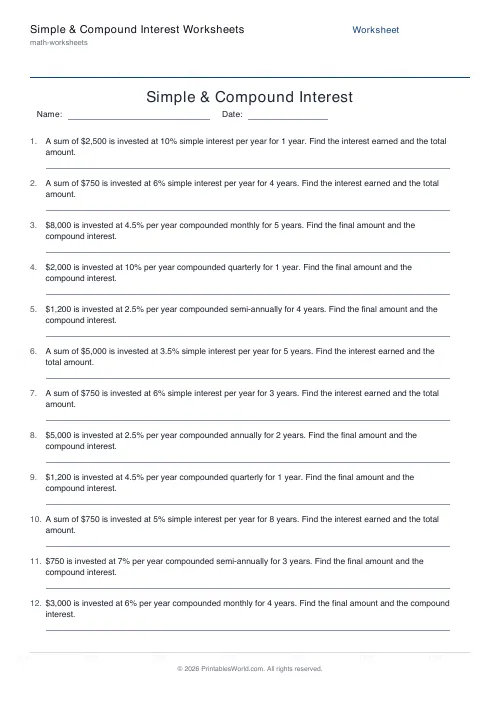
What this tool does
Word problems on the two interest formulas. Simple interest gives you a principal, a rate and a time, and asks for I = P·R·T. Compound adds a compounding frequency and asks for A = P(1 + r/n)^(nt). Mixed puts both kinds on one sheet, so the pupil has to work out which formula a question wants before they can start substituting into it. Four to thirty problems. Answer key to two decimal places.
People also used
BODMAS Order of Operations Generator
Order-of-operations practice with brackets, exponents and mixed arithmetic.
Introduction to Algebra Worksheets
Printable beginner algebra practice. Evaluate, simplify, and substitute.
Equation Solving Worksheets
Printable one-step and two-step linear equations to solve.
Feedback
Spotted something off with this tool?
Two formulas, and a sheet that makes you choose
Simple mode gives a principal, an annual rate and a number of years, and asks for the interest and the total. Compound mode adds a compounding frequency and asks for the final amount and the interest earned.
Mixed puts both kinds on one page, and that is where the assessment happens. On a single-formula sheet a pupil substitutes into whatever they were shown at the start of the lesson and gets everything right without deciding anything. On a mixed sheet they have to read each question and work out which formula it wants first.
The formulas
- Simple interest. I = P × R × T, where P is the principal, R the annual rate and T the time in years. The total is A = P + I.
- Compound interest. A = P(1 + r/n)^(n·t), where n is how many times a year interest is added. The interest earned is A − P, which is the step people forget.
That last point is worth labouring. The compound formula gives the final amount, not the interest, and a pupil who writes down A when the question asked for interest has done every hard part correctly and lost the mark.
Where the numbers come from
Principals run from $500 up to $12,000. Rates are drawn from 2% to 10% in realistic steps. Nothing is a round trick number, so the arithmetic feels like arithmetic rather than a puzzle.
Compounding comes annually, or semi-annually, or quarterly, or monthly. Simple-interest problems run from one year to ten, while compound ones stop at five, and that cap is deliberate. Ten years compounded monthly is an exponent of 120, which stops testing the formula and starts testing whether the calculator was used correctly.
A worked one
$2,000 invested at 6% per year, compounded quarterly, for 3 years.
So P = 2000, r = 0.06, n = 4, t = 3. That gives A = 2000(1 + 0.06/4)^(4×3) = 2000 × 1.015¹² ≈ $2,391.24, and the interest earned is $391.24.
The key prints both figures to two decimal places, so a pupil checking their own work can see whether they missed the formula, the rate conversion, or just the rounding. Those are three different mistakes and they need three different conversations.
Why the difference is worth showing, not telling
Simple interest grows in a straight line. The same amount is added every year, for ever.
Compound interest earns interest on the interest, so the balance curves upward, and the more often it compounds the steeper that curve gets. A mixed sheet makes that visible in a way an explanation does not: two problems with the same principal, the same rate and the same number of years produce visibly different answers, and the pupil has just calculated both.
Which is the whole financial-literacy lesson in one page. Compounding is the best thing that can happen to a saver and the worst thing that can happen to somebody carrying a credit-card balance, and it is the same arithmetic either way.
A teaching order that works
Simple first, until substitution into I = P·R·T is automatic. Then compound on its own, where the only new thing is the exponent. Then mixed, as an assessment rather than as practice.
For a pupil revising alone, generate a fresh sheet each time. The numbers change every generation, so the method becomes automatic without the answers becoming memorable, and the key lets you diagnose your own errors instead of merely counting them.
FAQs
Quick answers
What is the difference between simple and compound interest?
Simple interest is calculated only on the original principal using I = P·R·T, so the same amount is added each period. Compound interest is calculated on the principal plus any interest already earned, using A = P(1 + r/n)^(n·t), so the balance grows faster over time.
Which compounding frequencies does the generator use?
Compound problems randomly use annual, semi-annual, quarterly, or monthly compounding (n = 1, 2, 4, or 12). The frequency is stated in words in each question so students know which value of n to use.
How are the answers rounded?
The answer key shows both the final amount and the interest earned rounded to two decimal places (to the nearest cent), which is standard for money calculations.
Can I put both simple and compound problems on one sheet?
Yes. Choose Mixed mode and each problem is randomly either a simple or a compound interest question, so students have to decide which formula to apply.
Can I control the exact principals and rates used?
No. The generator picks realistic values automatically. Principals from a few hundred to several thousand dollars and rates between 2% and 10%. If you need specific numbers you can edit the PDF or generate several sheets and choose the ones you want.
How many problems fit on one page?
You can request 4 to 30 problems. Because each question is a full word problem with a ruled answer line, 10 to 15 per page is the most readable; higher counts shrink the text to fit.
Will the worksheet print correctly on US Letter paper?
Yes. The PDF is designed to fit both A4 and US Letter without cropping or scaling. Load your paper and print at 100%.
Related tools
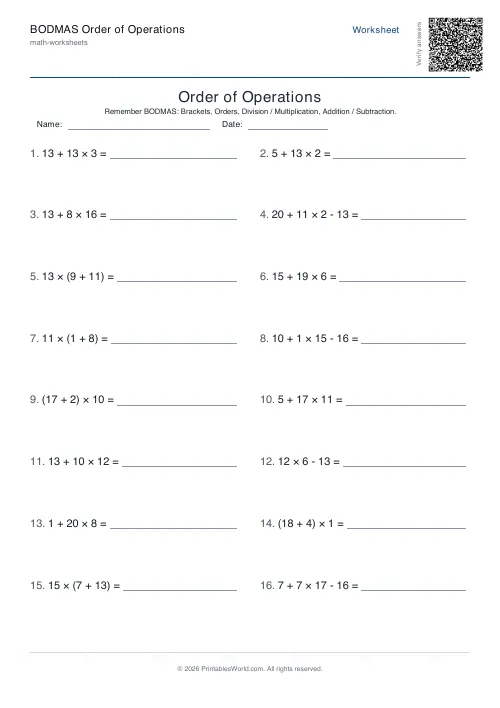
BODMAS Order of Operations Generator
Order-of-operations practice with brackets, exponents and mixed arithmetic.
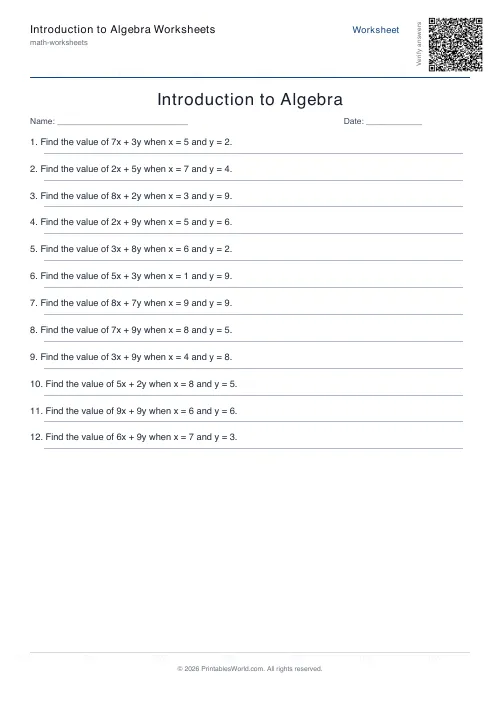
Introduction to Algebra Worksheets
Printable beginner algebra practice. Evaluate, simplify, and substitute.
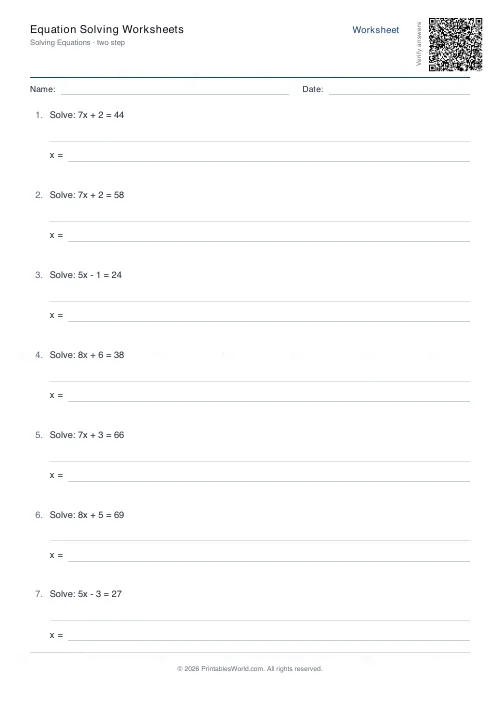
Equation Solving Worksheets
Printable one-step and two-step linear equations to solve.
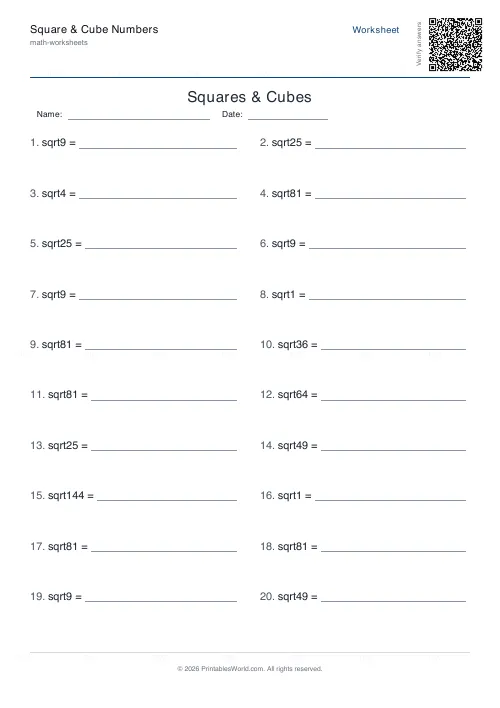
Square & Cube Numbers Generator
Printable squares, cubes, square roots and cube roots worksheets with optional answer keys.
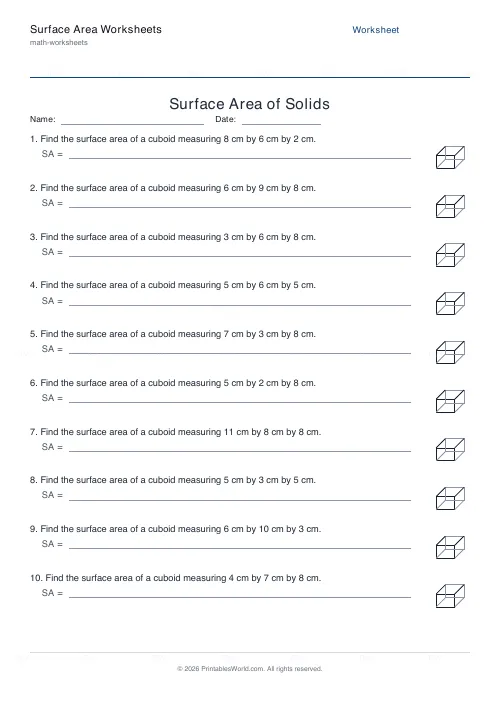
Surface Area Worksheets
Generate surface-area practice for cuboids, cylinders and mixed solids with worked answer keys.
Further reading
Math Worksheets
Fractions made simple: teaching fractions at home
Fractions go wrong when the rules arrive before the meaning. Here is the order that works, the four misconceptions to head off early, and how to use everyday objects before any worksheet.
6 min read
Math & Numeracy
How to help a child who's stuck on times tables
A simple two week plan to help child with times tables, using short daily practice and free printable multiplication grids you can customise and print.
7 min read
Math Worksheets
Understanding BODMAS and PEMDAS: order of operations explained
BODMAS and PEMDAS describe the same rule in different words. The trouble is that both hide two facts the acronym cannot express. Which is where nearly every mistake comes from.
5 min read
More like this
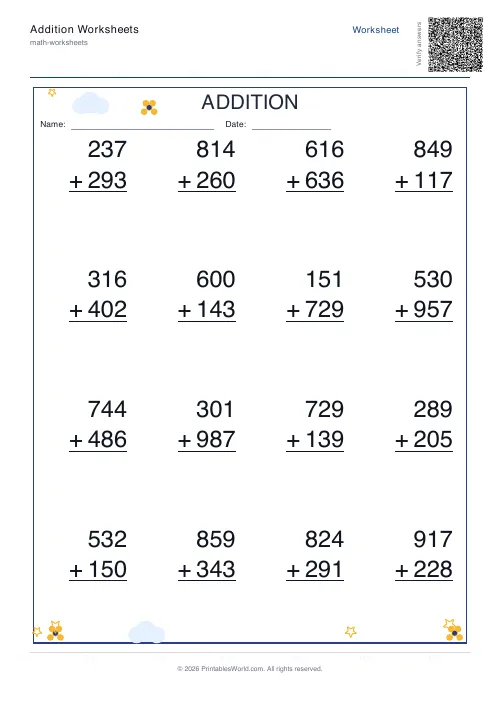 Addition Worksheets Generator
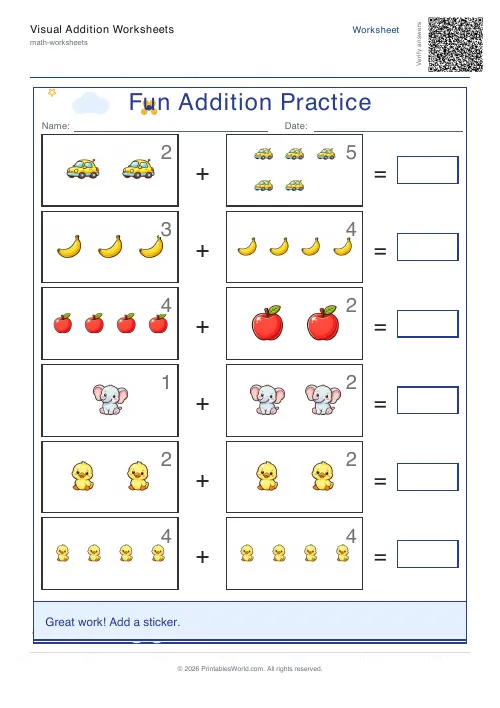 Visual Addition Worksheets Generator
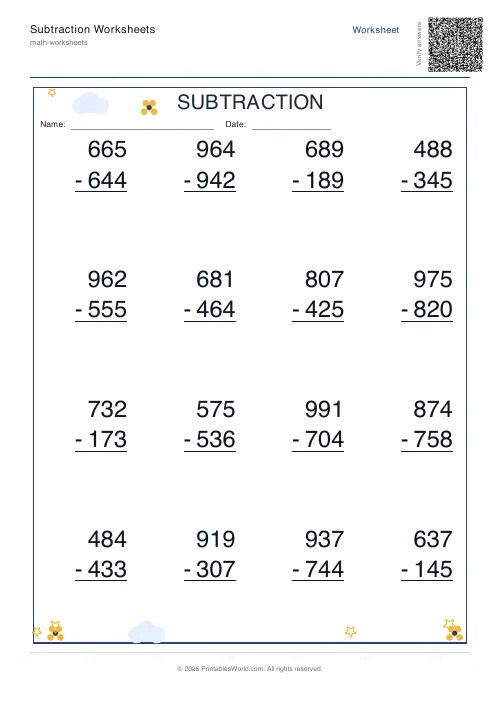 Subtraction Worksheets Generator
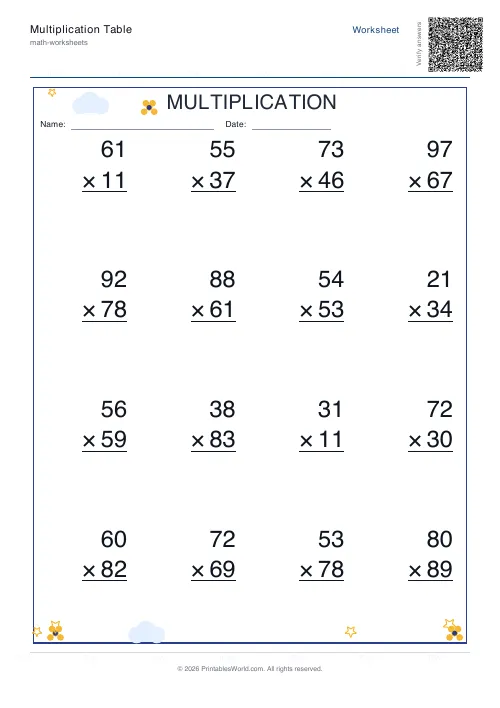 Multiplication Table Generator
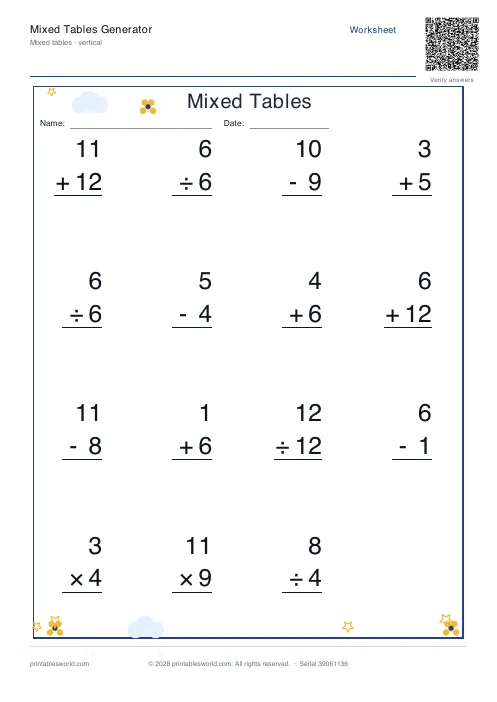 Mixed Tables Generator
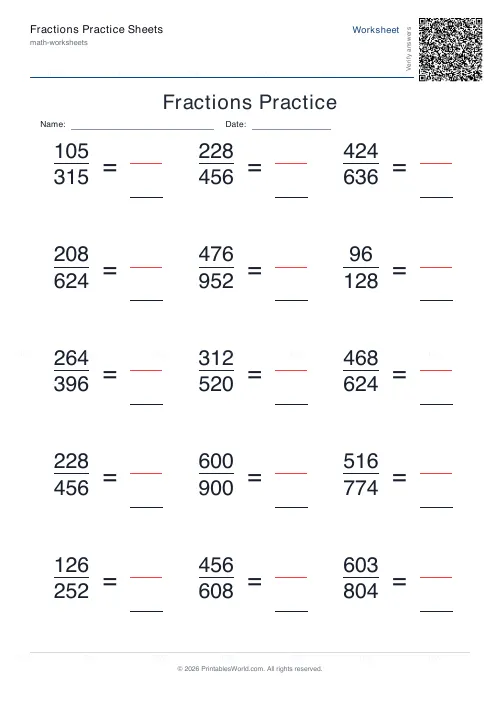 Fractions Practice Sheets Generator
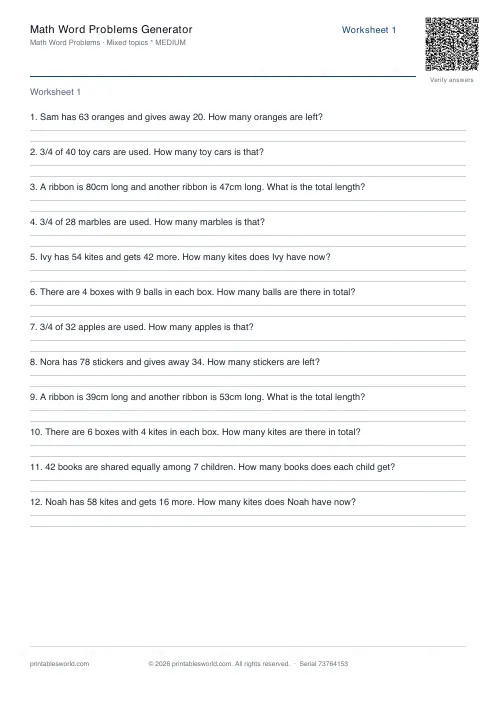 Math Word Problems Generator
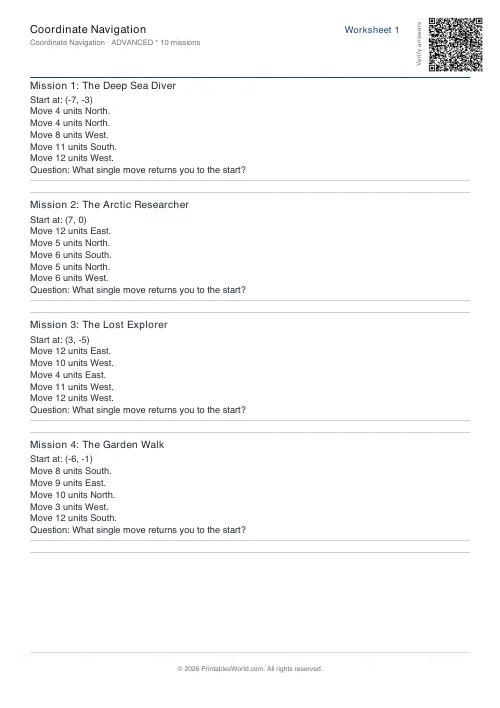 Coordinate Navigation Generator
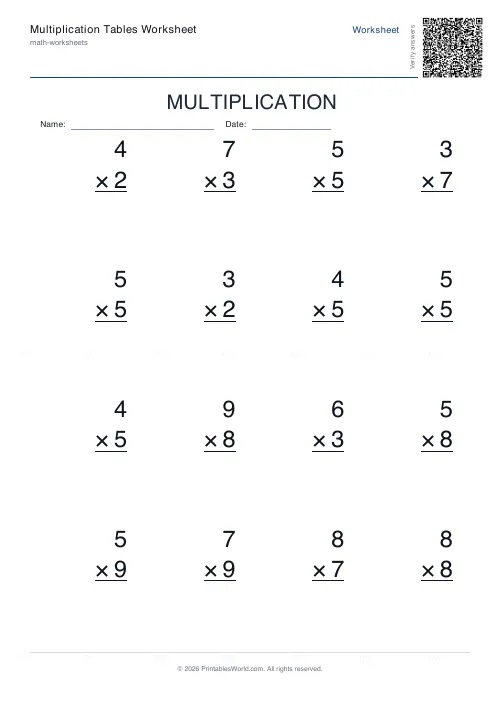 Multiplication Tables Worksheet
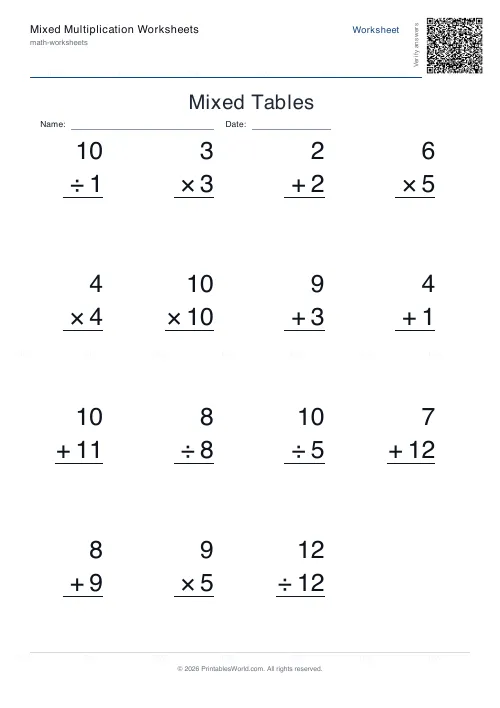 Mixed Multiplication Worksheets
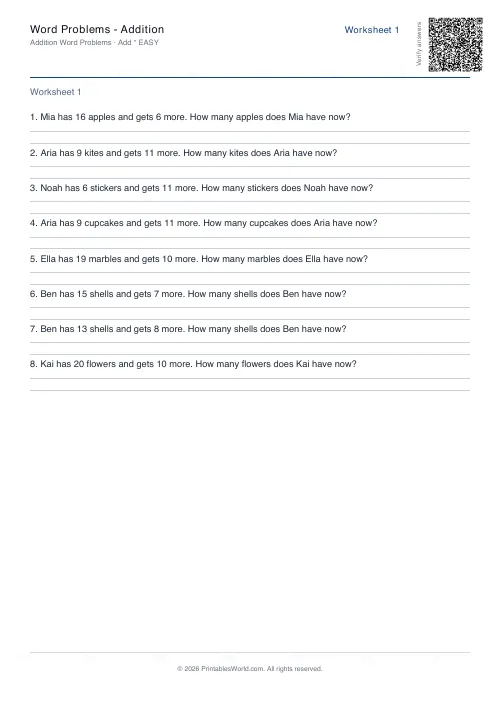 Word Problems: Addition
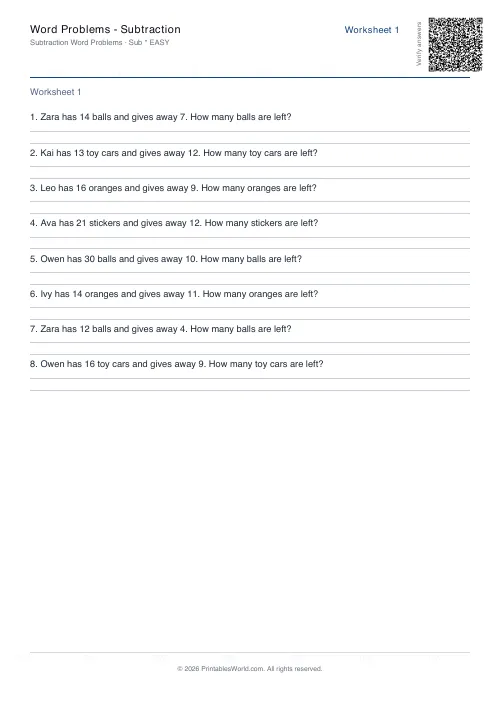 Word Problems: Subtraction
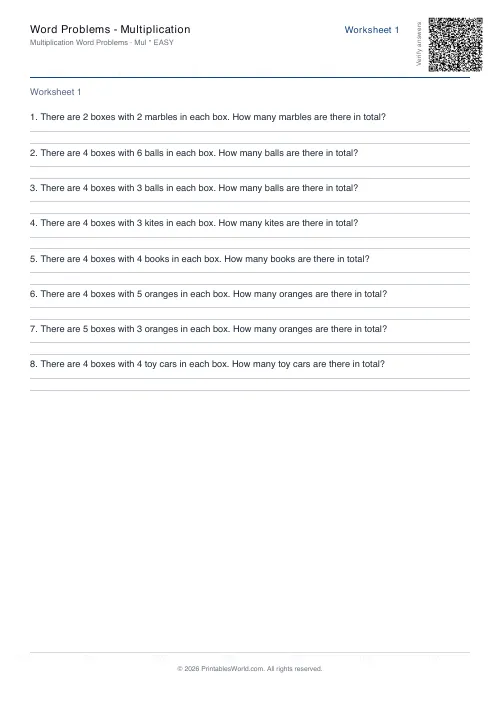 Word Problems: Multiplication
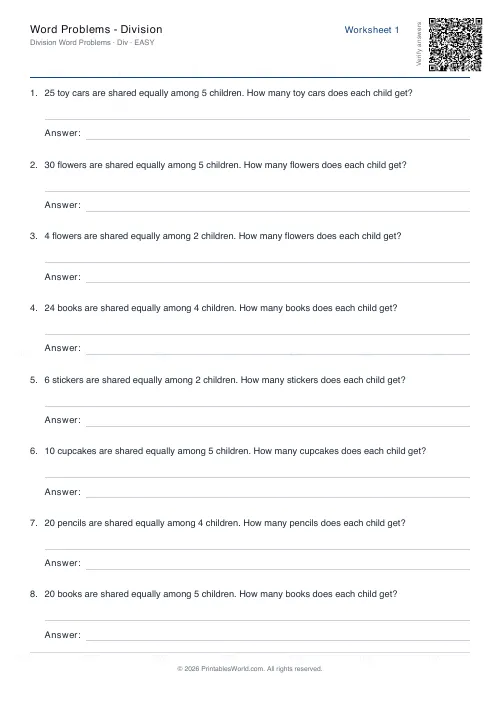 Word Problems: Division