Math Worksheets
Fractions made simple: teaching fractions at home
By Jobi · Creator & Maintainer, PrintablesWorld · Updated 2026-07-30 · 6 min read
Fractions are where a lot of confident young mathematicians suddenly stop being confident. The usual reason is that the rules arrive before the meaning: a child who can recite "find a common denominator" without picturing what a third actually is has been given a procedure to memorise rather than an idea to use. Free printable fractions practice sheets are useful, but only once the meaning is in place.
This guide sets out the order that works, and the misconceptions worth heading off before they take hold.
Start with what a fraction actually is
A fraction is a number of equal parts of a whole. Two words in that sentence do most of the damage when they are skipped.
Equal. Children shown a pizza cut into four uneven slices and told "these are quarters" learn something false. Every early example must have genuinely equal parts, or the definition quietly becomes "a fraction is a piece of something".
Of a whole. Half of a large pizza is not the same amount as half of a small one. This is why 1⁄2 is a number rather than a fixed quantity, and it is the single most useful thing to establish early. Ask often: half of what?
Say the denominator as what it is — the number of equal parts the whole was split into — rather than "the bottom number". Bottom number is a position; parts is a meaning.
The order to teach fractions in
Each step here depends on the one before it. Skipping ahead is the most common cause of trouble later.
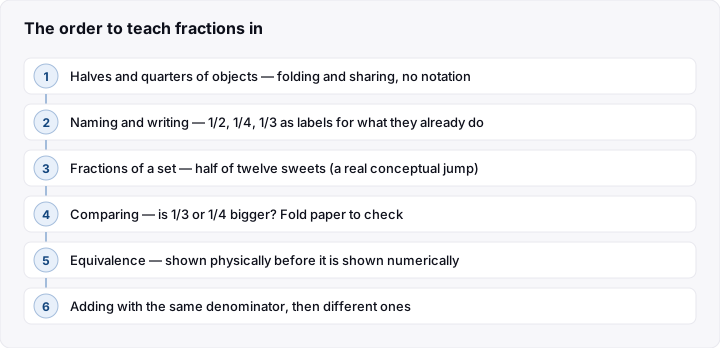
- Halves and quarters of objects. Fold paper, cut fruit, share biscuits. No notation yet.
- Naming and writing. Introduce 1⁄2, 1⁄4, 1⁄3 as labels for what the child is already doing.
- Fractions of a set. Half of twelve sweets. This is a genuine conceptual jump — the "whole" is now a group, not one object — and it is worth its own sessions.
- Comparing. Which is bigger, 1⁄3 or 1⁄4? Fold paper to check rather than telling them the rule.
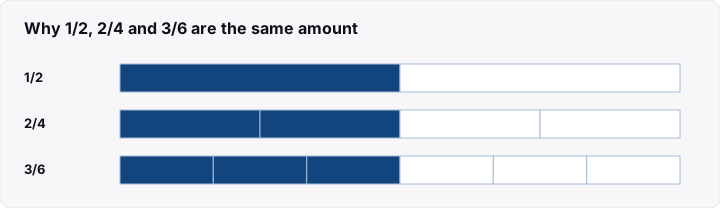
- Equivalence. 1⁄2 = 2⁄4 = 3⁄6, shown physically before it is shown numerically.
- Adding and subtracting with the same denominator. Easy, and it reinforces that the denominator names the parts rather than being a number to operate on.
- Adding with different denominators. Only now, and only because equivalence is already solid.
- Multiplying, dividing, decimals and percentages. Later still.
Why equivalence has to come before adding
This is the step most often rushed, and rushing it is what produces the classic error 1⁄2 + 1⁄3 = 2⁄5.
That answer is not careless. It is what you get by applying whole-number thinking to two fractions: add the tops, add the bottoms. The child is being consistent with a rule that has always worked for them.
The fix is not "you can't do that", it is a demonstration that the answer is impossible. 1⁄2 is already bigger than 2⁄5, so adding something to a half cannot produce less than a half. Do that with folded paper and the rule about common denominators arrives as the solution to a problem the child has felt, rather than as an instruction.
A useful test before moving on: can the child produce three fractions equal to 1⁄2 without being shown how, and explain why they are equal? If not, adding unlike fractions will be procedure-following.
Four misconceptions to head off
Bigger denominator means bigger fraction
The most common of all: 1⁄8 looks bigger than 1⁄3 because 8 > 3. Cutting one cake into eight and another into three fixes it in one demonstration.
The parts do not need to be equal
Catch this early by deliberately showing a shape split into unequal parts and asking whether the shaded bit is really a quarter.
A fraction is always less than one
Improper fractions are a shock if every example has been part of a single object. Introduce 3⁄2 with two half-pizzas plus another half fairly early, even informally.
The whole does not matter
Half of a chocolate bar versus half of a cake. Keep asking half of what? until the question stops being necessary.
Everyday objects that do the teaching for you
Fractions is the topic where physical objects earn their place most clearly. All of these are already in the house:
- Paper. Folding is the best fraction tool there is — the parts are exactly equal by construction, and folding again shows equivalence without any explanation.
- Food. Pizza, cake, oranges, chocolate bars. Sharing is the original fraction problem and children take it seriously.
- Measuring jugs and scales. Half a litre, a quarter of a kilo. Fractions as measurement, not just as slices.
- Clocks. Quarter past, half past. Many children know these fluently without connecting them to fractions at all — making the link is a free win.
- Lego. An eight-stud brick against a four and two twos is equivalence you can hold.
Where worksheets fit
Written practice consolidates something already understood; it does not build the understanding. Use a sheet after the folding and the sharing, to make the idea quick and automatic rather than to introduce it.
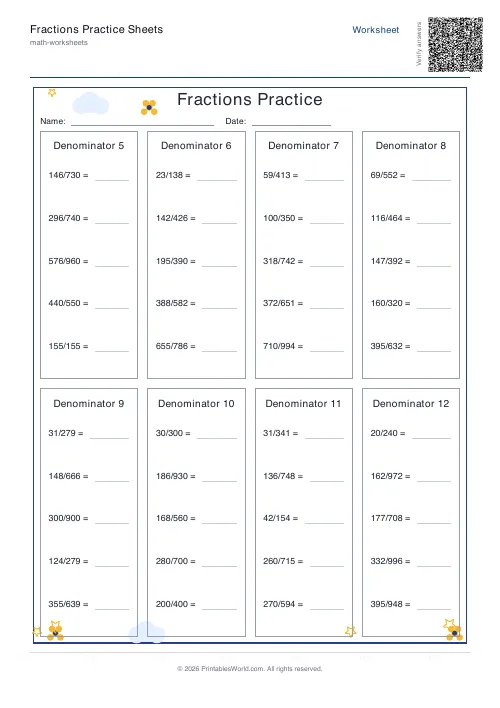
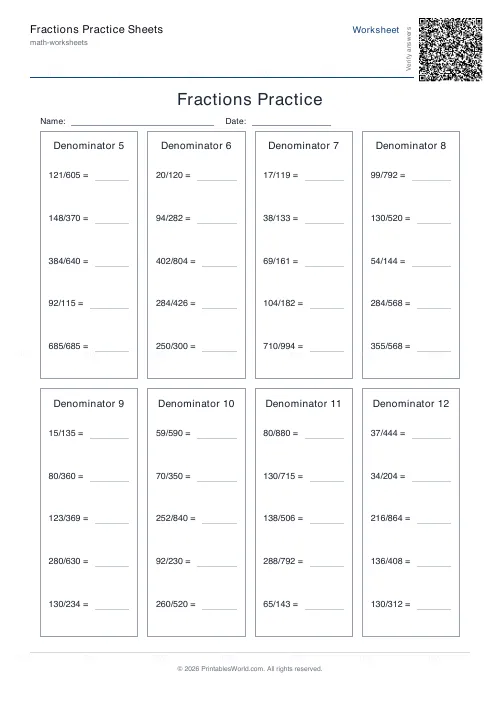
The fractions practice sheets generate sets at the stage you are working on, so you can keep the sheet narrow — equivalence only, or comparing only. A mixed sheet covering four skills at once tells you a child got six wrong without telling you which idea is missing.
Keep them short. Ten focused questions on one idea are worth more than forty mixed ones, and they leave time for the practical work that is doing the real teaching.
Frequently asked questions
What age do children start fractions?
Informal halving and sharing usually begins around ages five to six, with halves and quarters of shapes and small sets. Formal work with equivalence and adding typically comes later in primary school, though this varies between curricula.
My child can do the procedure but does not understand it. What now?
Go back to objects, even if it feels like a step backwards. Ask them to show you why 1⁄2 = 2⁄4 with paper. Procedures learned without meaning tend to collapse when the questions change shape.
Should I teach the "rules" at all?
Yes, eventually — fluent mathematicians do use them. The order is what matters: meaning first, then the rule as a shortcut for something they can already do slowly.
How much practice is enough?
Ten to fifteen minutes several times a week, on one idea at a time, does more than a long weekend session. Fractions reward returning to the same idea repeatedly rather than covering ground quickly.
Before you print
Fold paper before you print anything. Make sure equivalence is genuinely secure before touching addition with unlike denominators, and keep asking half of what? When you do want written practice, keep each sheet to a single idea — the fractions practice sheets will make one in a few seconds, and a fresh one tomorrow.
Related tools
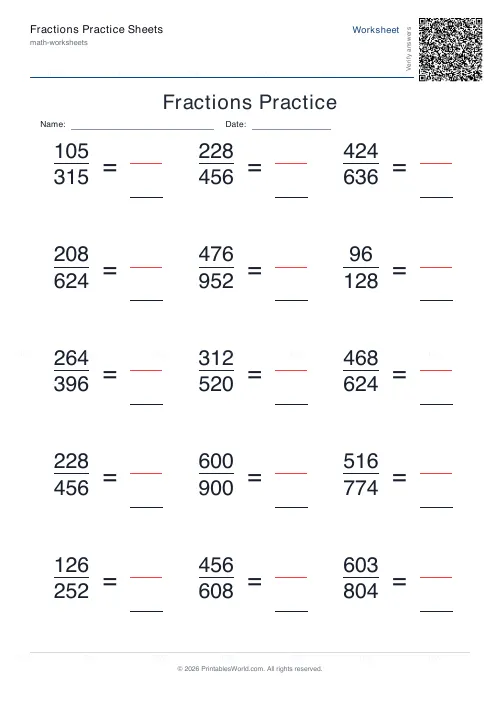
Fractions Practice Sheets Generator
Generate printable fraction simplification worksheets with custom ranges, layouts, and answer keys.
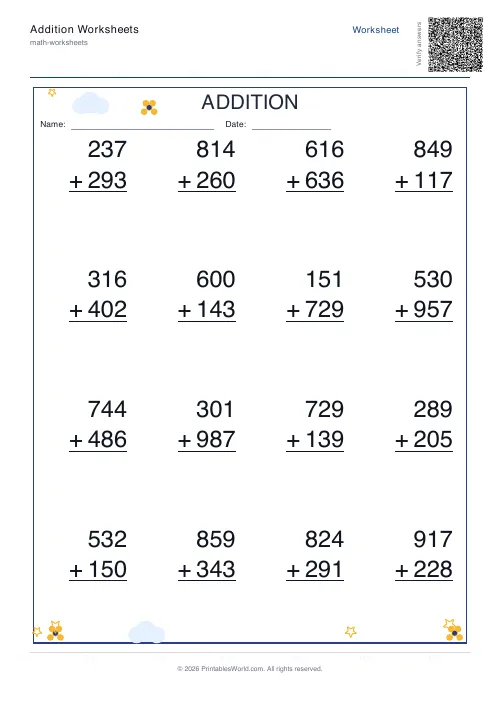
Addition Worksheets Generator
Free printable addition worksheets in tables or line-by-line layouts.
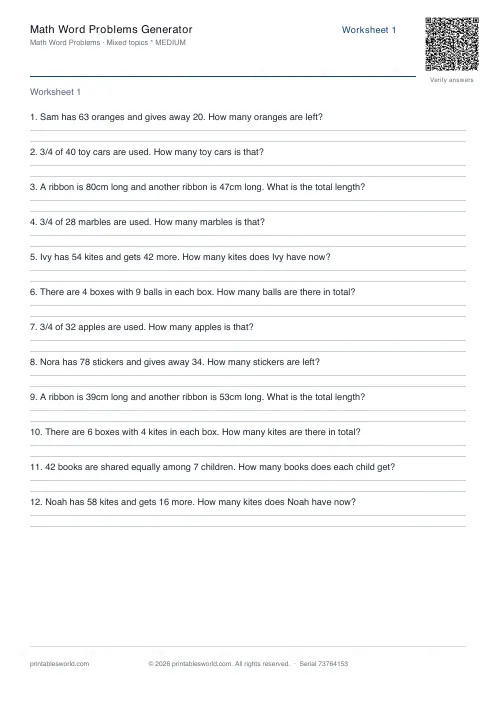
Math Word Problems Generator
Generate printable math word problem worksheets with customisable topics, difficulty, and answer keys.
Continue reading