Math Worksheets
Understanding BODMAS and PEMDAS: order of operations explained
By Jobi · Creator & Maintainer, PrintablesWorld · Updated 2026-07-10 · 5 min read
Order of operations is the rule that stops 2 + 3 × 4 having two answers. Without an agreed order, one reader gets 20 and another gets 14, and neither is being careless. Free printable order of operations worksheets give the practice, but the acronym itself is what most people half-remember and half-misapply.
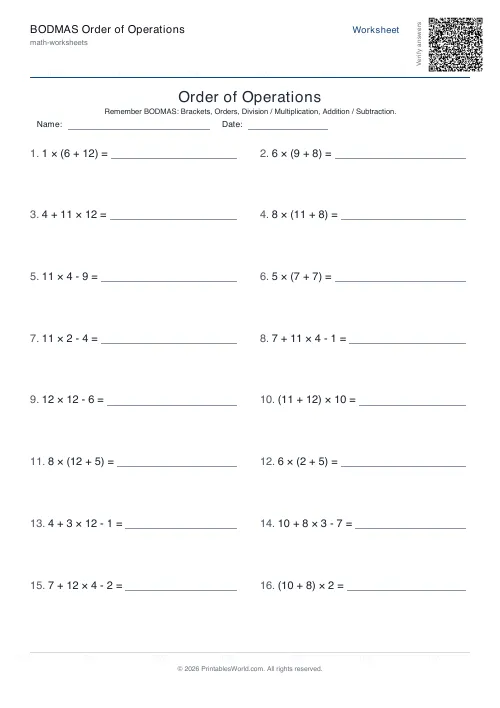 Order Of Operationsworksheet: With brackets
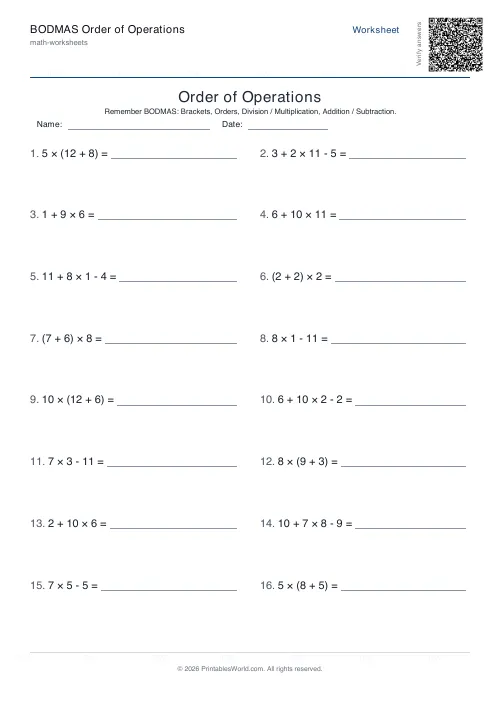 Order Of Operationsworksheet: With brackets, with answer key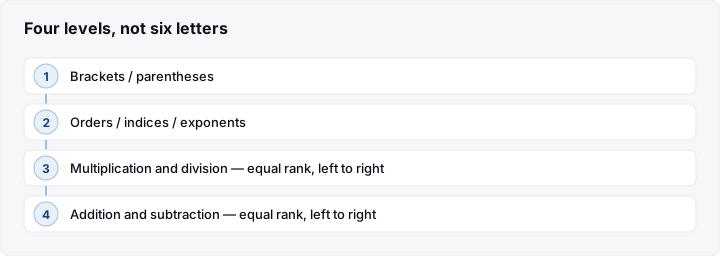
BODMAS and PEMDAS are the same rule
Which acronym you learned depends mostly on where you went to school.
- BODMAS: Brackets, Orders, Division, Multiplication, Addition, Subtraction. Common in the UK and much of the Commonwealth. Some places teach BIDMAS, with Indices instead of Orders.
- PEMDAS: Parentheses, Exponents, Multiplication, Division, Addition, Subtraction. Standard in the US, often remembered as "Please Excuse My Dear Aunt Sally".
Brackets and parentheses are the same thing. Orders, indices and exponents are the same thing. And although one acronym puts division before multiplication and the other reverses them, that difference does not matter: which is the first thing the acronym hides.
The two things the acronym hides
1. Multiplication and division rank equally. So do addition and subtraction.
They are not four separate steps; they are two. Multiplication and division sit on one level, addition and subtraction on the next. This is why BODMAS and PEMDAS give identical answers despite listing the middle pair in opposite orders.
2. Where operations rank equally, work left to right.
Nothing in either acronym says this, and it is the source of most errors. Take 20 ÷ 5 × 2. Reading BODMAS as "division before multiplication" gives 20 ÷ 10 = 2. Working left to right gives 4 ÷ 2 = 8, and 8 is correct.
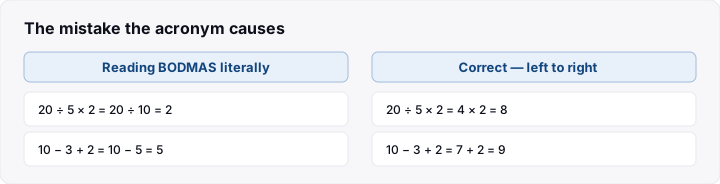
So the honest version of the rule has four levels, not six:
- Brackets
- Orders / exponents
- Multiplication and division, left to right
- Addition and subtraction, left to right
A worked example, step by step
Take 6 + 2 × (9 − 4)² ÷ 5.
- Brackets first: 9 − 4 = 5, giving 6 + 2 × 5² ÷ 5.
- Orders: 5² = 25, giving 6 + 2 × 25 ÷ 5.
- Multiplication and division, left to right. The multiplication comes first in the line, so 2 × 25 = 50, giving 6 + 50 ÷ 5. Then 50 ÷ 5 = 10, giving 6 + 10.
- Addition: 16.
Note step 3. Had we done the division first because BODMAS lists D before M, we would have had 2 × 5 = 10 and then 6 + 10 = 16. The same answer here by coincidence. Change the numbers slightly and it stops being a coincidence, which is exactly why left-to-right has to be taught explicitly rather than left to luck.
The four mistakes that cost marks
Doing division before multiplication because the acronym says so. The single most common error. They rank equally; go left to right.
Doing addition before subtraction for the same reason. Same fix. 10 − 3 + 2 is 9, not 5.
Forgetting that a fraction bar is a bracket. In an expression written as a fraction, everything above the line is grouped and everything below it is grouped, whether or not brackets are printed.
Mishandling a minus sign with powers. −3² is −9, because the exponent binds to the 3 before the negative is applied. (−3)² is 9. Worth its own short lesson.
Why those viral Facebook sums are unfair
Every few months an expression like 6 ÷ 2(1 + 2) circulates with people arguing for 1 and for 9.
The argument is not really about the rule. It is about whether implied multiplication, the multiplication signalled by writing 2(3) rather than 2 × 3, binds more tightly than explicit division. Some conventions, particularly in higher mathematics and some textbooks, treat it as binding tighter, giving 1. Standard school convention treats it as ordinary multiplication, giving 9.
The genuine lesson is that the expression is badly written. A mathematician would add brackets rather than defend an answer. If a child brings one of these home, the most useful response is that ambiguous notation is a fault in the question, not a test of the reader.
Teaching it so it sticks
Teach it as four levels, not six letters, and write the levels somewhere visible. Children who memorise six letters produce the division-before-multiplication error almost immediately.
Have them underline the part they are about to do at each step and rewrite the whole expression. Skipping the rewrite is where sign errors and dropped terms creep in.
Start without brackets and add one layer at a time: two operations, then three, then brackets, then powers. A sheet mixing all four from the first question tells you a child got six wrong without telling you which level failed. The order of operations generator lets you keep each sheet narrow.
Once the rule is secure, it transfers straight into algebra, where the same levels govern how expressions are simplified. An introduction to algebra sheet is the natural next step.
Frequently asked questions
Is BODMAS or PEMDAS correct?
Both. They are the same rule with different regional wording, and they give the same answer provided you remember that multiplication/division rank equally and addition/subtraction rank equally.
Why does order of operations exist at all?
It is a convention, not a discovery. Agreed so that everyone reads an expression the same way. Without it, written mathematics would be ambiguous, much like language without punctuation.
What age is this taught?
Usually upper primary or early secondary, once multiplication and division are fluent. Curricula vary, but it tends to arrive shortly before algebra, because algebra depends on it.
Do calculators follow it?
Scientific calculators do. Basic four-function calculators often do not. They evaluate strictly as you type. That difference is worth demonstrating: type 2 + 3 × 4 into both and compare.
Before you print
Teach four levels rather than six letters, say "left to right" out loud every time, and add one layer of difficulty per sheet. Print the order of operations worksheets narrow rather than mixed, and move to introductory algebra once the four levels are automatic.
Related tools
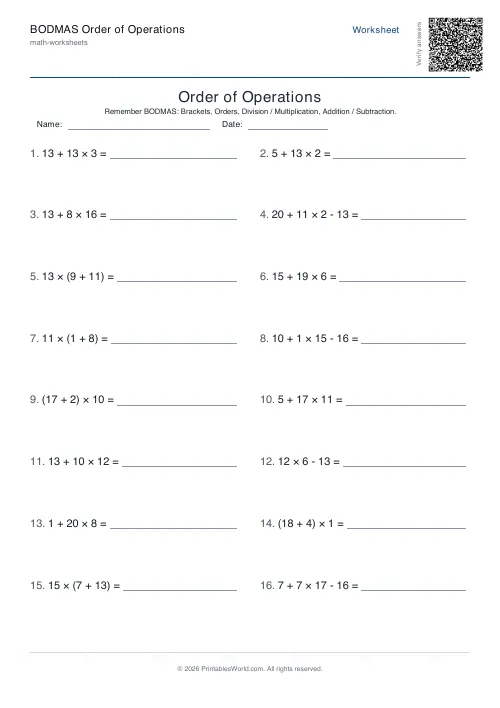
BODMAS Order of Operations Generator
Order-of-operations practice with brackets, exponents and mixed arithmetic.
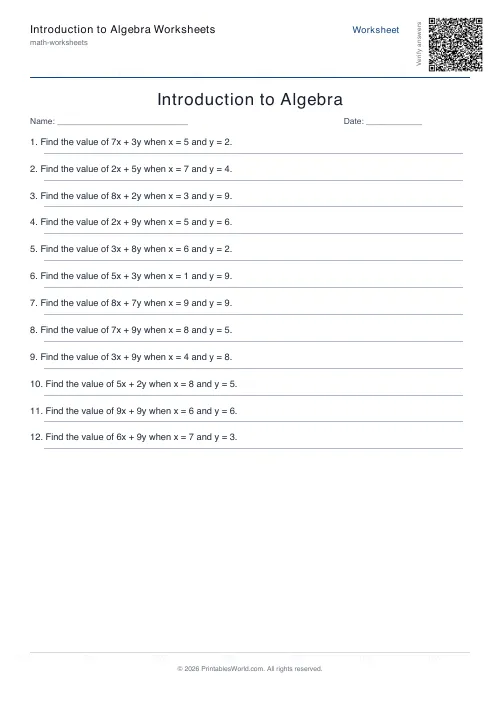
Introduction to Algebra Worksheets
Printable beginner algebra practice. Evaluate, simplify, and substitute.
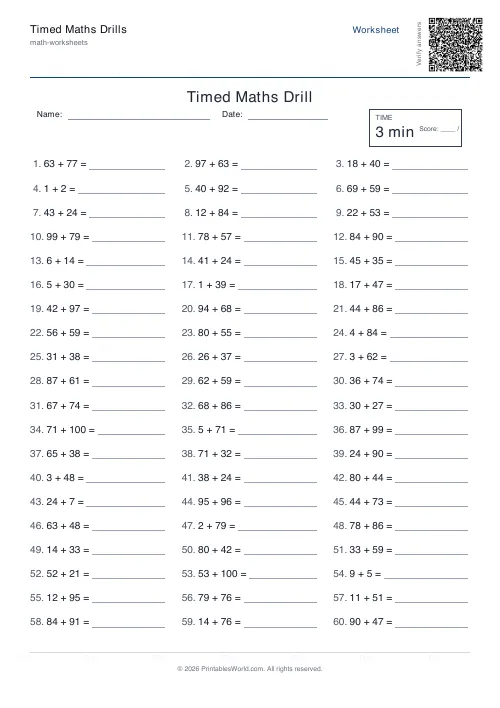
Timed Maths Drills Generator
Dense 50–100 question timed drills with a printed timer box and score line.
Continue reading
Math Worksheets
Making maths fun: 15 ways to practise without tears
Maths tears are usually about difficulty, length or fear of being wrong, not about maths. Fifteen practical changes, grouped by which of those three problems they actually solve.
6 min read
Math Worksheets
Fractions made simple: teaching fractions at home
Fractions go wrong when the rules arrive before the meaning. Here is the order that works, the four misconceptions to head off early, and how to use everyday objects before any worksheet.
6 min read