Handwriting
Print vs cursive: which should children learn first?
By Jobi · Creator & Maintainer, PrintablesWorld · Updated 2026-06-19 · 6 min read
Ask two teachers whether children should learn print or cursive first and you may well get two confident, opposite answers. Both are defensible, which is the honest starting point for this question. A free printable handwriting practice generator will produce sheets in either style, so the decision is about teaching order rather than resources.
What the two styles actually are
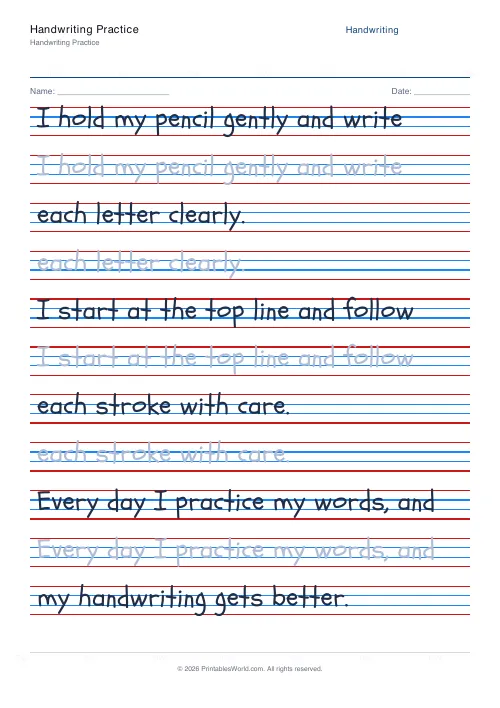
Print (also called manuscript, or ball-and-stick) uses separate letters made of straight lines and circles. It closely matches the letters children see in books and on screens.
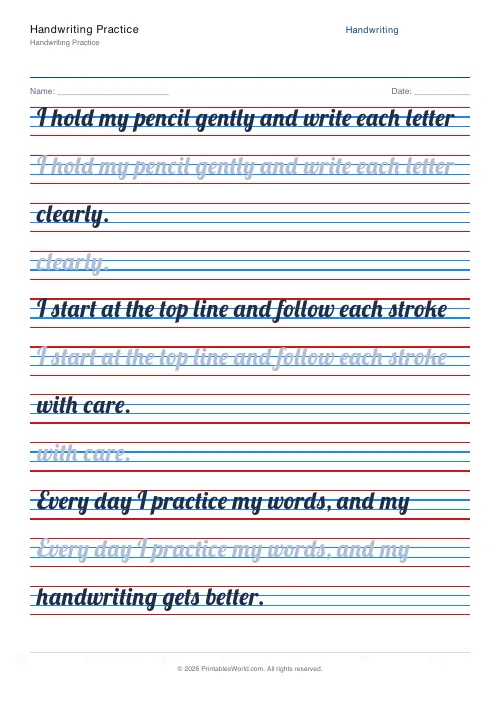
Cursive joins letters with linking strokes so the pencil lifts less often. There are several varieties: fully joined cursive, semi-joined styles, and "continuous cursive", where every letter begins with a lead-in stroke from the baseline so joining is natural from the start.
That third variety is the reason the debate is often confused. A school teaching continuous cursive from the first day is doing something quite different from a school teaching print and adding joins at age seven — but both describe themselves as "teaching cursive".
The case for print first
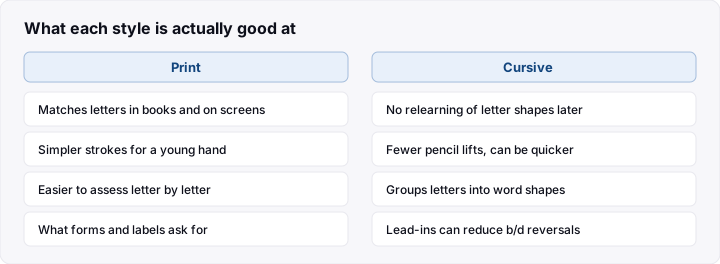
- It matches what children read. The letters in books, on signs and on screens are print. A child learning to read and write simultaneously meets one letter shape rather than two.
- The strokes are simpler. Straight lines and circles are within reach of a hand that cannot yet manage a controlled curve-and-join.
- It is easier to assess. A separated letter is either formed correctly or not; a joined one can hide a badly formed letter inside a fluent-looking word.
- Forms and labels want it. Block capitals and clear print remain what adults are asked for on official paperwork.
The case for cursive first
- No relearning. Teaching print then cursive means teaching letter shapes twice. Continuous cursive from the start avoids the second pass.
- Fewer pencil lifts. Once fluent, joined writing can be quicker, which matters for extended writing and exams.
- Word shape. Joining groups letters into words visually, which some teachers find supports spelling patterns.
- Reversals. A lead-in stroke starting on the baseline gives b and d different starting movements, which can reduce the classic confusion.
What the research does and does not show
This is where both camps tend to overclaim. The evidence base comparing print-first with cursive-first is smaller and more mixed than the confidence of the arguments suggests, and much of it is correlational or uses small samples.
What is reasonably well supported is broader: forming letters by hand appears to engage processes linked to letter recognition in ways that tracing or typing do not, and handwriting fluency — how automatic it is — is associated with the quality and length of what children write, presumably because a child not thinking about letter formation has more attention for content.
Note that neither of those findings favours one style. They favour handwriting practice in general. Anyone citing them as proof that cursive specifically raises attainment is stretching them.
The practical conclusion: choose on the grounds below, and do not expect the choice itself to change outcomes much. What the child does with the pencil matters more than which style the pencil is making.
How to decide for one child
Three questions settle it in most cases.
What does their school do? This is the strongest factor, and it usually ends the discussion. A child taught continuous cursive at school and print at home is being taught two systems at once, which helps nobody. Match the school.
How is their fine motor control? A child who finds a controlled curve difficult will find joined writing harder, not easier. Print first gives them simpler shapes while control develops.
What is the goal right now? If a child is struggling to be understood, legibility is the target and print is the shorter route. If they are legible but slow, joining is the thing worth working on.
Making the move from print to cursive
If you are moving a child from print to joined writing, do not start with the alphabet again.
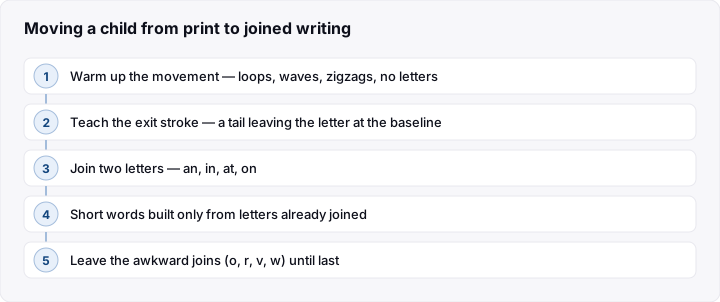
- Warm up the movement. Rows of loops, waves and zigzags rehearse the joining action without any letters involved.
- Teach the exit stroke. Most joins are just a tail leaving the letter at the baseline. Practise adding a tail to letters the child already writes well.
- Join two letters. Pairs before words — an, in, at, on.
- Then short words built only from letters already joined.
- Leave the awkward joins until last. Letters ending high — o, r, v, w — and the descenders take longer. They are a separate lesson, not a failure.
The upper and lower case practice sheets are useful in the transition, since capitals in most cursive schemes stay unjoined and can be practised separately.
Frequently asked questions
Do children still need to learn cursive?
It depends where you are. Some school systems require joined writing and assess it; others dropped it from the core curriculum and leave it to individual schools. Even where it is not required, children generally need to be able to read cursive to cope with handwritten notes from adults.
Is cursive actually faster?
It can be once fluent, because the pencil lifts less often. But a slow cursive writer is not faster than a fluent print writer, and fluency comes from practice rather than from the style. Speed follows automaticity either way.
My child's school teaches cursive and I only know print. Does that matter?
Not much, as long as you support rather than contradict. Ask the school for their letter formation sheet and use that as your model. Teaching a different set of shapes at home is the one thing to avoid.
Can a child learn both?
Yes, and most eventually do — print for forms and labels, joined writing for continuous text. The argument is only about which to teach first, not whether both are useful.
Sources and further reading
- National Handwriting Association, on handwriting styles and teaching practice.
- James, K. H. and Engelhardt, L. (2012), The effects of handwriting experience on functional brain development in pre-literate children, Trends in Neuroscience and Education.
Before you print
Match the school first; if there is no school to match, print is the gentler start for a young hand and joining can follow once letters are secure. Whichever you choose, the practice matters more than the style — the handwriting practice generator makes sheets in either.
Related tools
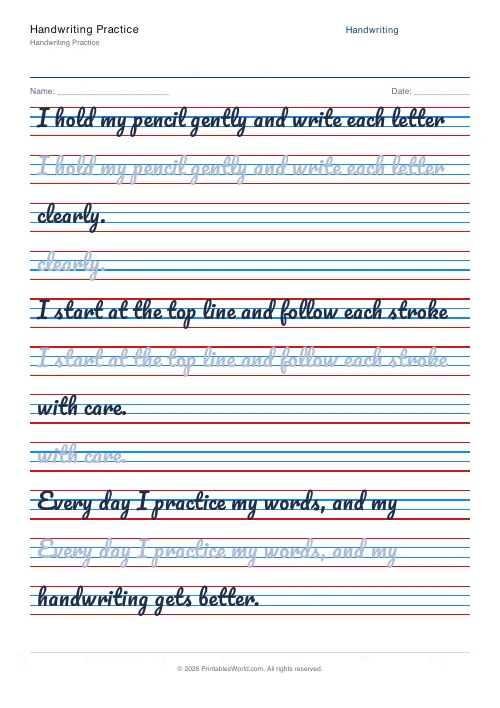
Handwriting Practice Generator
Create custom 4-line handwriting practice sheets with trace rows, adjustable guides, and your own text.
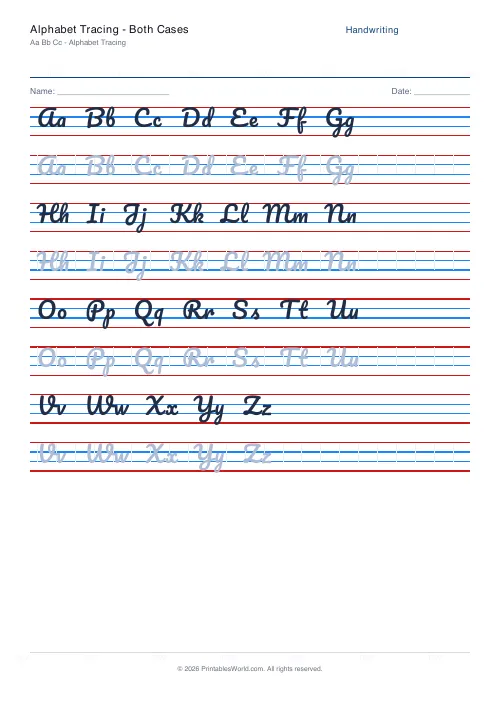
Alphabet Tracing: Both Cases
Uppercase and lowercase letters paired on one sheet for comparison.
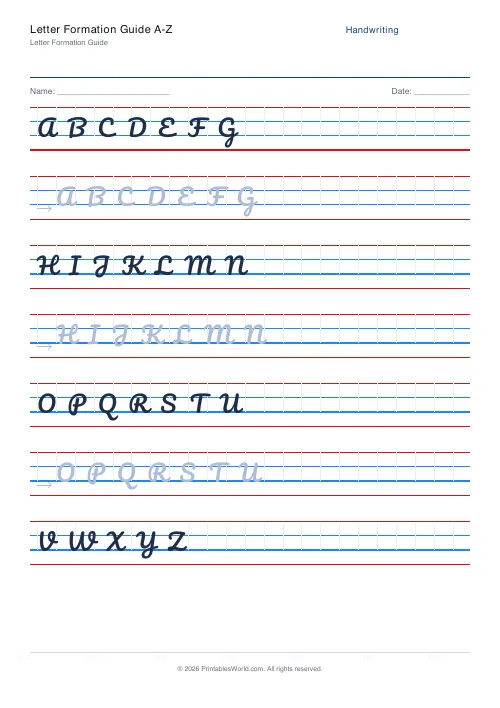
Letter Formation Guide A-Z
Full alphabet with directional arrows for stroke-order learning.
Continue reading
Handwriting
How to teach cursive at home: a step-by-step plan
A simple step-by-step plan for teaching cursive at home, with letter families grouped by stroke, a four-week practice sequence, and free printable sheets to download.
8 min read
Handwriting
How to teach handwriting to kids: a step-by-step guide
A practical order for teaching handwriting: get the body and the pencil right first, then teach letters in stroke families rather than alphabetically, and keep sessions short enough that the hand never tires.
7 min read