Planners
Study planning for exams: a student's complete guide
By Jobi · Creator & Maintainer, PrintablesWorld · Updated 2026-07-26 · 5 min read
Most revision timetables fail in one of two ways: they are so ambitious that they are abandoned in week one, or they are followed faithfully and fill the hours with re-reading, which feels productive and is one of the weakest ways to study. A free printable exam revision timetable solves the first problem. The second needs a decision about what goes in the slots.
Work backwards from the exam date
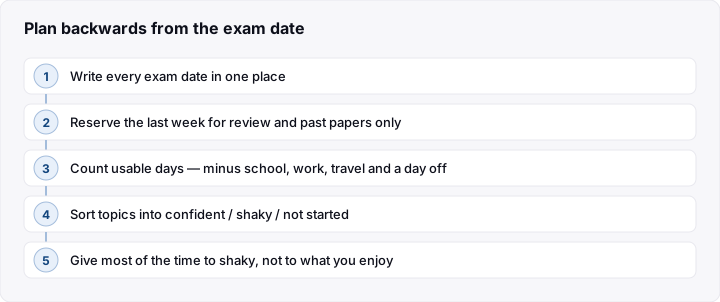
Start at the exam and move back, not from today forwards. Forwards planning produces a timetable that runs out of road; backwards planning shows you immediately whether the plan is possible.
- Write every exam date in one place. Clashes and clusters are the constraint everything else bends around.
- Reserve the last week for review and past papers only. No new material.
- Count the usable days between now and each exam, not calendar days. Subtract school, work, travel and at least one day off a week.
- Divide the topics across those days.
If the arithmetic does not fit, you have found that out with weeks to spare rather than three days before. That is the entire value of planning backwards, and it usually means prioritising rather than working faster.
Audit before you schedule
Most students give the most time to the subjects they like, which are usually the ones they already know. Sort every topic into three groups before allocating a single hour:
- Confident: could answer a question on it today. Needs light review only.
- Shaky: understood it once. This is where most of your time belongs.
- Not started: needs teaching before it needs revising, and probably needs help.
Be honest, and check the honesty: try a past question rather than relying on the feeling of familiarity. Recognising material is not the same as being able to produce it, and confusing the two is the most common revision mistake there is.
What actually works in a study session
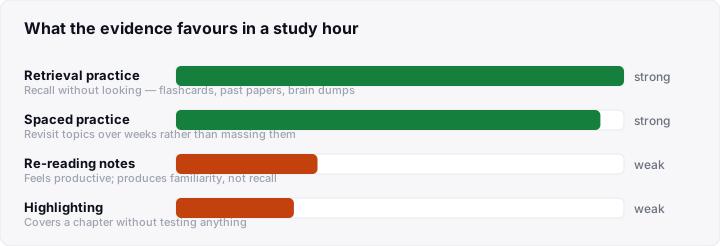
Research on study techniques fairly consistently favours two, and consistently finds two popular ones weak.
Retrieval practice: trying to recall the material without looking. Flashcards, blank-page brain dumps, answering questions from memory, past papers. It feels harder and less pleasant than re-reading, which is precisely why it works: the effort of retrieval is what strengthens the memory.
Spaced practice: spreading study over time rather than massing it. Covered below.
By contrast, re-reading notes and highlighting tend to perform poorly. Both produce a strong feeling of familiarity that is easily mistaken for knowing, and both let you cover a chapter without ever testing whether you could reproduce any of it.
The practical rule: if a study hour involved no moment where you tried to remember something without looking, it was probably not a study hour.
Spacing: why little and often wins
Six hours on one topic in a day is worse than one hour on six days, for the same total. Memory benefits from being allowed to fade slightly and then retrieved again. The difficulty is doing the work.
In practice this means revisiting each topic several times across the revision period rather than finishing it and moving on. A simple pattern that fits a timetable: cover a topic, revisit after two days, again after a week, again after two weeks.
This is also the argument against subject-per-week timetables, which look tidy and mean each subject is untouched for weeks at a time. Mixing subjects within a week is less satisfying to plan and more effective.
Building the timetable
With the audit done and the days counted:
- Sessions of 30–50 minutes with a short break. Long sessions drift into re-reading.
- Name the topic and the method in each slot. "Photosynthesis: past questions from memory", not "Biology". A vague slot becomes re-reading by default.
- Two or three subjects a day, not one.
- One day off a week, scheduled. A timetable with no rest is abandoned rather than followed.
- Leave 20% empty for overruns and the topics that turn out harder than expected.
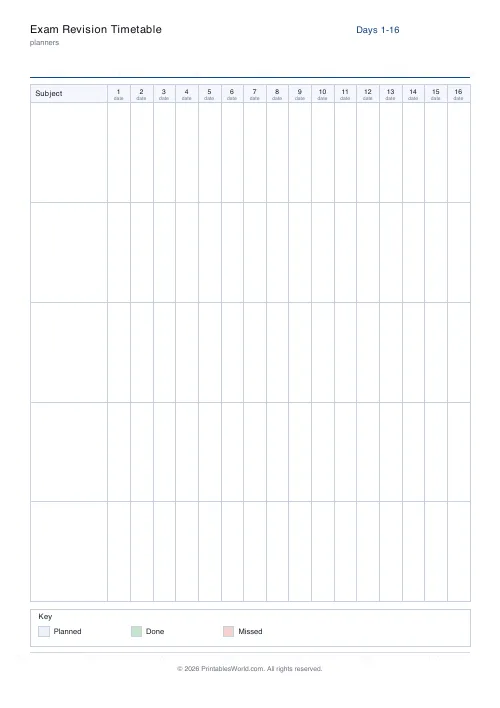
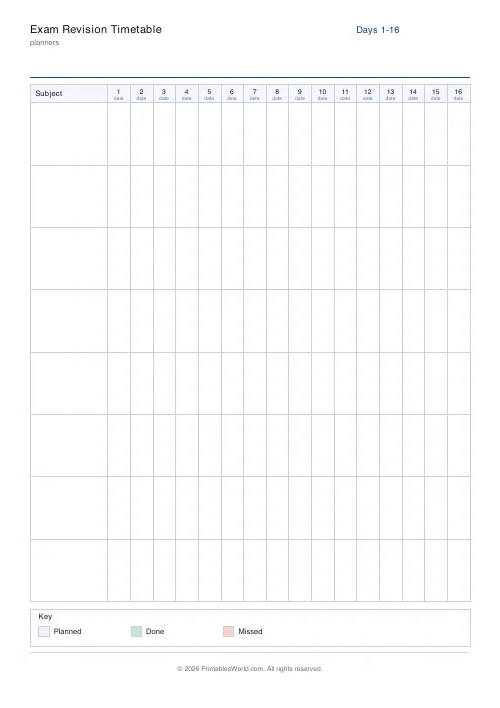
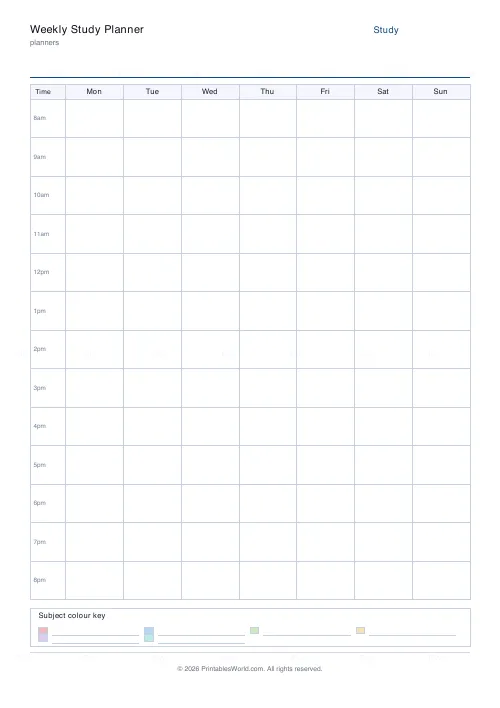
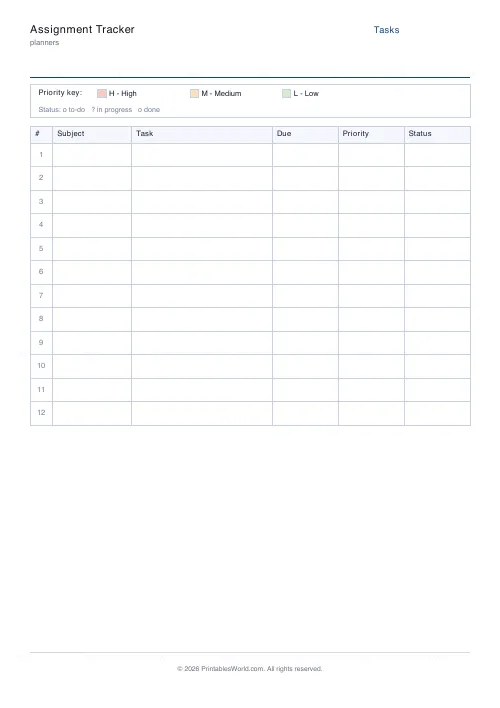
Track what has actually been covered separately from what was planned. The assignment tracker works for this, and the gap between the two lists is the most useful information you will get all term. For week-by-week structure alongside it, the weekly study planner is the lighter option.
When you fall behind
Everyone does. The failure is not falling behind; it is responding by abandoning the plan.
Do not try to catch up by rescheduling everything you missed. Instead, re-run the audit quickly: what is still shaky, what is now confident, what has become urgent because the exam moved closer? Then rebuild the remaining days from that, accepting that some low-value topics will get less time than you hoped.
Prioritising deliberately beats attempting everything badly. A student who knows three quarters of the syllabus well generally does better than one who has skimmed all of it.
Frequently asked questions
How many hours a day should I revise?
Fewer than most timetables assume. Three to four focused hours is a realistic day for most students alongside school; more than that tends to become passive reading. Quality of the hour matters more than the count.
When should I start?
Early enough to space the material, which for major exams usually means a couple of months rather than a couple of weeks. Starting early mainly buys you the ability to revisit topics, which is where the benefit lies.
Are past papers the best revision?
They are among the most useful, because they combine retrieval practice with the format of the exam. Do them from memory and under time pressure at least sometimes. An open-book past paper is a reading exercise.
Should I revise with friends?
It depends what you do. Testing each other is genuine retrieval practice and works well. Sitting in the same room reading is usually just company, which has its own value but is not revision.
Before you print
Plan backwards from the exam, audit topics honestly with a past question, name the method in every slot, and revisit rather than finish. Print the revision timetable for the whole period and the weekly study planner for the week you are actually in.
Related tools
Continue reading
Planners
Time blocking for beginners: a complete guide
Time blocking is deciding when each task happens, not just what. Here is how to size blocks realistically, what to do when the day breaks, and why most beginners over-schedule.
5 min read
Planners
How to build a daily routine that actually sticks
Most routines fail in week two, when motivation runs out and nothing has replaced it. The fix is structural: fewer items, fixed anchors, and a plan for the day you miss.
6 min read