Word Puzzles
Fun ways to build vocabulary in kids
By Jobi · Creator & Maintainer, PrintablesWorld · Updated 2026-06-26 · 5 min read
Vocabulary is one of the better predictors of reading comprehension, which is why it gets so much attention. The unhelpful conclusion people draw is that children should memorise word lists. Most vocabulary is not learned that way. It is picked up from repeated encounters in contexts that make the meaning inferable. Free printable vocabulary sheets have a real role, but a supporting one.
How children actually learn words
Three things matter more than any activity.
Repeated encounters. A single meeting with a word rarely sticks. Estimates of how many exposures are needed vary widely, but the direction is consistent: several encounters, spread out, in different contexts. This is why wide reading beats any list. It produces those encounters naturally.
Context that makes meaning inferable. A word met in a sentence that gives it away teaches itself. A word met in isolation teaches nothing until it is defined, and a definition alone is usually forgotten.
Depth, not just recognition. Knowing a word properly means knowing what it means, how it is used, what it collocates with, and roughly how formal it is. A child who can define "reluctant" but never uses it has partial knowledge.
Reading, and reading aloud past the age you stopped
Wide independent reading is the single biggest contributor, because written language uses vocabulary that conversation does not. Everyday speech is remarkably repetitive; books are where the unusual words live.
The more actionable point: keep reading aloud after a child can read independently. Most families stop around seven or eight, which is precisely when it becomes most valuable for vocabulary. A child's listening comprehension runs well ahead of their reading ability for years, so reading aloud exposes them to language they could not yet access alone.
Audiobooks do a similar job and are worth using without guilt, particularly for a reluctant reader or a long car journey.
Talking like the book
The vocabulary a child hears at home is a large part of what they end up with, and the useful habit is simply not simplifying by default.
Use the precise word and then gloss it in passing, "it's enormous, absolutely huge", so the meaning arrives with the word and nothing is interrupted. Children absorb a great deal this way without any activity taking place.
Other things that cost nothing: narrating what you are doing with the real names for it, offering an alternative when they use a vague word ("it was good", "brilliant? interesting? funny?"), and answering "what does that mean?" properly rather than substituting an easier word.
Which words to teach directly
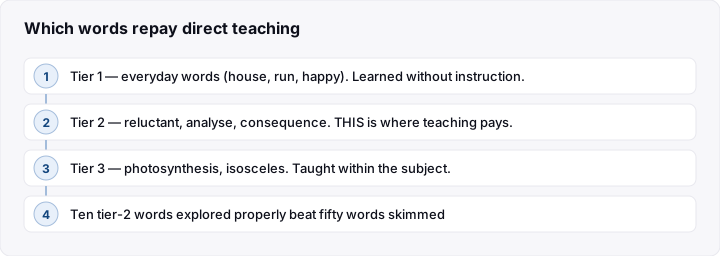
Direct teaching has limited time, so it should target the words that repay it. A widely used framework sorts vocabulary into three tiers:
- Tier 1: everyday words (house, run, happy). Learned without instruction.
- Tier 2: words that appear across many subjects and in books but not much in speech (reluctant, analyse, consequence, fortunate). This is where direct teaching pays.
- Tier 3: subject-specific terms (photosynthesis, isosceles). Taught within the subject when needed.
Tier 2 is the productive target because those words unlock comprehension across everything and are unlikely to be picked up from conversation. A list of ten tier-2 words worked on properly beats fifty mixed words skimmed.
Games and puzzles that help
These consolidate words already met. Treat them as review rather than introduction.
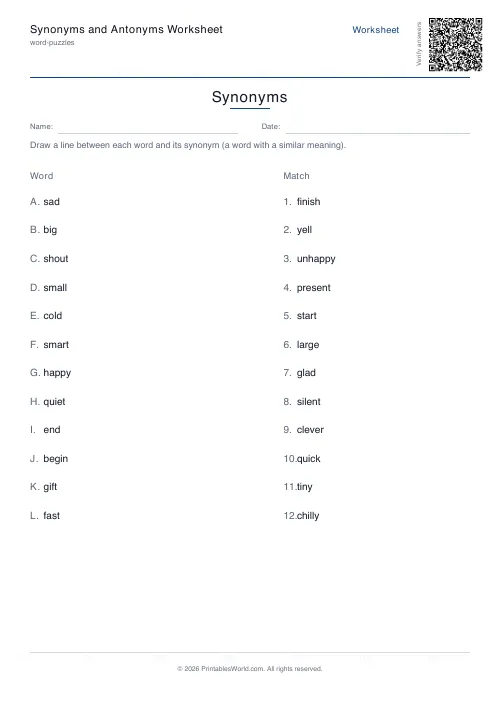
- Synonym and antonym work. Building a shade-of-meaning ladder, warm, hot, scorching, teaches precision rather than substitution. Synonym and antonym sheets suit this directly.
- Word of the day, used deliberately by everyone in the house until bedtime. Silly and effective.
- Call my bluff. Three definitions, one true. Excellent, and children love writing the false ones.
- Categories and word association, in the car, no materials.
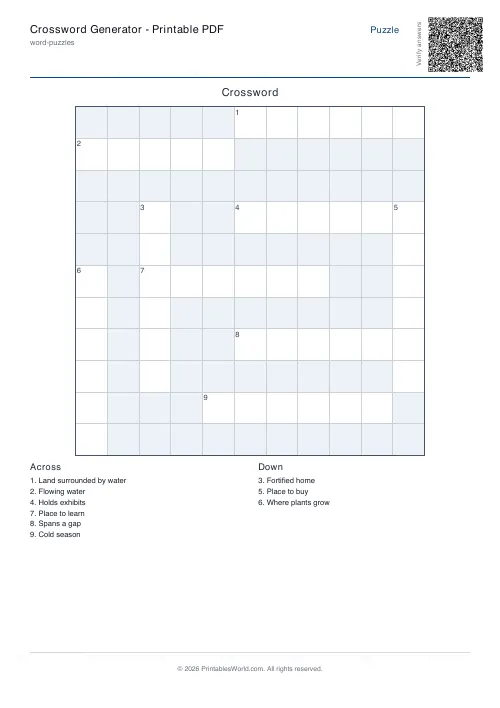
- Crosswords with definition clues, which force recall from meaning.
- Word roots. Teaching that aqua means water unlocks a family of words at once and is one of the highest-leverage things you can do with older children.
Frequently asked questions
Do vocabulary lists work?
Only partly. Lists can introduce words efficiently, but words learned from a list and never met again tend to fade. They work best when the listed words then appear in reading, conversation and writing over the following weeks.
How many new words should a child learn a week?
For direct teaching, a handful, five to ten tier-2 words, properly explored, is more effective than a long list skimmed. Most vocabulary growth happens outside direct teaching anyway.
My child reads a lot but has a small vocabulary. Why?
Possibly the reading is narrow. The same series or level repeatedly, which recycles the same words. Widening the range, including non-fiction, usually helps. It is also worth checking they are not skipping unknown words entirely rather than inferring them.
Should I make them look up every unknown word?
No. It interrupts reading and makes it a chore. Encourage inferring from context, and look up the ones that matter or keep recurring.
Before you print
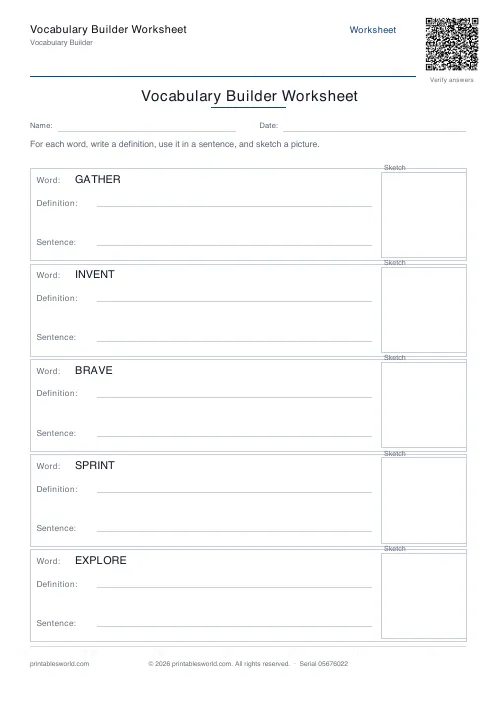
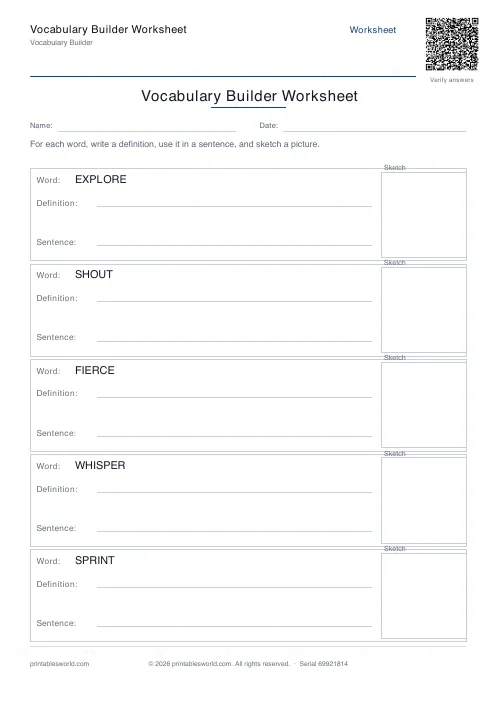
Keep reading aloud past the age you were planning to stop, use the precise word and gloss it in passing, and target tier-2 words for the direct teaching you do. Print vocabulary sheets and synonym and antonym sheets to consolidate words already met rather than to introduce new ones.
Related tools
Continue reading
Word Puzzles
Crosswords for kids: age-by-age difficulty guide
The grid size matters less than the clues. Here is what suits each age, and the four clue types that work with children. Plus the one that does not.
5 min read
Word Puzzles
Sight words: the complete teaching guide
Sight words are usually taught as words to memorise. Most of them are partly decodable, and treating them that way works better. Here is how, and how many to teach at once.
6 min read