Mazes
Printable maze difficulty: matching mazes to ages
By Jobi · Creator & Maintainer, PrintablesWorld · Updated 2026-06-11 · 4 min read
Maze difficulty is usually presented as one slider from easy to hard. It is really two, and they solve different problems: how hard the maze is to draw through, and how hard it is to solve. A free printable maze generator lets you set both, which is the main reason to generate rather than photocopy.
The two dials
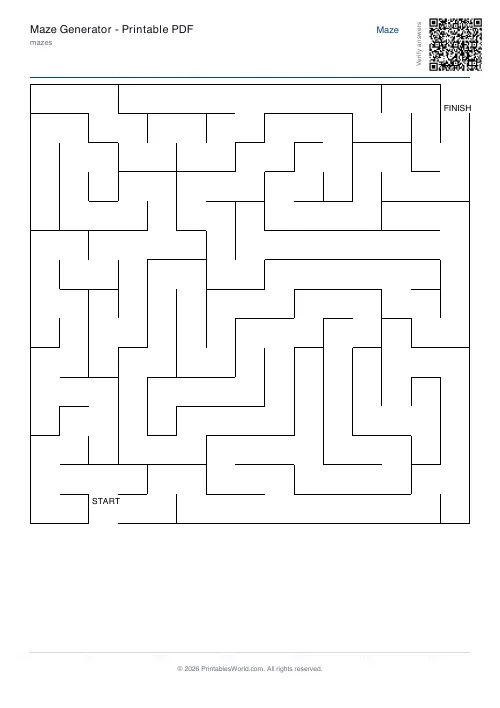
Corridor width and line thickness govern the motor demand. How precisely a child must control the pencil to draw a line without touching the walls.
Grid size and complexity govern the cognitive demand. How many decisions there are, how many dead ends, how far ahead you must look.
These are independent. A maze can be wide-corridored and complex, or fine and trivial. Treating difficulty as a single slider is what produces a maze that is either fiddly and boring or spacious and instantly solved.
By age, roughly
Starting points, not rules. A child's pencil control and puzzle experience matter more than their age.
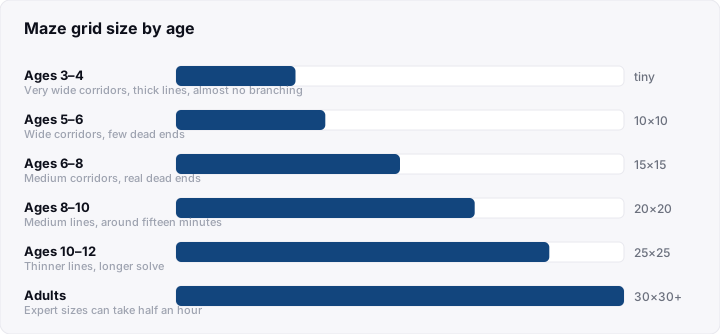
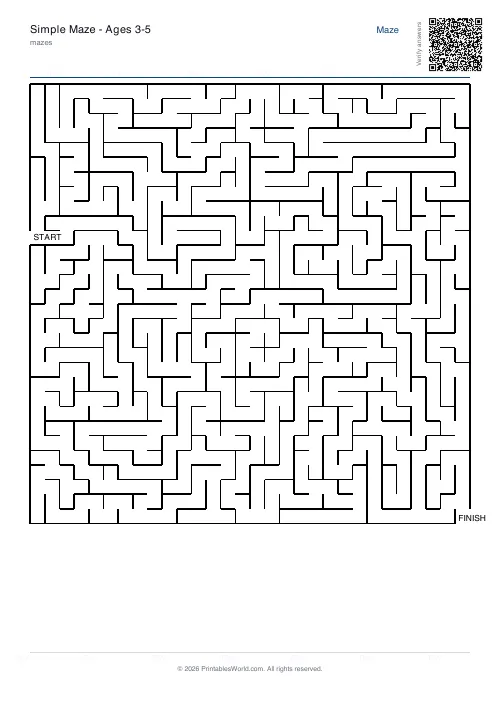
- Ages 3–4: very wide corridors, thick lines, a short path with almost no branching. Often solvable with a finger before a pencil.
- Ages 5–6: wide corridors, roughly a 10×10 grid, few dead ends. Around five minutes.
- Ages 6–8: medium corridors, 15×15, real dead ends. Ten minutes or so.
- Ages 8–10: 20×20, medium lines. Fifteen minutes for many children.
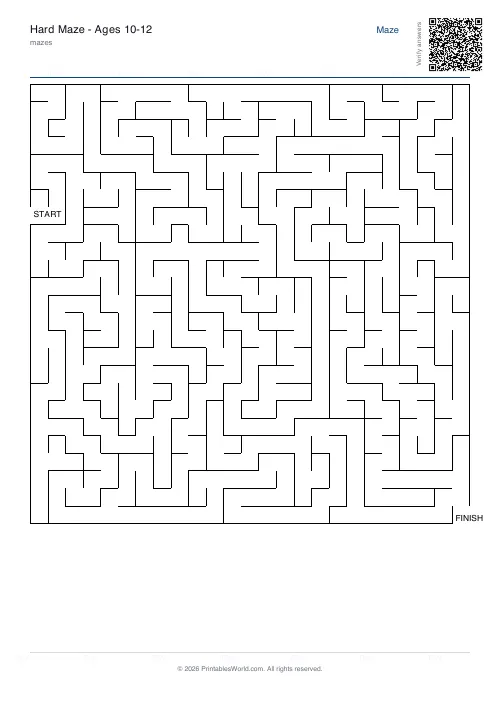
- Ages 10–12: 25×25, thinner lines, longer solve.
- Adults: 30×30 and above; expert sizes can occupy half an hour.
Pitch below where you think they are for a first maze. A child who finishes quickly asks for a harder one; a child who abandons one rarely asks for another.
The mismatch cases
This is where separating the two dials earns its keep.
An older child with weak pencil control wants a complex maze with wide corridors. Reducing the grid size would be insulting and boring; narrow corridors would defeat them. This combination is genuinely useful for occupational-therapy-style practice, and it is not available from a maze book.
A young child who is good at puzzles wants the reverse: wide corridors and a bigger grid, so the thinking is stretched while the drawing stays achievable.
A child who is frustrated: widen the corridors first, before simplifying the maze. Frustration is more often about the line going wrong than about being lost.
A child who is bored: increase the grid size before narrowing the corridors. Boredom is about the thinking, not the drawing.
Maze type also changes difficulty
A perfect maze has exactly one route between any two points and no loops. Every wrong turn ends in a dead end, which makes backtracking straightforward.
A braided maze has loops and few or no dead ends, so more than one route reaches the exit. That sounds easier and is not always. You can circle indefinitely without ever hitting a dead end to tell you that you were wrong. Braided mazes suit races between two children, since neither is stuck for long.
Shaped mazes, an egg, a tree, a heart, carry an extra consideration. The outline itself can help, because a pinch point in the silhouette forces the route through it. That makes a shaped maze often slightly easier than a rectangular one of the same size, and considerably more appealing to a reluctant child.
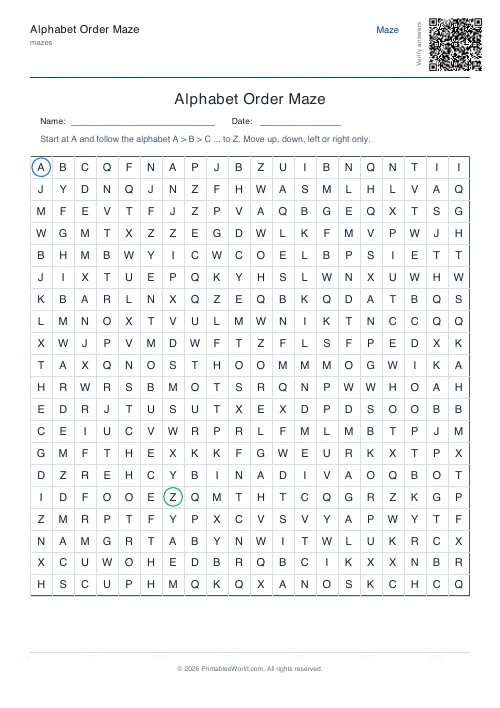
For content alongside the puzzle, an alphabet order maze requires following A to Z through the grid, which adds a second task to the same sheet.
Frequently asked questions
What size maze suits a five-year-old?
Around 10×10 with wide corridors and thick lines. Fewer dead ends matters more than the grid size at that age.
Should I use thick or thin lines?
Thick for young children and anyone with limited pencil control. It widens the visual path and is more forgiving. Thin lines suit older solvers and make a large grid legible.
How long should a maze take?
Five minutes for a young child, ten to fifteen for primary age, longer for expert sizes. If a child is still going after twenty minutes and losing interest, it was pitched too high.
Are shaped mazes easier than square ones?
Often slightly, because the outline constrains the route and pinch points force the path. They are also more motivating, which matters more than the small difference in difficulty.
Before you print
Set corridor width for the hand and grid size for the head, separately. If a child is frustrated, widen the corridors; if they are bored, enlarge the grid. Print a maze a notch easier than you think for a first attempt, and try a shaped or alphabet maze for a child who needs a reason to finish.
Related tools
Continue reading
Mazes
Why mazes are great for kids' development
Mazes are one of the few activities that exercise pencil control and forward planning at the same time. Which is why they suit the years just before formal handwriting.
4 min read
Logic Puzzles
The benefits of logic puzzles for developing brains
Logic puzzles teach deduction and persistence, which are worth having. The claim that they make children generally smarter is weaker than the marketing suggests.
5 min read