Mazes
Why mazes are great for kids' development
By Jobi · Creator & Maintainer, PrintablesWorld · Updated 2026-07-05 · 4 min read
Mazes look like pure entertainment, which is part of why they work. Children do them willingly and at length. What they exercise underneath is a genuinely useful combination: the hand that will later hold a pencil for writing, and the habit of looking ahead before committing. Free printable mazes at any difficulty take seconds to produce.
Pencil control, without practising letters
Drawing a line along a winding corridor without touching the walls is precisely the control handwriting needs. A controlled, continuous line, changing direction deliberately, staying within a boundary.
The advantage over handwriting practice is that a child who is bored by letter tracing will happily do six mazes. For the years before formal handwriting, and for a child who has decided writing is not for them, that difference matters enormously.
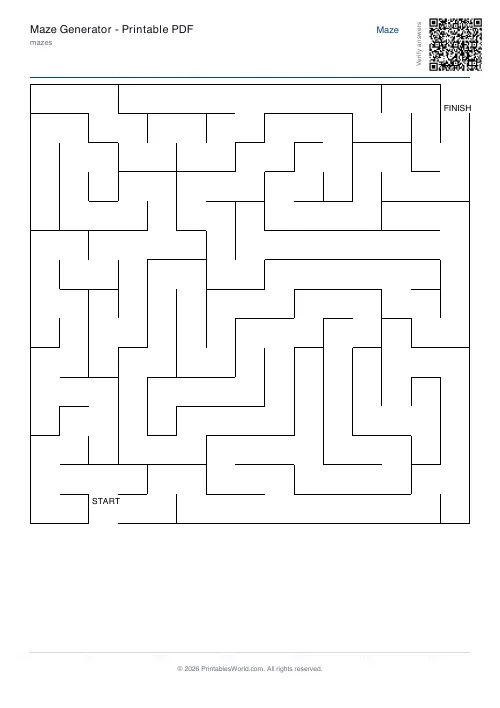
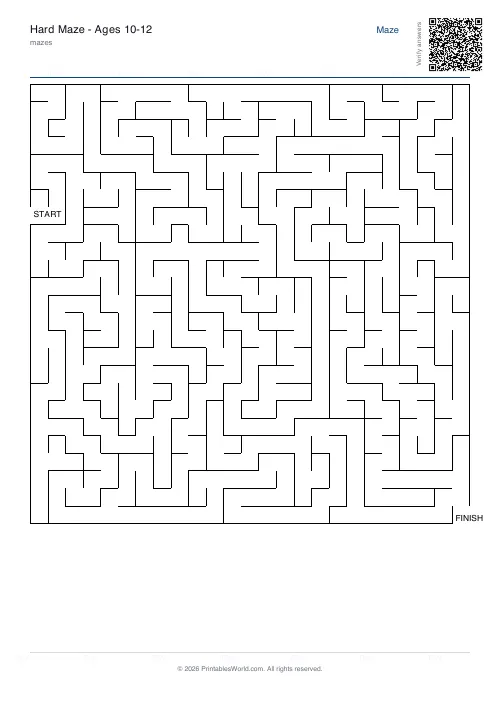
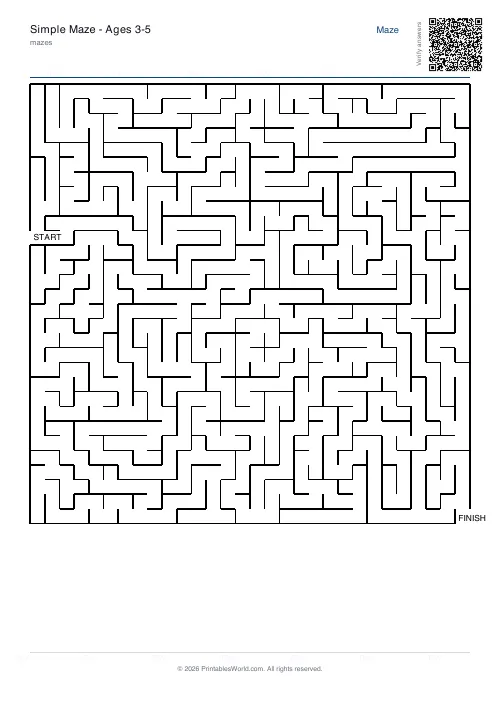
Corridor width is the setting that controls this. Wide corridors suit a crayon and a three-year-old; narrow ones demand real precision. That is the dial to turn for fine-motor work, not the maze's complexity.
Visual tracking and scanning
Following a path with the eyes, holding your place, and scanning ahead for where it leads are the same visual skills reading requires. Tracking along a line, returning accurately, and not losing your position.
Mazes exercise this without any reading involved, which makes them useful for a child whose reading is behind, or who has come to associate anything on a page with difficulty. The task is identical in kind and carries none of the history.
Planning ahead and accepting dead ends
The interesting shift is watching a child move from drawing first and discovering the dead end, to looking first and choosing. That is planning before acting, and it is visible in a way it rarely is elsewhere.
Dead ends do something valuable too. A maze is a low-stakes place to be wrong: you back up and try another route, nobody marks it, and the failure costs nothing. Children who are anxious about getting things wrong often relax with mazes for exactly this reason, and the habit of backtracking calmly is worth having.
Being careful about the claims
Mazes are often credited with improving concentration, problem-solving and even general cognitive ability. The honest position is narrower.
They clearly exercise the specific skills above. Evidence that puzzle activities produce broad transfer to unrelated abilities is weak. Research on brain-training generally finds people improve at the trained task without large general gains. A child who does mazes gets better at mazes, better at controlled pencil movement, and gets practice at planning; expecting a measurable change in schoolwork is a stretch.
That is still a good case. Pencil control and visual tracking are genuinely useful, and an activity children choose voluntarily is worth a great deal.
Matching a maze to a child
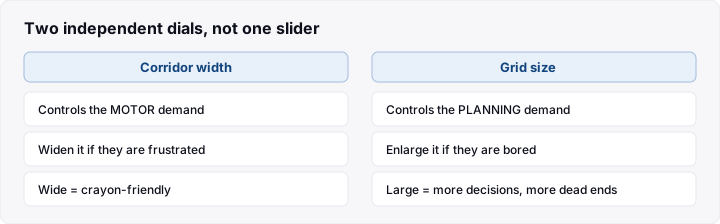
Two independent dials, and confusing them is the usual mistake:
- Corridor width: how much motor control is needed.
- Grid size and complexity: how much planning is needed.
A three-year-old wants wide corridors and a simple path. A ten-year-old with poor pencil control wants wide corridors and a complex path: reducing the complexity would insult them, while narrow corridors would defeat them. Being able to set these separately is the main reason to generate rather than photocopy.
Rough guidance: ages 3–5, very simple with thick lines; 6–8, medium grids; 8–12, larger grids with narrower corridors; 12+, expert sizes. Shaped mazes are worth using for reluctant children, because the picture provides a reason to finish.
For a version that carries curriculum content, a word maze combines the path-finding with letters, and a maths maze does the same with arithmetic.
Frequently asked questions
What age can children start mazes?
Around three, with very wide corridors and a short simple path. Many children can trace a straight or gently curving path before they can manage a maze with choices in it.
Should they use a pencil or a finger?
Finger first for the youngest. It lets them solve without the motor demand, and they can see the route before drawing it. Move to pencil once the path is being found reliably.
Do mazes help with handwriting?
They exercise the same pencil control that handwriting needs, so they are a reasonable pre-writing activity. They do not teach letter formation, which is a separate skill.
My child just draws through the walls. Is that a problem?
Not at first. It usually means the corridors are too narrow for their current control, or they have not grasped the rule. Widen the corridors and trace one together with a finger.
Before you print
Set corridor width for motor control and grid size for planning, separately. They are different dials solving different problems. Print a maze with thick lines for a young hand even if the path is complex, and try a word maze when you want the activity to carry some content.
Related tools
Maze Generator: Printable PDF
Generate printable maze PDFs with custom grid size, difficulty, and layout. Perfect, braided, or room-based.
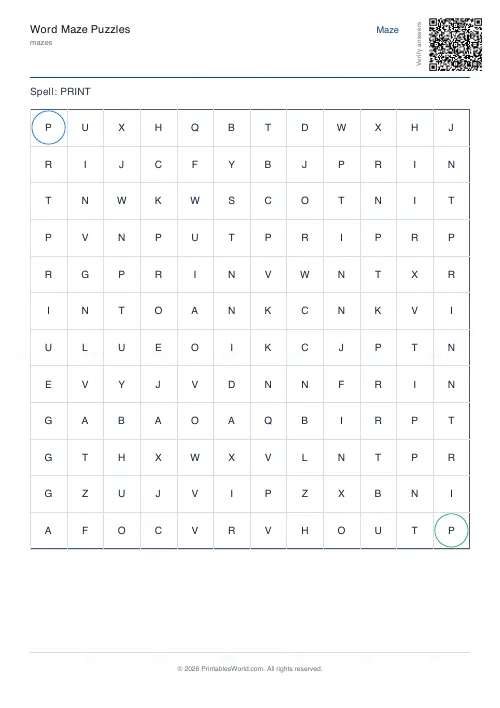
Word Maze Puzzles
Follow the correct spelling of a word through a grid of letters.
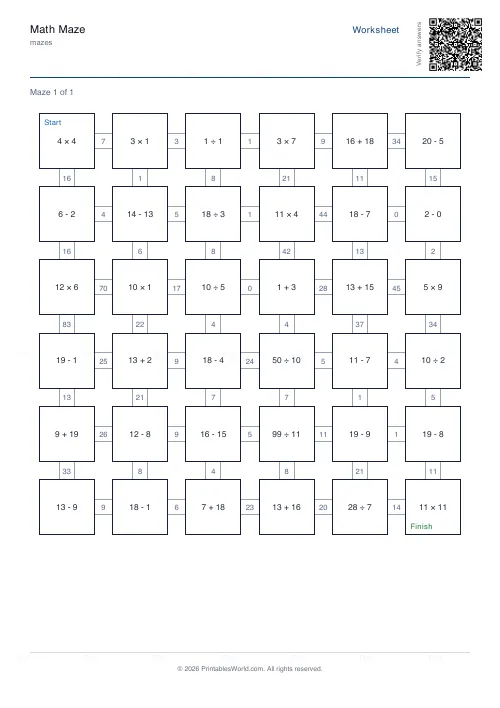
Math Maze Generator
Print math maze worksheets where students solve arithmetic to find the correct path through the grid.
Continue reading
Mazes
Printable maze difficulty: matching mazes to ages
Maze difficulty has two independent dials, and confusing them is why a maze is either too fiddly or too easy. Here is which to turn for which child.
4 min read
Handwriting
The best age to start handwriting practice
Age is the wrong question. Three readiness signs predict whether handwriting practice will help or frustrate. And what to do with the child who is not there yet.
5 min read