Word Puzzles
Prefixes and suffixes: a simple teaching guide
By Jobi · Creator & Maintainer, PrintablesWorld · Updated 2026-07-16 · 5 min read
Teaching affixes is one of the highest-leverage things you can do for vocabulary and spelling, because each one unlocks a family of words rather than a single word. A child who understands un- can read and spell dozens of words they have never met. Free printable prefix and suffix sheets give the practice.
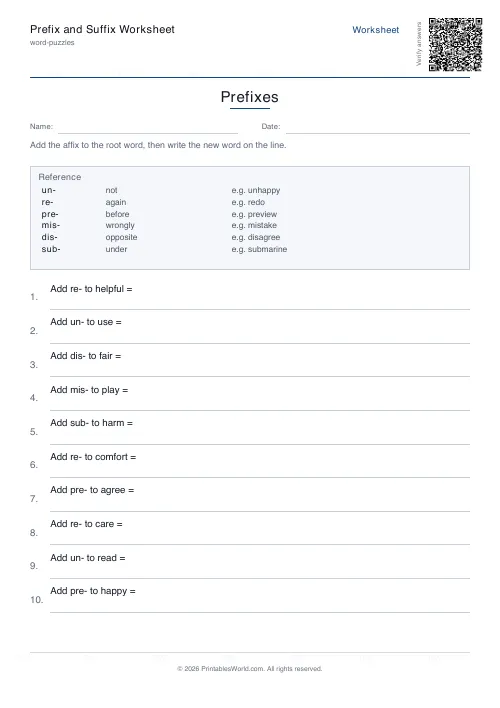
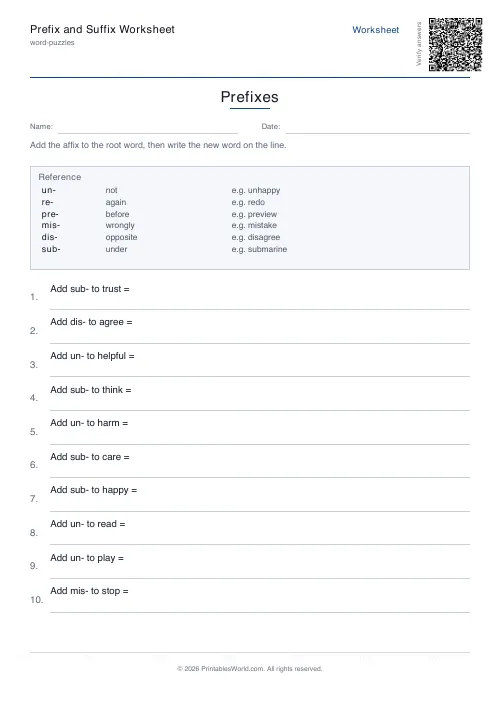
Start with the root word
Before any affix, a child needs the idea that words have parts, and that a base word can stand alone.
Start by removing rather than adding. Give unhappy, replay, helpful and ask what is left when you take off the front or the end. Children find removal easier than construction, and it establishes the base word as the thing being modified.
Watch for the classic trap: not every word beginning with un- has a prefix. Uncle and under do not, and unit certainly does not. The test is whether a real word remains when you remove it.
The prefixes worth teaching first
Roughly in order of usefulness:
- un-: not, or the reverse of (unhappy, undo). By far the most common; teach it first and alone.
- re-: again (replay, rewrite).
- dis-: not, or the opposite (disagree, dislike).
- pre-: before (preview, prepay).
- mis-: wrongly (misread, misspell).
- sub-, super-, inter-, anti-, auto-: later, and useful for subject vocabulary.
Teach one at a time and secure it. Introducing un- and dis- together invites confusion, because both mean roughly "not" and which one a word takes is largely arbitrary. Unhappy but dishonest, and there is no rule to derive it from.
Suffixes, and the two kinds
Worth distinguishing, because they behave differently.
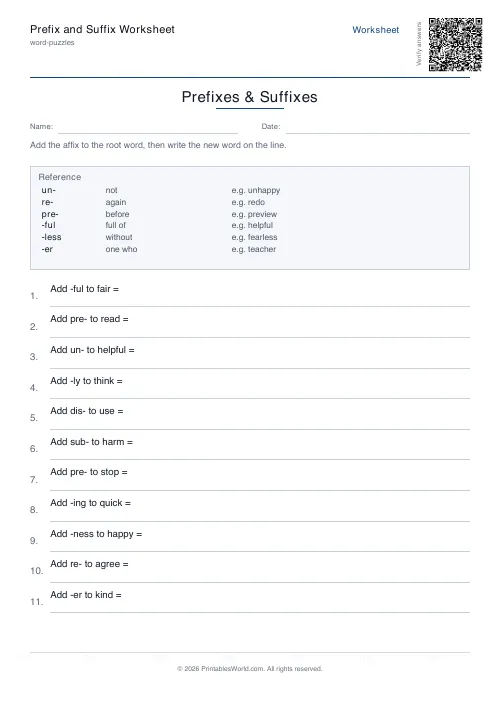
Inflectional suffixes change the grammar but not the word: -s, -ed, -ing, -er, -est. Walk and walked are the same word in different forms.
Derivational suffixes make a new word, often a different part of speech: -ful, -less, -ness, -ly, -ment, -tion, -able. Care becomes careful, careless, carefully.
Children generally meet the inflectional ones first through ordinary use, and the derivational ones are where teaching adds most. Particularly -tion and -ment, which produce the abstract nouns that fill subject writing.
The three spelling rules that cause errors
Prefixes are easy: they attach without changing the root. un + happy = unhappy, mis + spell = misspell: including the double s, which looks wrong and is right.
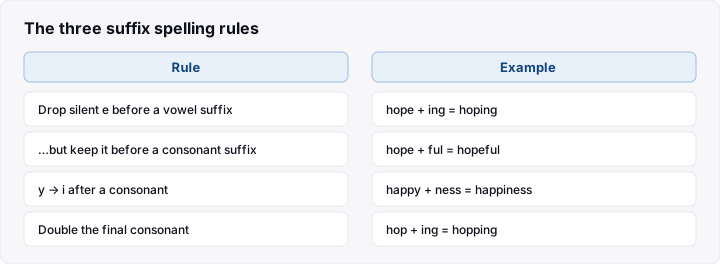
Suffixes are where the errors live, and three rules cover most of them.
1. Drop the silent e before a vowel suffix. hope + ing = hoping, use + able = usable. But keep it before a consonant suffix: hope + ful = hopeful.
2. Change y to i when the y follows a consonant. happy + ness = happiness, carry + ed = carried. Not when a vowel precedes it: play + ed = played. And never before -ing: carrying.
3. Double the final consonant on a short-vowel single-syllable word before a vowel suffix. hop + ing = hopping, run + er = runner. This is what distinguishes hoping from hopping, which is worth demonstrating side by side.
Teach these one at a time, several weeks apart. Presented together they blur into "something changes sometimes".
How to teach them
Build word families. Take one root, help, and generate everything: helper, helpful, helpless, helping, unhelpful, helpfully. Seeing the family at once makes the structure obvious.
Use a word sum. Writing un + help + ful → unhelpful separates the parts visually and makes the spelling rules visible when they apply.
Ask what it means, not just how it is spelled. The point is that affixes carry meaning; a child who spells disagreement correctly without knowing it contains "not agree" has learned a string of letters.
Hunt for them in real text. Ask children to find every word with a prefix on a page of their reading book. Far better than a list, because the words are in context.
Word family sheets pair naturally with this, since both are about seeing the shared part of related words.
Frequently asked questions
What age are prefixes and suffixes taught?
Simple suffixes like -s, -ed and -ing come early, often around ages five to seven. Prefixes and derivational suffixes usually follow from about seven onwards, with the more complex ones continuing into secondary.
Should I teach Latin and Greek roots too?
Yes, for older children. Aqua, bio, tele, graph unlock a great deal of subject vocabulary at once. It is one of the highest-return things you can teach around ages ten and up.
Why is it "unhappy" but "dishonest"?
Largely historical, and not derivable from a rule. Which prefix a word takes generally has to be learned word by word, which is why teaching one prefix at a time and meeting words in reading matters more than trying to systematise it.
How many should a child learn at once?
One prefix or suffix at a time, secured over a week or two with plenty of examples, before introducing the next.
Before you print
Establish the root word first by removing affixes rather than adding them, teach one affix at a time, and separate the three suffix spelling rules by weeks. Print prefix and suffix sheets alongside word family sheets, and hunt for real examples in a reading book.
Related tools
Continue reading
Word Puzzles
Fun ways to build vocabulary in kids
Children learn most words by meeting them repeatedly in context, not by memorising lists. Here is what that means practically, and where word lists still earn their place.
5 min read
Word Puzzles
Sight words: the complete teaching guide
Sight words are usually taught as words to memorise. Most of them are partly decodable, and treating them that way works better. Here is how, and how many to teach at once.
6 min read