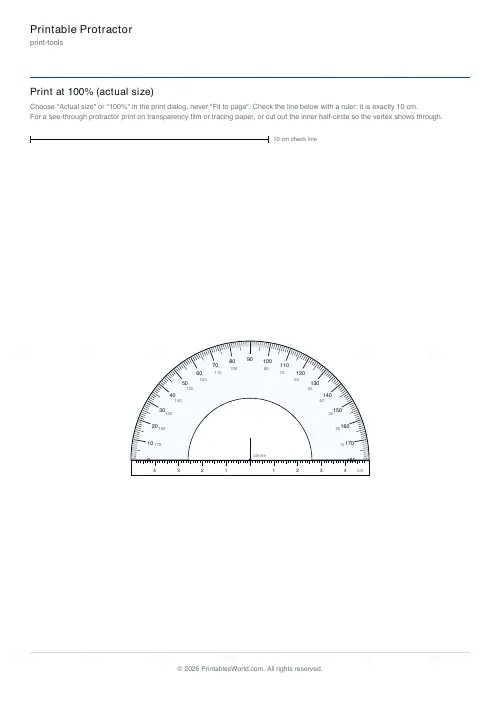
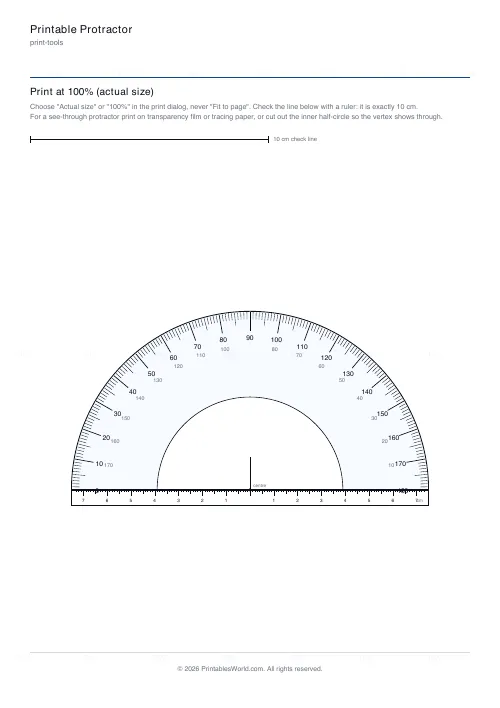
What this tool does
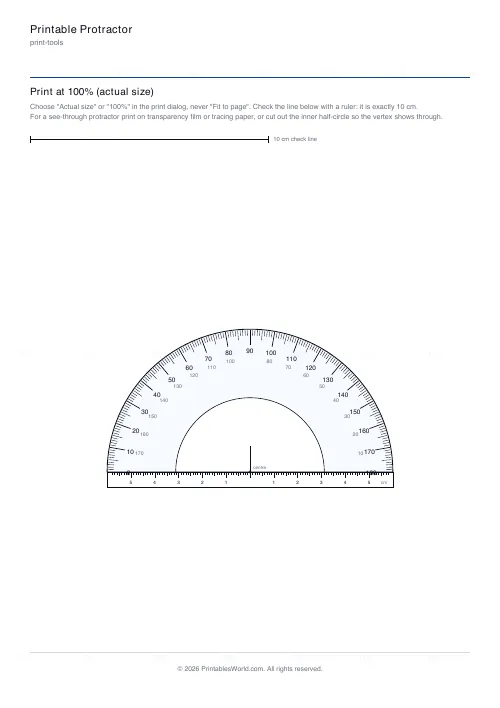
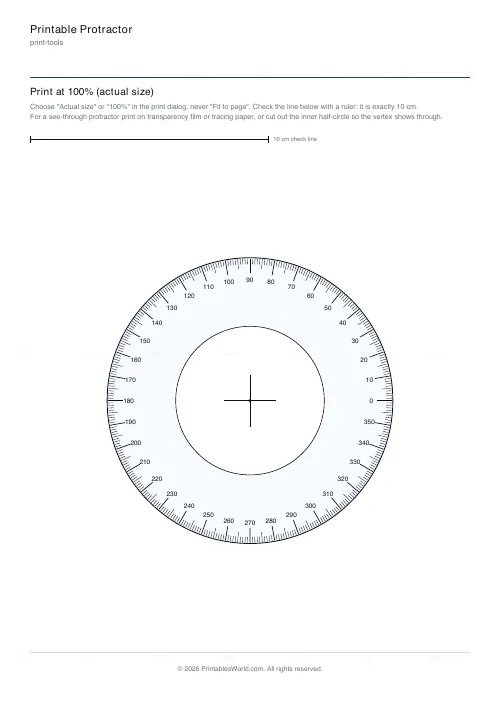
A protractor drawn at exact scale: a tick for every degree, longer ones at five and ten, labels every ten degrees reading both ways as on a real one, a centre crosshair to line up on the vertex, and a centimetre scale along the base of the half-circle version. The sheet carries a 10 cm line to confirm the print was not scaled.
People also used
Printable Ruler
Accurate cm, mm and inch rulers with a scale-check square and print-at-100% guidance on the sheet.
Print Scaling Calculator
Scale any document to fit your chosen paper size.
Graph Paper Generator
Create custom graph paper PDFs with square or rectangular grids, dot styles, and axis numbering.
Feedback
Spotted something off with this tool?
Half circle or full
The 180 degree protractor is the classroom one: a half-circle with a flat base, numbered from zero to 180 in both directions so an angle can be read from whichever arm sits on the baseline. The 360 degree version is a full circle with a single scale running clockwise, used for bearings, compass work and anything measured from a fixed reference. Both have a small crosshair at the centre for the vertex and a tick at every single degree.
Reading it
Put the centre crosshair on the vertex of the angle and the baseline along one arm. Read where the other arm crosses the scale, using the row of numbers that starts at zero on the baseline arm. Beginners read the wrong row; the second row of smaller numbers on the 180 version is there so that whichever way the angle opens, one row starts at zero.
The base scale
The half-circle version can carry a centimetre scale along its base, measured out from the centre in both directions, so the same tool marks a length and an angle. It is the layout of the plastic protractors sold in school sets.
Size
Eight, ten, twelve or fifteen centimetres across. Ten is the standard school size. Fifteen is easier to read and better for wall charts or for a child who is still learning where to look. All of them print with a degree tick every single degree; on the eight centimetre version those ticks are about half a millimetre apart, which is as fine as paper takes.
Make it see-through
A paper protractor hides the angle under itself. Print on tracing paper or transparency film, or cut out the inner half-circle along its line so the vertex and the arms show through the hole. The sheet says so at the top.
Print at true size
The angles are right at any scale; a protractor scaled by ten percent still reads 45 degrees as 45. The centimetre base scale is not, and neither is the diameter you chose. The 10 cm check line at the top of the page tells you whether the printer scaled the sheet. Choose Actual size or 100 percent, never Fit to page.
FAQs
Quick answers
Should I print the 180 or the 360?
180 for measuring angles in geometry lessons and drawings. 360 for bearings, compass headings and anything measured all the way round.
Why are there two rows of numbers?
So an angle can be read from either arm on the baseline. Use the row that starts at zero on the arm you lined up.
How do I see the angle through the paper?
Print on tracing paper or transparency film, or cut out the inner half-circle so the vertex shows through.
Does scaling matter for a protractor?
Not for the degrees, which are the same at any size. It matters for the centimetre scale on the base and for the diameter. Check the 10 cm line on the sheet.
What sizes are available?
8, 10, 12 and 15 cm across. 10 cm matches a standard school protractor.
Is there a ruler on it?
The 180 version can print a centimetre scale along its base, counted out from the centre both ways.
Related tools
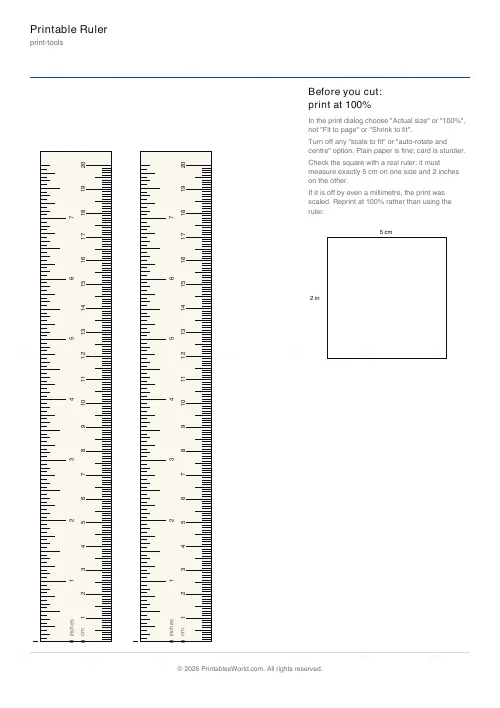
Printable Ruler
Accurate cm, mm and inch rulers with a scale-check square and print-at-100% guidance on the sheet.
Print Scaling Calculator
Scale any document to fit your chosen paper size.
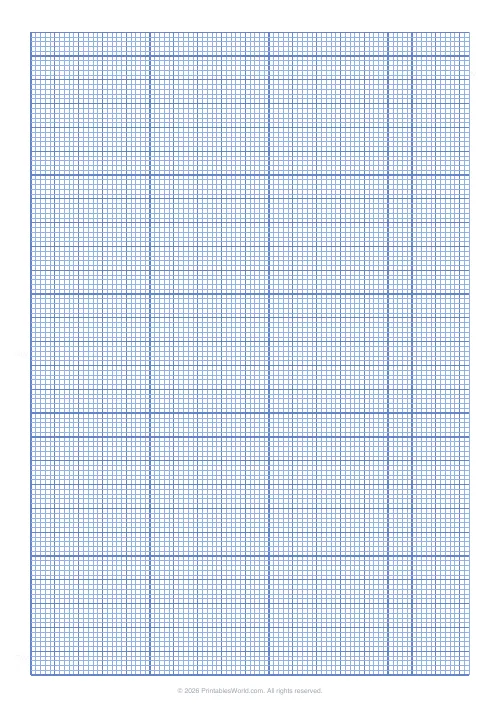
Graph Paper Generator
Create custom graph paper PDFs with square or rectangular grids, dot styles, and axis numbering.
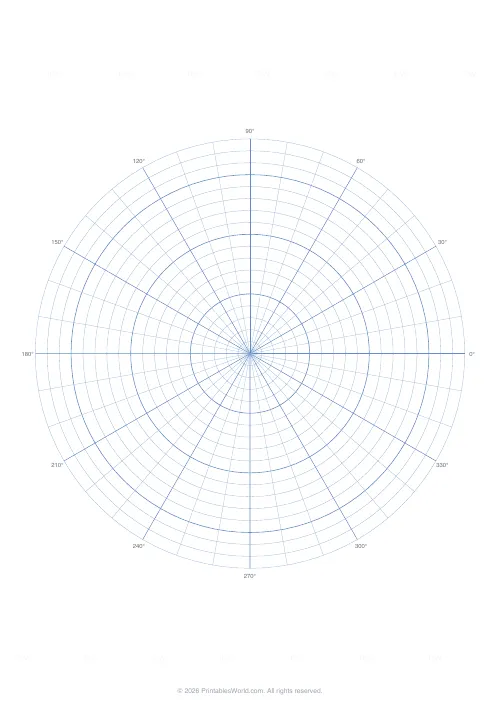
Polar Graph Paper
Concentric circles and radial spokes for polar coordinates.
DPI Calculator
Calculate DPI, print size, or required pixels for sharp, print-ready images.