Classroom Activities
How to run a classroom economy (free printables)
By Jobi · Creator & Maintainer, PrintablesWorld · Updated 2026-07-22 · 5 min read
A classroom economy gives children a currency they earn through jobs and behaviour and spend on privileges. Done well it teaches earning, saving, choosing and the cost of things simultaneously, and it handles a good deal of behaviour management as a side effect. Done carelessly it inflates, collapses, or becomes a bribery scheme. Free printable classroom money is the easy part. The numbers below are the part that decides whether it works.
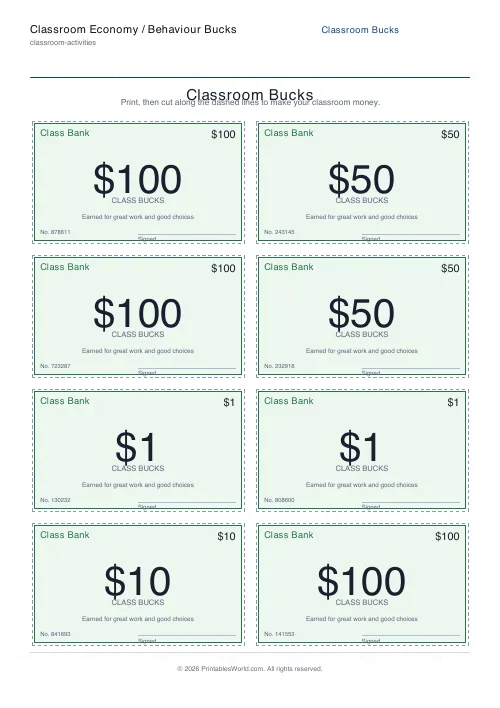
How a classroom economy works
Children earn a classroom currency, and spend it on things they want. That is the whole mechanism; everything else is parameters.
Most systems add two refinements that make it feel real: classroom jobs that children apply for and are paid for, and rent: a regular charge for their desk. Rent is what stops the economy being pocket money. It creates a baseline obligation, which means saving involves genuine choice, and it introduces the idea that some money is spoken for before you decide anything.
Setting up earning
Jobs are the backbone. Ten to fifteen roles. Line leader, librarian, tech assistant, board cleaner, register monitor, plant carer. Children apply, ideally in writing, and hold the job for a few weeks before roles rotate.
The application is worth keeping. Writing a short application, being appointed, and being paid for doing it reliably is a more complete lesson than simply being given a task.
Bonuses for specific, observable things. Helping without being asked, real effort on a hard task, a demonstrated improvement. Keep these occasional and unpredictable, because bonuses for everything become an entitlement and stop meaning anything.
Fines are optional and need care. Small charges for things within the child's control (a lost pencil, late homework) can work. Never fine for things outside their control, never fine so heavily that a child cannot recover, and never let it become the main mechanism. An economy that mostly takes money away is a punishment system wearing a costume.
Setting up spending
The rewards decide whether children engage, and the best ones cost nothing.
- Sit with a friend for a day
- Choose the class music
- Hat/no-uniform pass, where school rules allow
- Extra reading time or first choice at the book corner
- Teacher's chair for a lesson
- Homework pass, used carefully and rarely
- A small class-vote privilege. Film choice, extra playtime
Price them across a wide range: something affordable weekly, something that takes a month of saving, and one aspirational item. Without the expensive item, saving never happens and the economy becomes weekly spending.
Run a shop at a fixed time, Friday afternoon, rather than continuously, or you will spend the week doing transactions.
Getting the numbers right
This is where most classroom economies fail, and it is straightforward arithmetic done once.
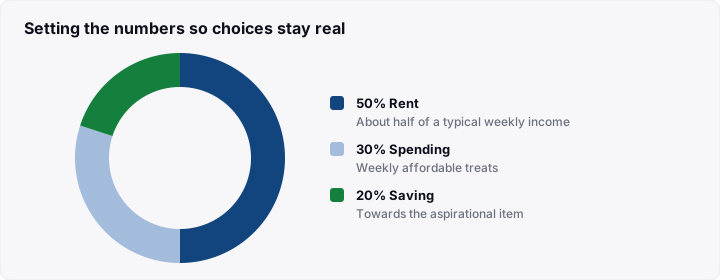
Work out the total weekly income of a typical child: job pay plus expected bonuses. Then set rent at roughly half of that. That leaves half for saving and spending, which is enough to matter and tight enough to require choices.
Then price the shop against what is left. If a child clears the equivalent of ten units a week after rent, a weekly treat at three, a monthly item at twenty-five, and an aspirational item at sixty gives a sensible spread.
Watch for inflation. If you hand out bonuses freely, prices must rise or everything becomes affordable and the choices disappear. It is easier to be stingy with bonuses from the start than to devalue the currency later. Devaluation is noticed and resented.
Four pitfalls
It becomes bribery for basic behaviour. Paying children to do what is simply expected undermines the expectation. Pay for jobs and genuine extra effort, not for sitting still.
The same children always earn most. If the economy rewards existing advantage, it teaches the wrong lesson. Make sure every child has a job, and pitch some bonuses at effort and improvement rather than attainment.
The admin eats your week. Ten minutes on Friday, run by the children where possible. Appoint a class banker as one of the jobs. If you are doing all the accounting, the system is costing more than it returns.
It fizzles out in November. The commonest ending. Prevent it by keeping the routine fixed and small, and by refreshing the shop occasionally so the rewards stay wanted.
If you want the behaviour side without the full economy, a simple behaviour chart does much of the work with none of the accounting.
Frequently asked questions
What age does this suit?
It works from roughly age seven upwards, and best in upper primary and lower secondary where children can handle the arithmetic and the delayed gratification. Younger classes generally do better with a simple sticker or points chart.
Does it teach children to expect payment for everything?
It can, if you pay for basic behaviour. Keeping payment attached to jobs and genuine extra effort, with ordinary expectations remaining unpaid, is what avoids it.
How much time does it take to run?
Perhaps an hour to set up, then ten to fifteen minutes a week once it is running, less if children handle the banking. If it is taking longer, simplify it.
What if a child goes bankrupt?
Have a route back. Extra jobs available to work off a deficit. A child permanently unable to participate has been excluded by the system, which is the opposite of the intention.
Before you print
Do the arithmetic first: weekly income, rent at about half, and shop prices spread from weekly to aspirational. Print classroom money in a couple of denominations, appoint a class banker, and run the shop at one fixed time a week.
Related tools
Classroom Economy / Behaviour Bucks
Print a sheet of cut-out classroom money for a token reward economy.
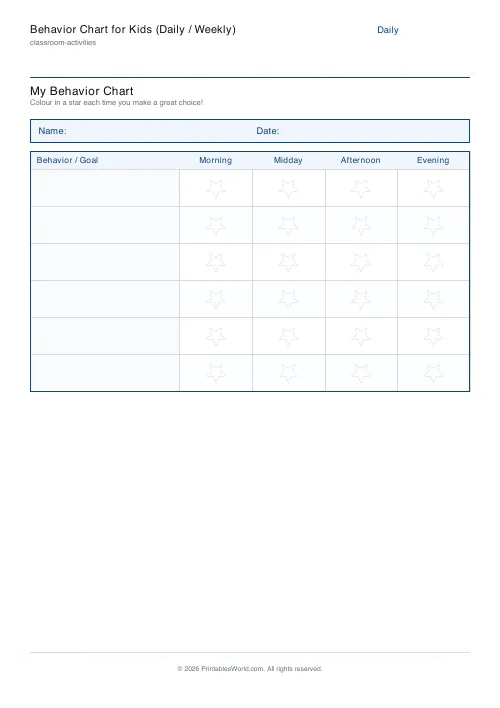
Behavior Chart for Kids (Daily / Weekly)
Printable daily or weekly behavior chart for children. Behaviors and goals down the side, days or time slots across the top.
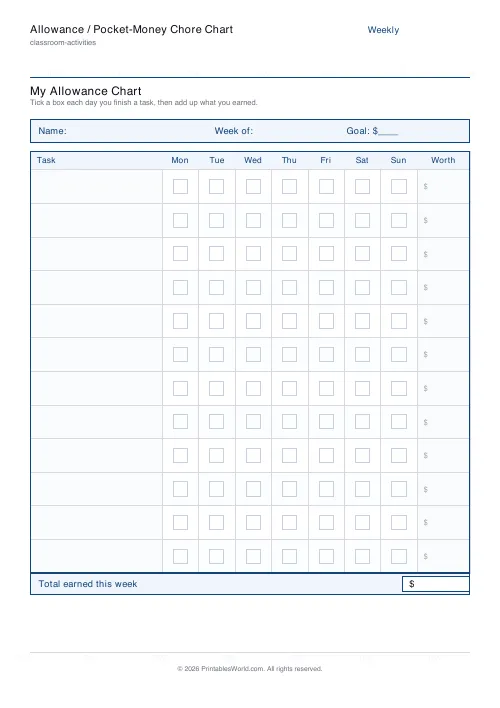
Allowance / Pocket-Money Chore Chart
Printable allowance chart. Tasks × 7 days of tick boxes, a money column and a weekly total.
Continue reading
Classroom Activities
Positive reinforcement in the classroom: charts that work
Reward charts work when they name a specific behaviour and fade over time. They backfire when they rank children publicly. Here is the difference in practice.
5 min read
Classroom Activities
Back-to-school printables every teacher needs
Sorted by when you will actually need them: the two things to print before the children arrive, the week-one set, and the routines worth establishing while everyone is still compliant.
5 min read