Classroom Activities
How to make learning stations work in any classroom
By Jobi · Creator & Maintainer, PrintablesWorld · Updated 2026-06-17 · 5 min read
Learning stations let you work intensively with a small group while everyone else works productively without you. That is the entire promise, and it depends completely on the second half. The groups you are not with. Free printable exit tickets and sorting activities are the kind of thing that makes an independent station genuinely independent.
How many stations, and how long
Three or four stations for most classes. Five means groups of five or six, which is too many for the teacher-led station to be worth anything.
Ten to fifteen minutes each for primary; up to twenty for older students. Shorter than that and transitions eat the lesson; longer and the independent groups drift.
Not every group has to visit every station in one lesson. Two rotations in a lesson, completing the cycle over two days, is often more realistic than cramming four transitions into an hour. And transitions are where the time actually goes.
Signal transitions the same way every time: a bell, a countdown, a piece of music. A class that knows the routine moves in thirty seconds; a class that does not takes three minutes, four times a lesson.
The test for an independent task
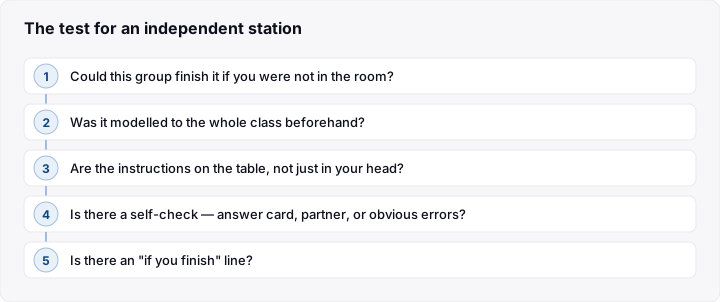
Here is the test, and it is strict: could this group complete the task if you were not in the room?
If the answer is no. If they will need something explained, or will not know what to do when they finish, or cannot check whether they are right. Then it is not an independent task, and putting it at a station means you will be interrupted throughout the teacher-led group. Which defeats the point.
Three things make a task pass the test:
- It was modelled beforehand, as a whole class, so nobody is meeting the instructions cold.
- The instructions are on the table, in writing or pictures, not only in your memory of what you said.
- There is a self-check: an answer card, a partner to compare with, or a task where being wrong is obvious.
Add an "if you finish" line to every station. The group that finishes early with nothing to do is the group that disrupts everyone else.
What each station should contain
A useful default set for a primary literacy or numeracy rotation:
- Teacher station: new teaching or targeted intervention with a small group. The reason the whole structure exists.
- Practice station: consolidation of something already taught. Worksheets are entirely appropriate here.
- Application station: a game, a sorting activity, or a problem that uses the skill in a different form. A cut-and-paste sorting activity works well because being wrong is visible.
- Independent reading or writing: genuinely quiet, needing nothing from you.
Vary the type across stations so children are not doing four written tasks in a row. And end with an exit ticket. One question, answered individually, which tells you what actually landed at each station and takes two minutes to read.
The two failures that sink rotations
Interruptions at the teacher station. If children come to you with questions while you are teaching a group, the model collapses. Establish and rehearse an alternative: ask three classmates first, use the instruction card, put a query on a sticky note for later. Then hold the line for a fortnight until it sticks. The rule only works if it is never broken by you.
Groups that finish at different rates. A group sitting idle for six minutes will not sit quietly for six minutes. Every station needs an extension that is genuinely optional and genuinely useful, not busywork they can identify as busywork.
A third, quieter failure: stations that are activity rather than learning. Something colourful and enjoyable that practises nothing is a pleasant use of fifteen minutes and a waste of a lesson. Check each station against the objective before you set it out.
Frequently asked questions
What age do learning stations suit?
They work throughout primary and into lower secondary. Younger classes need shorter rotations, simpler tasks and more rehearsal of the routine itself.
How do I group the children?
Depends on the purpose. Mixed-attainment groups work for application and games; similar-attainment groups work better for the teacher station, where you are pitching to a specific need. Many teachers keep flexible groups that change by topic.
How long does it take to set up?
The first few are slow. Mostly building the routines rather than the resources. Once the class knows the transitions and the ask-three-first rule, preparation drops to choosing the tasks.
What if I only have one adult?
That is the normal case, and the model is designed for it. The independence test above is what makes it possible; with a second adult you can run two taught groups, but it is not required.
Before you print
Apply the independence test to every station that is not yours, put written instructions and a self-check on each table, and add an "if you finish" line everywhere. Print a sorting activity for the application station and an exit ticket to find out what landed.
Related tools
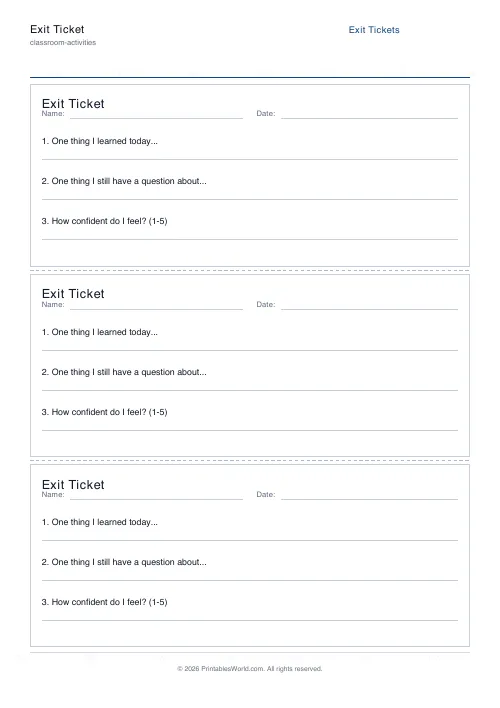
Exit Ticket Generator
Three exit tickets per A4 page for quick end-of-lesson reflection.
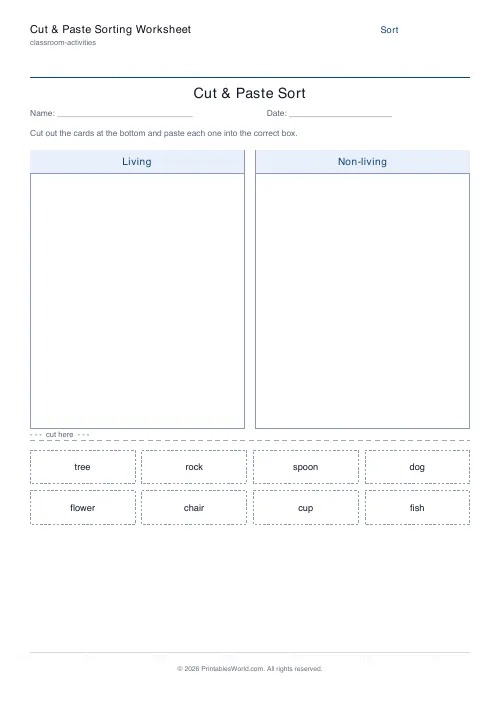
Cut & Paste Sorting Worksheet
Cut out the cards and paste each one into the right group.
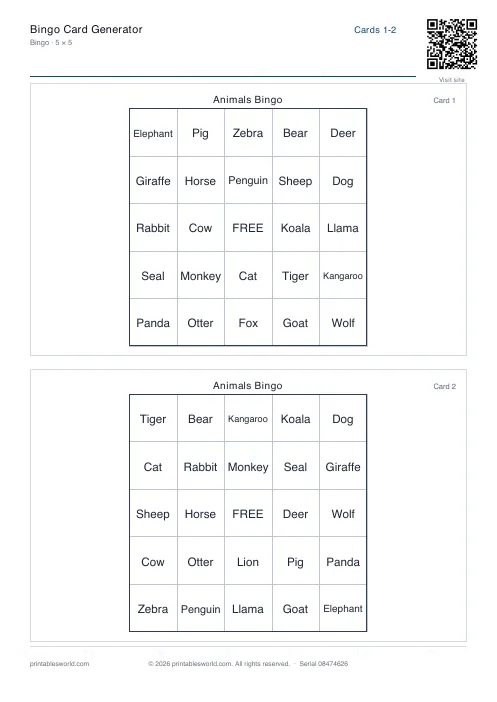
Bingo Card Generator
Generate unique printable bingo cards with custom words, FREE centre toggle, call sheet, and seeded shuffles.
Continue reading
Classroom Activities
20 classroom games that need zero prep
Games organised by the gap they fill: two minutes at the end of a lesson, ten minutes before assembly, or a whole wet lunchtime. Almost all need nothing but a voice.
6 min read
Classroom Activities
Back-to-school printables every teacher needs
Sorted by when you will actually need them: the two things to print before the children arrive, the week-one set, and the routines worth establishing while everyone is still compliant.
5 min read